
LED masks are sold on the color of their light, but color is only a shorthand for wavelength, measured in nanometers (nm). Two bands do most of the work in face masks: red, around 630 to 660 nm, and near-infrared, around 810 to 850 nm.
Longer wavelengths reach further into skin
As a general rule in skin optics, longer visible and near-infrared wavelengths travel further before they are absorbed or scattered. Blue light is mostly spent near the surface. Red reaches a little deeper, and near-infrared deeper again. That is why brands pair them: each band is aimed at a different depth.
Near-infrared is invisible to the eye. If your mask has an 830 nm setting and you see only a faint dusky glow, that is expected.
What the studies used
Two of the most cited trials on LED skin rejuvenation used the same pairing Halvia uses in Renew mode:
- Russell, Kellett and Reilly (Journal of Cosmetic and Laser Therapy, 2005) treated facial skin with 633 nm and 830 nm light over nine sessions and reported improvements in the look of fine lines on a scored scale.
- Lee and colleagues (Journal of Photochemistry and Photobiology B, 2007) ran a split-face, placebo-controlled study comparing 830 nm, 633 nm and a combination, and measured changes in wrinkle scores and skin elasticity.
Both studies used in-office devices at higher output than an at-home mask delivers. Home masks rely on more frequent sessions instead.
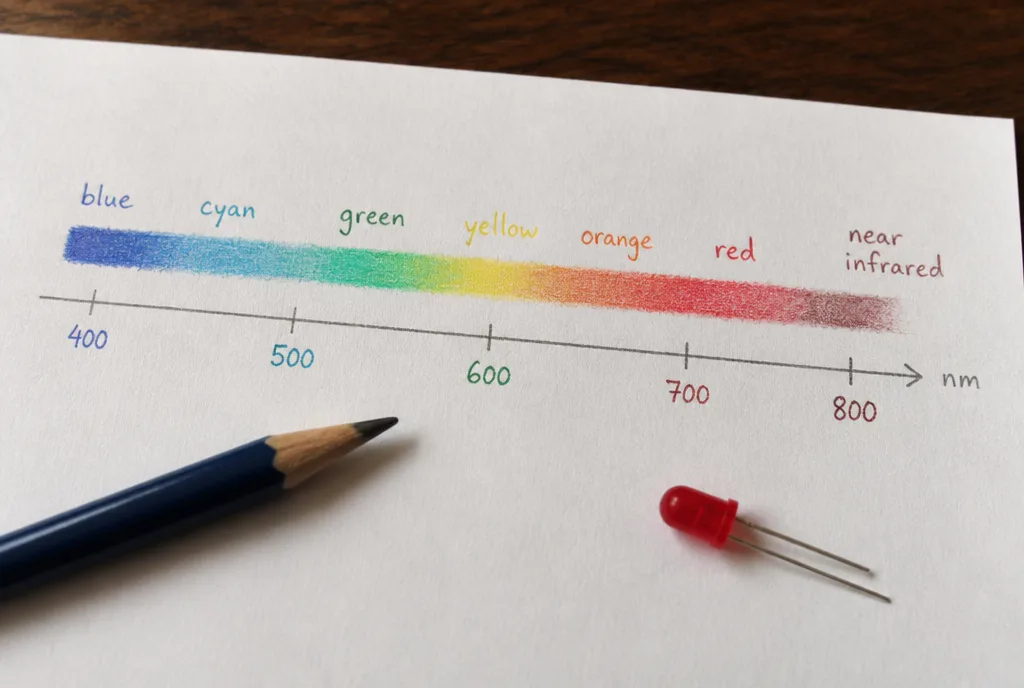
How Halvia uses each band
| Band | Wavelength | Mode |
|---|---|---|
| Blue | 415 nm | Clarify |
| Amber | 590 nm | Renew |
| Red | 633 nm | Renew and Clarify |
| Deep red | 660 nm | Renew |
| Near-infrared | 830 nm | Renew |
What to take from this
Look for a mask that publishes its exact wavelengths. "Red light" on a box without a number tells you very little. If a brand lists 633 nm and 830 nm, you can read the studies that used those bands yourself.
Sources: Russell BA, Kellett N, Reilly LR. J Cosmet Laser Ther. 2005;7(3-4):196-200. Lee SY et al. J Photochem Photobiol B. 2007;88(1):51-67.
This article is general information, not medical advice. Talk to a dermatologist about any skin condition.