
22 Jul 202611 min readBy Gregory Yeoh
30 Social Media Caption Prompts for Faster, Easier Content
Stop staring at the blank caption box. Copy an expert-written prompt, paste it into ChatGPT, and post in your own voice.
Who it's for: For business owners and marketers who post regularly but spend too much time starting each caption from scratch.
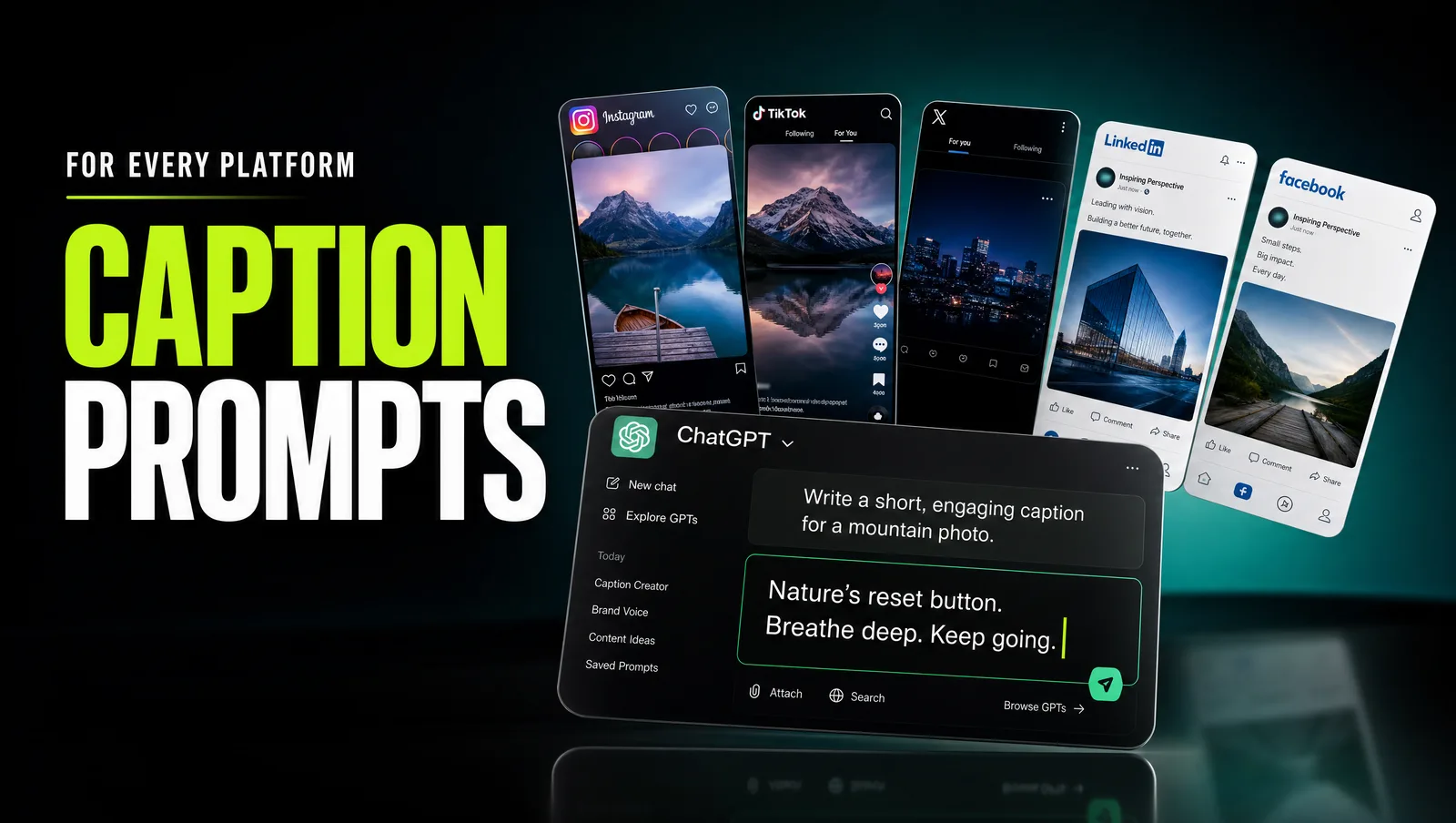
Seed Light's verdict: start with the prompt written for the platform you are using. The same idea can work across several channels, but the length, opening, format and call to action should usually be adapted. Use the AI output as a first draft, then add your real examples and voice before posting.
Thirty ready-to-use prompts, grouped by platform. Replace the bracketed fields with your real business information and use the result as a draft rather than publishing it unchanged.
In short
- Thirty ready-to-paste caption prompts: five each for Instagram, Facebook, LinkedIn, X, and TikTok, plus a cross-platform set.
- Each platform gets its own style. What works on LinkedIn flops on TikTok, and the prompts respect that.
- Swap [your niche] for what you do and the same prompt works for any business.
- Specific context, examples and constraints help make the output less generic.
- Keep a shortlist of the prompts that fit your voice and reuse them every week.
Instagram caption prompts
Instagram captions need to earn attention quickly and remain easy to read on a phone. These five prompts cover captions, hooks, carousels, hashtags and everyday-photo posts.
1. Write captions that earn the comment
Use it for: turning any post idea into Instagram captions that get saved and replied to.
Act as an experienced Instagram strategist. I run a business in [your niche]. Write me 5 Instagram captions for the post below. Each one opens with a one-line hook that makes my audience feel seen, delivers one genuinely useful idea in 3 to 5 short lines with plenty of white space, and ends with a simple question that is easy to answer in the comments. Keep the language plain and human, the way I would text a friend, and do not add hashtags yet. After the 5, tell me which one you would post first and why it fits my audience. """ [PASTE THE TOPIC, OFFER, OR PHOTO IDEA FOR THIS POST. Or leave this blank and pick 5 strong content angles for my business first, then write a caption for each.] """
2. Stop the scroll in the first line
Use it for: writing opening lines so good that people tap to read more.
Act as an experienced hook writer. The first line matters because it is often what decides whether someone keeps reading. I work in [your niche]. Give me 15 opening lines for posts aimed at my audience about the topic below. Mix three styles: a few that name a frustration they feel, a few that promise a quick win, and a few that point out something most people in my space get wrong. Keep every line under 12 words, plain and curious, no emojis and no clickbait the post cannot pay off. Then pick the three you would test first and say in one line why each would make my audience stop. """ [PASTE THE TOPIC OF YOUR NEXT POST. Or leave this blank and choose a topic my audience cares about first.] """
3. Turn one tip into a carousel that gets saved
Use it for: building a swipeable carousel that teaches one thing per slide.
Act as an experienced content designer. My business is in [your niche]. Turn the tip below into a 6-slide Instagram carousel for my audience. Slide 1 is a bold hook that promises a payoff and earns the swipe. Slides 2 to 5 each teach one idea, with one short line of on-screen text plus a spoken-style line under it, and no slide trying to say two things. Slide 6 is a soft call to action that invites a save or a comment without hard selling. Keep every on-screen line under 10 words. Then write the caption that goes under the carousel. """ [PASTE THE TIP OR TOPIC. Or leave this blank and pick a tip my audience would save first.] """
4. Get hashtags that actually reach people
Use it for: building a smart, tiered hashtag set instead of guessing.
Act as an experienced Instagram strategist. I run a business in [your niche]. For the post below, suggest a small set of relevant hashtags only if they genuinely add context or discoverability. Prioritise specific topic, niche and location tags over huge generic tags. Do not promise that hashtags will make the post rank or reach a particular audience. Give me 3 to 8 relevant hashtags, why each one fits, and any hashtags that would be too broad or irrelevant. """ [PASTE THE TOPIC OR THE CAPTION. Or leave this blank and pick a topic for my business first.] """
5. Make a plain photo worth posting
Use it for: writing a caption that gives an everyday photo a reason to exist.
Act as an experienced brand storyteller. My business is in [your niche]. Below is a description of a photo I want to post. Write me 3 caption options that each open with a line that pulls the reader in, tell a short and honest micro-story in a few lines, tie back to what I do without sounding like an ad, and end with one clear next step. Keep each under 120 words and keep the voice warm and real. Then tell me which one fits my audience best and one small tweak to make it land harder. """ [DESCRIBE THE PHOTO. Or leave this blank and suggest 3 everyday photos my business could post first, then caption one.] """
Facebook caption prompts
Facebook often suits conversational, useful posts that are easy to respond to. These five prompts cover tips, customer stories, offers, rewrites and monthly planning.
6. Write a Facebook post that reads like a friend
Use it for: posts that get comments because they feel personal, not promotional.
Act as an experienced Facebook content strategist. I run a business in [your niche]. Write me a Facebook post about the topic below. Open with a relatable problem my audience nods at, then give 3 quick, useful tips as short lines with arrows, and close by asking a question that invites them to share their own experience. Use one short sentence per line with plenty of white space so it is easy to read on a phone. Keep it under 160 words, warm and plain, no hype. Then suggest the best angle to post it from. """ [PASTE THE TOPIC. Or leave this blank and pick a topic my audience cares about first.] """
7. Share a customer win without bragging
Use it for: turning a real result into a humble, trust-building story post.
Act as an experienced story-driven copywriter. My business is in [your niche]. Below is what happened with a customer. Write it as a short Facebook story post: start in the middle of the moment, keep me humble and make the customer the hero, show the small specific details that bring it to life, and end with one soft line that invites others who want the same. One sentence per line, under 180 words. Do not use star ratings or salesy language. Then give me a one-line version I could reuse as a caption elsewhere. """ [DESCRIBE WHAT HAPPENED WITH THE CUSTOMER. If no real customer story is provided, ask me for one.] """
8. Announce an offer people want to act on
Use it for: posting news or a promotion that feels exciting, not pushy.
Act as an experienced promotions copywriter. I run a business in [your niche]. Write me a Facebook post announcing the offer or news below. Lead with what is genuinely in it for my audience, explain it in a few plain lines, add one honest reason to act now that is true and not fake urgency, and finish with exactly what to do next and how. Keep it warm and clear, one sentence per line, under 150 words. Then give me 2 alternative opening lines I could test. """ [PASTE THE OFFER OR NEWS. If I have not supplied a real offer, ask what I am actually promoting before writing.] """
9. Make an old post readable again
Use it for: rewriting a wall-of-text post so people actually read it on a phone.
Act as an experienced editor. My business is in [your niche]. Below is a post I wrote that feels like a wall of text. Rewrite it for Facebook so it keeps my exact meaning but becomes easy to scan: one short sentence per line, white space between thoughts, one clear point, and a stronger first line that earns the read. Cut filler and any hype words. Show me the rewrite, then list the 3 changes that made the biggest difference so I can do it myself next time. """ [PASTE THE POST. Or leave this blank and write a typical too-long post for my business first, then fix it.] """
10. Plan a month of Facebook posts in one go
Use it for: filling a content calendar so you never stare at a blank box.
Act as an experienced content planner. I run a business in [your niche]. Give me a 12-post plan for my Facebook page that mixes useful tips, a behind-the-scenes look, a customer story, a myth I can bust, a simple offer, and a question post, spread so it never feels repetitive. For each post give me a one-line hook and the type of post it is, written for my audience. Then mark the 3 I should post first because they build trust the fastest for a business like mine. """ [OPTIONAL: PASTE A SEASON, EVENT, OR GOAL TO BUILD THE MONTH AROUND. Or leave this blank and build a balanced general month for my business.] """
LinkedIn post prompts
LinkedIn works well for useful ideas, professional stories and clear opinions written in a human voice. These five prompts cover authority posts, stories, hooks, soft selling and editing.
11. Write a LinkedIn post that builds authority
Use it for: a post that teaches, sounds human, and gets people talking.
Act as an experienced LinkedIn ghostwriter. I run a business in [your niche]. Write me a LinkedIn post about the topic below. Open with a hook line that stands alone and makes my audience want the next line, tell a short lesson or story, break it into one sentence per line with white space, and close with a question that invites opinions. Sound confident and plain, never corporate, around 150 words, no buzzwords and no hype. Then give me 2 alternative first lines. """ [PASTE THE TOPIC OR THE LESSON. Or leave this blank and pick a lesson my audience would value first.] """
12. Turn one lesson into a story post
Use it for: sharing what you learned in a way people remember and reshare.
Act as an experienced narrative copywriter. My business is in [your niche]. Take the experience below and write a LinkedIn post that opens on a specific moment or a surprising line, walks through what happened in short one-line sentences, lands on the lesson, and ends with what I would tell someone just starting out. Keep me honest and humble, make the reader feel it could be them, around 160 words. Then pull out the single line most likely to get quoted in the comments. """ [DESCRIBE THE EXPERIENCE OR LESSON. If I have not supplied a real experience or lesson, ask me for one.] """
13. Hooks that beat the see-more cut-off
Use it for: first lines that earn the click on a feed that hides everything after line two.
Act as an experienced hook strategist. On LinkedIn only the first two lines show before see-more. I work in [your niche]. Give me 12 opening lines for posts aimed at my audience about the topic below. Make them specific and a little bold, no buzzwords, each one a complete thought that creates a question the reader needs answered. Mix a few that challenge a common belief, a few that promise a useful breakdown, and a few that open a story. Keep each under 14 words, then pick the 3 strongest and say why each earns the click for my audience. """ [PASTE THE TOPIC. Or leave this blank and choose a topic my audience cares about first.] """
14. Write the post that quietly sells your service
Use it for: a helpful post that positions you as the expert without pitching.
Act as an experienced positioning expert. I run a business in [your niche]. Write me a LinkedIn post that teaches my audience how to handle a problem I solve for them, in genuine detail they could act on today, so the post demonstrates useful expertise before mentioning my service. Do not pitch or mention my services until a single soft line at the very end that invites a conversation. One sentence per line, around 180 words, plain and confident. Then explain in one line why giving away the how makes the reader more likely to reach out, not less. """ [PASTE THE PROBLEM YOU SOLVE. Or leave this blank and pick a problem my audience struggles with first.] """
15. Make a draft sound less salesy
Use it for: fixing a post that reads like an ad so it reads like a person.
Act as an experienced copy editor. My business is in [your niche]. Below is a draft. Rewrite it for LinkedIn so it keeps my point but loses the hype: cut buzzwords and brag, lead with value for my audience, use one sentence per line, and make it sound like a confident person talking, not a brochure. Show me the rewrite, then list the exact words and phrases you removed and the warmer lines you put in their place. """ [PASTE YOUR DRAFT. Or leave this blank and write a typical salesy post for my business first, then fix it.] """
X and Twitter prompts
Short posts on X need to make a clear point quickly. These prompts cover standalone posts, threads, concise tips, rewrites and useful replies.
16. Write tweets a real person would say
Use it for: single tweets that sound human and get replies.
Act as an experienced writer on X. I run a business in [your niche]. Write me 5 tweets about the topic below. Each is a complete thought a real person would actually say, under 250 characters, no hashtags and no emojis, plain and a little opinionated. Make at least one a clear stance my audience would either nod hard at or want to argue with. Then tell me which one is most likely to get replies and why. """ [PASTE THE TOPIC. Or leave this blank and pick a topic my audience cares about first.] """
17. Turn one idea into a thread
Use it for: expanding a single point into a thread people read to the end.
Act as an experienced thread writer. My business is in [your niche]. Turn the idea below into a 6-tweet thread for my audience. Tweet 1 is a standalone hook that promises a clear payoff and could earn shares on its own. Each tweet after it makes one clean point in plain language, no fluff, easy to skim. The last tweet gives a takeaway and a light nudge to follow for more. Keep each tweet tight. Then give me 2 alternative hooks for tweet 1. """ [PASTE THE IDEA. Or leave this blank and pick an idea worth a thread for my business first.] """
18. Specific one-line tips worth saving or sharing
Use it for: punchy one-liners that get saved and shared.
Act as an experienced writer. I work in [your niche]. Give me 10 one-line tweets sharing specific, genuinely useful tips for my audience about the topic below. Each must stand on its own, be instantly understandable, and give a small win the reader could use today, no hashtags and no fluff. Avoid generic advice everyone has heard. Then pick the 3 most useful and say in one line what makes each one stick. """ [PASTE THE TOPIC. Or leave this blank and choose a topic my audience cares about first.] """
19. Sharpen a tweet that fell flat
Use it for: tightening a wordy tweet into something with punch.
Act as an experienced editor who tightens wordy posts without losing the point. My business is in [your niche]. Below is a tweet that is too long or too soft. Rewrite it 3 ways for my audience: one shorter and punchier, one a little bolder with a clear stance, and one that opens a small loop of curiosity. Keep each under 250 characters, natural and human, no hashtags. Then tell me which version you would post and why it fits the way my audience talks. """ [PASTE THE TWEET. Or leave this blank and write a typical flat tweet for my business first, then fix it.] """
20. Reply your way into conversations
Use it for: thoughtful replies that get you noticed without selling.
Act as an experienced community builder. I run a business in [your niche]. Below is a post I want to reply to. Write me 5 reply options that add a genuinely useful angle or a short relevant story, sound like a peer and not a marketer, and never pitch my business. Keep each short and natural. Then pick the reply that adds the most useful contribution and explain why. """ [PASTE THE POST YOU WANT TO REPLY TO. If I leave this blank, ask me for the post I want to reply to.] """
TikTok and Reels prompts
Short-form video needs to earn attention early. These five prompts cover scripts, hooks, shot lists, captions and before-and-after ideas.
21. Write a short video script that holds attention
Use it for: a 30-second script with a hook, fast value, and a payoff.
Act as an experienced short-form video writer. The opening needs to give people a reason to keep watching. I run a business in [your niche]. Write me a 30-second video script about the topic below, in the words I would actually say out loud. Open with a 3-second hook that stops the scroll, deliver 3 fast and specific tips, and end with a line that makes them want more or take one small action. Mark the hook, the tips, and the close clearly. Then give me 2 alternative hooks in case the first does not land. """ [PASTE THE TOPIC. Or leave this blank and pick a topic my audience cares about first.] """
22. Hooks for the first 3 seconds
Use it for: opening lines that stop the thumb instantly.
Act as an experienced hook specialist for TikTok and Reels who focuses on clear, specific opening hooks. I work in [your niche]. Give me 12 video hooks about the topic below for my audience, written as the first line I would say or show on screen in the first 3 seconds. Mix bold claims, a common mistake, a quick promise, and a curiosity gap, all true to what my business actually does. Keep each under 12 words and easy to say out loud. Then pick the 3 strongest and say why each would stop my audience mid-scroll. """ [PASTE THE TOPIC. Or leave this blank and choose a topic my audience cares about first.] """
23. Turn a tip into a Reel, scene by scene
Use it for: a shot list with on-screen text and what to say.
Act as an experienced video producer. My business is in [your niche]. Turn the tip below into a Reel under 30 seconds. Give me a scene-by-scene plan: for each scene, the on-screen text, what I say out loud, and a quick note on what to film. Start with a 3-second hook scene, keep it easy to shoot with no fancy gear, and end on a clear call to action. Then suggest a caption to post with it for my audience. """ [PASTE THE TIP. Or leave this blank and pick a tip my audience would watch first.] """
24. Write the caption that travels with the video
Use it for: a short caption plus tags that help the video get found.
Act as an experienced short-video strategist. I run a business in [your niche]. Write three short caption options for a TikTok or Reel about the topic below. Each adds context the video alone does not give, in my plain voice. Add up to five relevant hashtags if useful, but do not treat hashtags as guaranteed reach or search rankings. Keep it tight and human. Then tell me which caption pairs best with a fast-paced video and why. """ [PASTE THE VIDEO TOPIC. Or leave this blank and pick a topic my audience cares about first.] """
25. Before-and-after ideas that show your work
Use it for: video concepts that prove your value without bragging.
Act as an experienced content strategist. Before-and-after content can be useful when the transformation is real and easy to show. My business is in [your niche]. Give me 8 before-and-after video ideas that show the transformation my work creates, framed around the customer's win, not my ego. For each, give a one-line concept and the hook I would open with. Keep them honest and specific to what I actually do. Then mark the 2 most likely to get shared and say why each builds trust with my audience. """ [OPTIONAL: PASTE A RECENT JOB OR RESULT. If no real job or result is supplied, ask me for one.] """
Prompts for any platform
These work anywhere. Run the first to teach ChatGPT your voice, then reuse the rest: repurpose one idea everywhere, build a CTA bank, plan a week, and sharpen any caption.
26. Teach ChatGPT your business once
Use it for: setting up every caption to sound like you, before you write a thing.
Act as an experienced brand voice strategist. I run a business in [your niche]. Ask me up to 6 sharp questions, one at a time, to learn what I sell, who my ideal customer is, the problems I solve, my tone of voice, and the words I love and hate. When you have my answers, write a short business profile I can paste at the start of any chat so you write in my voice every time. Keep the profile tight and practical. Then tell me to save it and reuse it before every prompt in this pack. """ [OPTIONAL: PASTE ANYTHING ABOUT YOUR BUSINESS TO START. Or leave this blank and just answer the questions.] """
27. Turn one idea into a post for every platform
Use it for: writing one thought once, then making it native everywhere.
Act as an experienced content repurposing specialist. My business is in [your niche]. Take the idea below and write a version made for each: Instagram, Facebook, LinkedIn, X, and a short video script for TikTok or Reels. Match each platform's length, format, and tone the way a local would write it, not the same text reworded. Keep my point the same across all of them. Then tell me which platform appears to be the best fit to test first based on the audience, format and idea, and explain your reasoning. Do not predict performance as a certainty. """ [PASTE THE IDEA. Or leave this blank and pick one strong idea for my business first.] """
28. Build a call-to-action bank you reuse
Use it for: ending any post with the right ask, from soft to direct.
Act as an experienced conversion writer. I run a business in [your niche]. Give me 10 call-to-action lines I can reuse at the end of my posts for my audience, ordered from very soft to direct: from inviting a comment, to a save or share, to a message, to a clear next step with me. Keep each natural and on-brand, never pushy or desperate. Then tell me which CTA fits a top-of-feed awareness post and which fits a post meant to bring in real leads. """ [OPTIONAL: PASTE WHAT YOU WANT PEOPLE TO DO. Or leave this blank and cover the common goals for my business.] """
29. Plan a week of content that mixes it up
Use it for: a 7-day plan that mixes value posts with promos.
Act as an experienced social media planner. My business is in [your niche]. Give me a 7-day content plan for my audience, one post a day, mixing a useful tip, a short story, a behind-the-scenes, a question post, a customer win, a myth I can bust, and one soft offer. For each day, give the platform it fits best, a one-line hook, and the type of post. Keep it realistic for a busy owner to actually make. Then tell me which post serves the most important strategic purpose in the week and why. """ [OPTIONAL: PASTE A GOAL OR THEME FOR THE WEEK. Or leave this blank and build a balanced general week for my business.] """
30. Make any caption clearer and stronger
Use it for: improving a caption you already wrote without losing your voice.
Act as an experienced caption editor. I run a business in [your niche]. Below is a caption I wrote. Give me 2 improved versions: one that keeps my structure but makes the hook and the close stronger, and one bolder rewrite that takes more of a swing. Keep my voice and my point in both, cut any filler or hype, and make every line easy to read on a phone. Then tell me which version fits my audience better and the one change that improved it most. """ [PASTE YOUR CAPTION. Or leave this blank and write a typical caption for my business first, then improve it.] """
Get better captions every time
If the first draft is close but not right, tell ChatGPT exactly what to change: shorter, warmer, clearer, less salesy or closer to a real example you provide.
AI can speed up the first draft. Your real experiences, customer language and judgment are what make the final post distinctive.
Frequently asked questions
1. How do I use these caption prompts?
Copy a prompt, replace the bracketed fields with real business details and paste it into ChatGPT. Review the output for facts, tone and accuracy, then edit it before posting.
2. Do the prompts work for every platform?
The pack includes dedicated prompts for Instagram, Facebook, LinkedIn, X and short-form video, plus a cross-platform set. The same idea may work across several channels, but the final format should still be adapted to each one.
3. Will the captions sound generic?
It will be less generic when you give it specific inputs: your offer, customer language, examples, opinions and real stories. A prompt alone cannot create a distinctive voice without distinctive source material.
4. Do I need any paid tools?
No paid tool is required to use the prompts themselves. They can be used with ChatGPT's free plan subject to the models and usage limits currently available.
About the author

Founder, Seed Light
Gregory Yeoh founded Seed Light in 2017 and works across web design, SEO, paid advertising and automation for small businesses.
On this page
More guides
 8 min readGoogle Ads vs Facebook Ads 2026 | Free Comparison Guide
 8 min read21 ChatGPT Prompts for Business Writing | Free Prompt Guide
Prefer it done for you?
Guides are great. Results are better.
Book a free 15-minute call and we will build it with you.
Book a free 15-minute callKeep reading
Google Ads vs Facebook Ads 2026 | Free Comparison Guide
One catches people already shopping. The other puts you in front of people who do not know you yet. Here is how to pick.
21 ChatGPT Prompts for Business Writing | Free Prompt Guide
Never stare at a blank page again. 21 copy-paste prompts for your posts, pages, emails, and review replies.

Let’s talk
Ready to get more
customers?
Tell us what you want to grow or improve. We’ll reply within 24 hours with honest advice, even if we never work together.
Prefer email or a call? hello@seed-light.com · +60 16-411 9138
Results so far
Results from real clients100+
Brands worked with
28,441+
Leads generated
$4.1M+
Sales generated for clients
Up to 13x
Return on Meta ad spend
Monthly leads