Email Marketing for Small Business: How to Start

Email works through a list you own, and Litmus reports that it returns about 36 times what you spend. Start in an afternoon: capture emails you own, pick a free tool, send a welcome email, begin a monthly newsletter, split your list in two, and watch clicks over opens. Seed Light sets the whole thing up end to end.
Key takeaways
Short on time? Here is the whole guide in five lines before we break each step down.
- You own your email list. No algorithm decides who sees you, which is why email returns about 36 times what you spend, more than any other channel (Litmus, vendor).
- The audience is huge. There are about 4.6 billion email users worldwide, and email is the second most-used channel among marketers (HubSpot).
- Owned beats rented. Facebook organic reach hovered between 1 to 2% of a Page's followers in 2025, down from about 16% in 2012 (Hootsuite).
- Start simple. Capture emails you own, pick a free tool, and send a welcome email. That is the whole first afternoon.
- Clicks matter more than opens. A click means someone wanted what you sent. That is the signal that matters.
1. Why email still wins (you own the list)
Email feels old. That is exactly why it works. While everyone chases the newest app, email quietly does the heavy lifting. The big reason is ownership. When someone gives you their email, that contact is yours. No platform sits in the middle deciding who sees you.
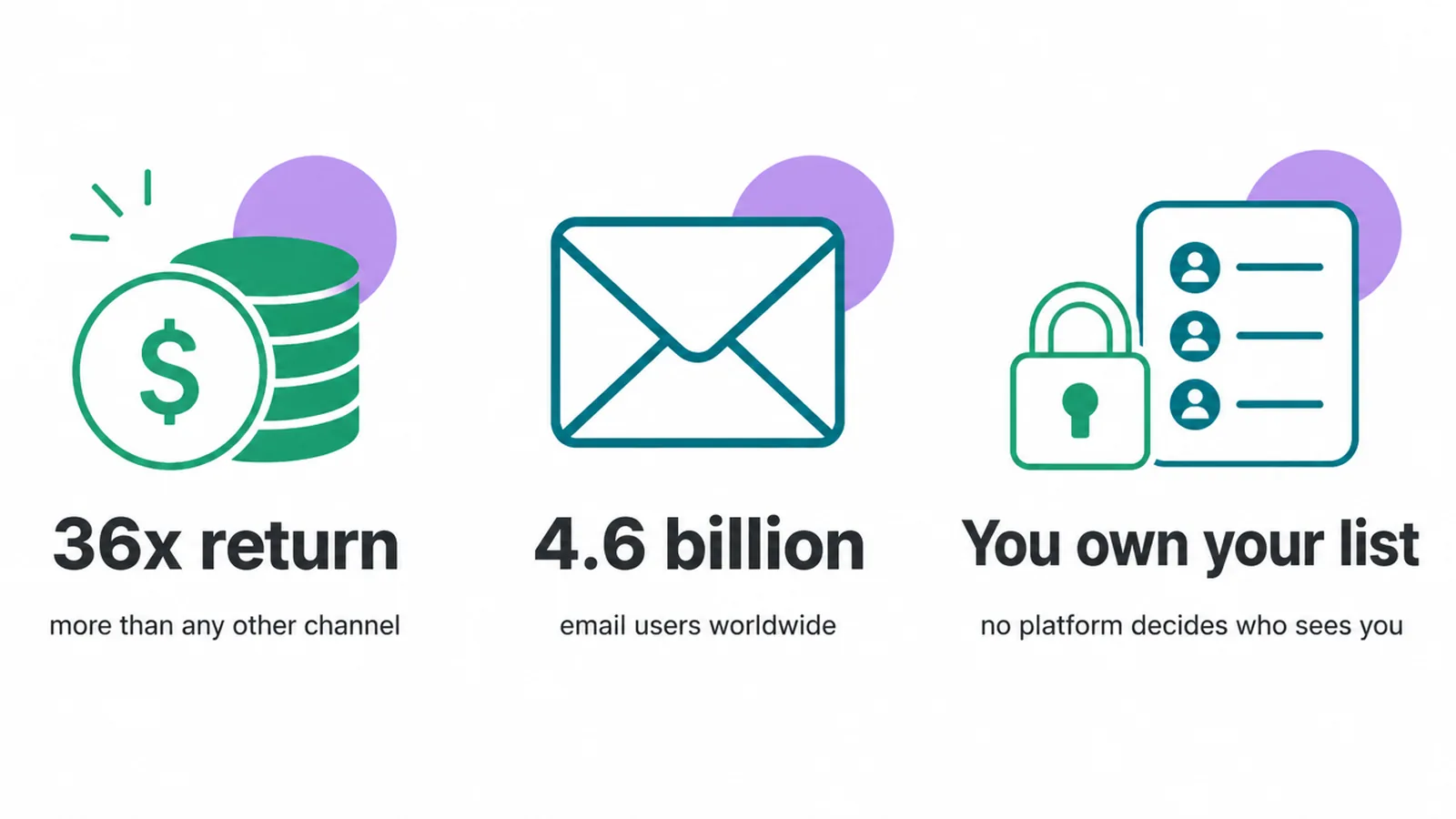
The numbers back it up. Email returns about 36 times what you spend, more than any other channel (Litmus, vendor). The reach is enormous too, with about 4.6 billion email users worldwide, and email ranks as the second most-used channel, used by 40% of marketers (HubSpot).
So this is not a fading channel. It is a proven one. Your own return will not be the average, so our free marketing ROI calculator works it out from your spend and your revenue.
For a small business, that ownership is the whole point. You spend years earning customers. Email lets you reach them again whenever you want, on your terms.
If you are mapping out your wider plan, this fits into our pillar guide on digital marketing for small business. Email is the channel that ties the rest together.
2. Owned vs rented: email vs social reach
Think of your marketing channels as either owned or rented. Your email list and your website are owned. Your social media followers are rented, because the platform decides how many of them actually see your posts.
If someone else runs those accounts for you, a managed social media service should still report the enquiries it produces.
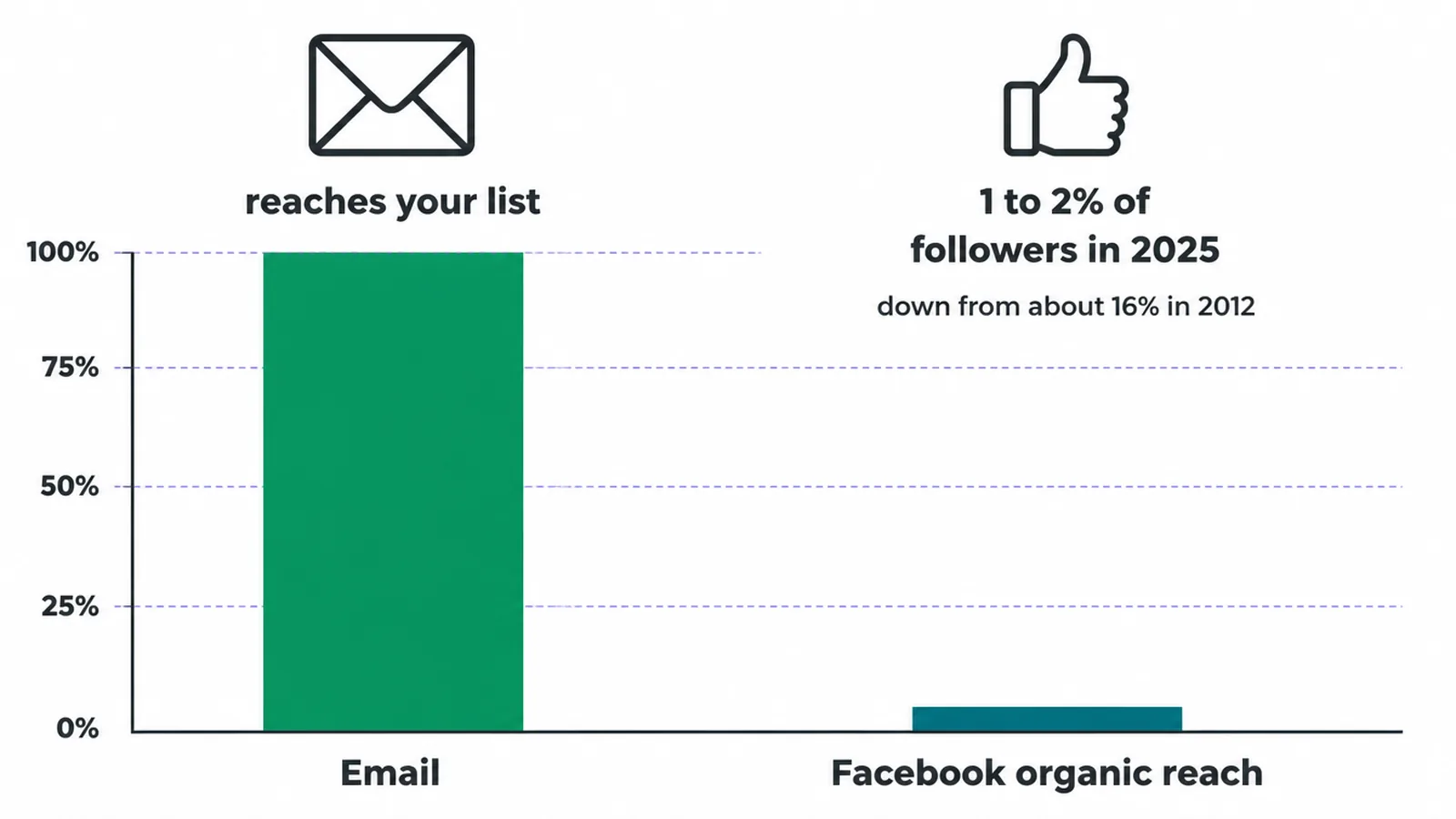
Here is why renting is risky. Facebook organic reach hovered between 1 to 2% of a Page's followers in 2025, down from about 16% in 2012 (Hootsuite). In plain terms, if a thousand people follow your Page, maybe ten to twenty see a normal post.
The rest you have to pay to reach. Steady posting plus paid reach is the answer on the social side, and it is what a Facebook page management service runs for you.
Email flips that. When you send to your list, it lands in every inbox. You are not bidding against the algorithm for your own audience.
Social media still has its place for finding new people, and you can read how the pieces fit in our guide to small business marketing. But the contacts you own are the ones that keep paying off. So build that list first.
3. Step 1: capture emails you own
You cannot send email to a list you do not have. So step one is collecting addresses, with permission, from the people who already like you. Give them a clear reason and a clear place to sign up.
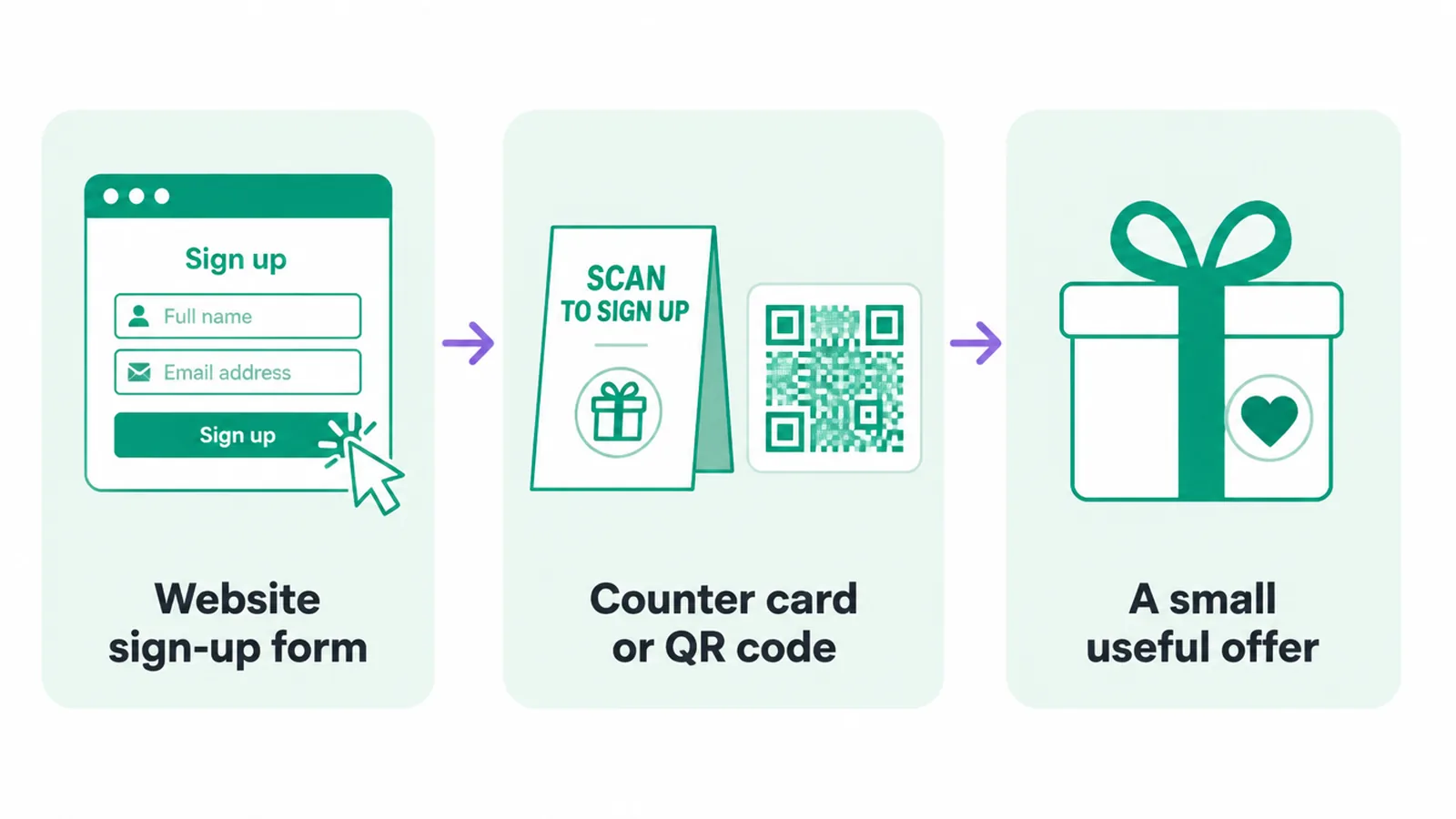
Add a sign-up form to your website
Put a short form in your footer and on your homepage. Ask for a first name and an email, nothing more. Every extra field you add lowers the number of people who finish. If you are still sorting your site, our guide to building a small business website covers where the form should live.
Use your real-world moments
You meet customers every day. Use it. Put a printed card or a QR code on your counter. Add a line to your receipt. Ask in person when someone is happy. These offline moments are some of the easiest signups you will ever get, and you already paid for the foot traffic.
Offer a small, useful reason
People guard their inbox. Give them something worth it: a short checklist, a first-order perk, or early access to a sale. Keep the promise small and specific, then deliver on it. Never buy a list, since those people never asked to hear from you and will mark you as spam.
4. Step 2: pick a free tool
You do not need a fancy platform to start. A free email tool will carry you a long way before you ever need to pay. The goal here is to pick one and move on, not to compare twenty options for a week.
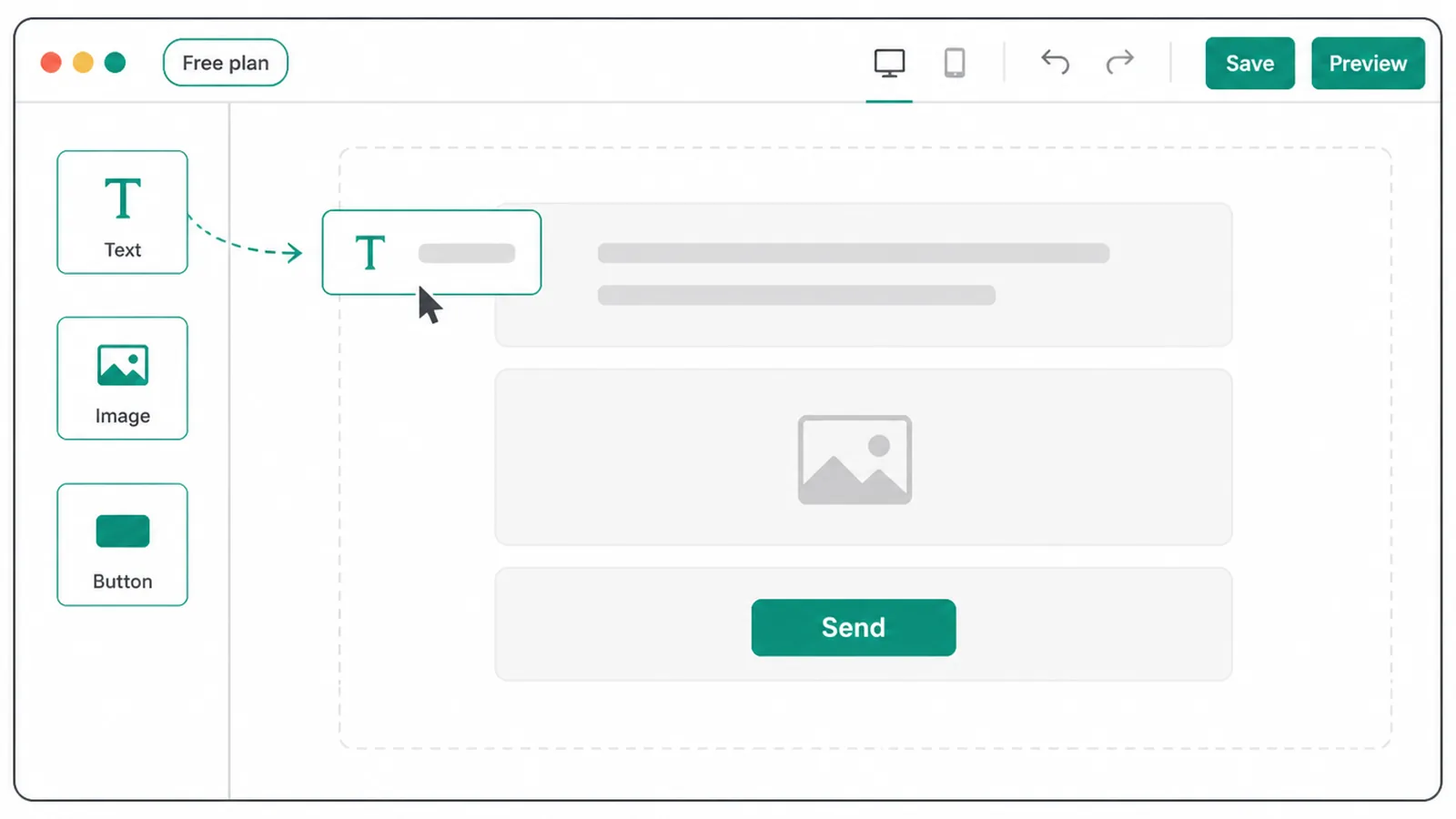
Look for four things: a generous free plan, drag-and-drop templates so you are not fighting design, an easy sign-up form you can drop on your site, and basic automation so you can send a welcome email by itself.
Tools like Mailchimp, Brevo, and MailerLite all clear that bar on their free tiers. Any of them works for a starting list.
Do not overthink this. The best tool is the one you will actually open and use. Once your list grows past the free limit, you can upgrade or switch with your contacts in hand, because remember, you own them.
If you want a wider view of helpful software, see our roundup of the best AI tools for small business.
5. Step 3: send a welcome email
The moment someone joins your list, they care about you the most. So do not waste it. A welcome email that goes out automatically is the single highest-impact email you will set up. It greets people while they still remember signing up.
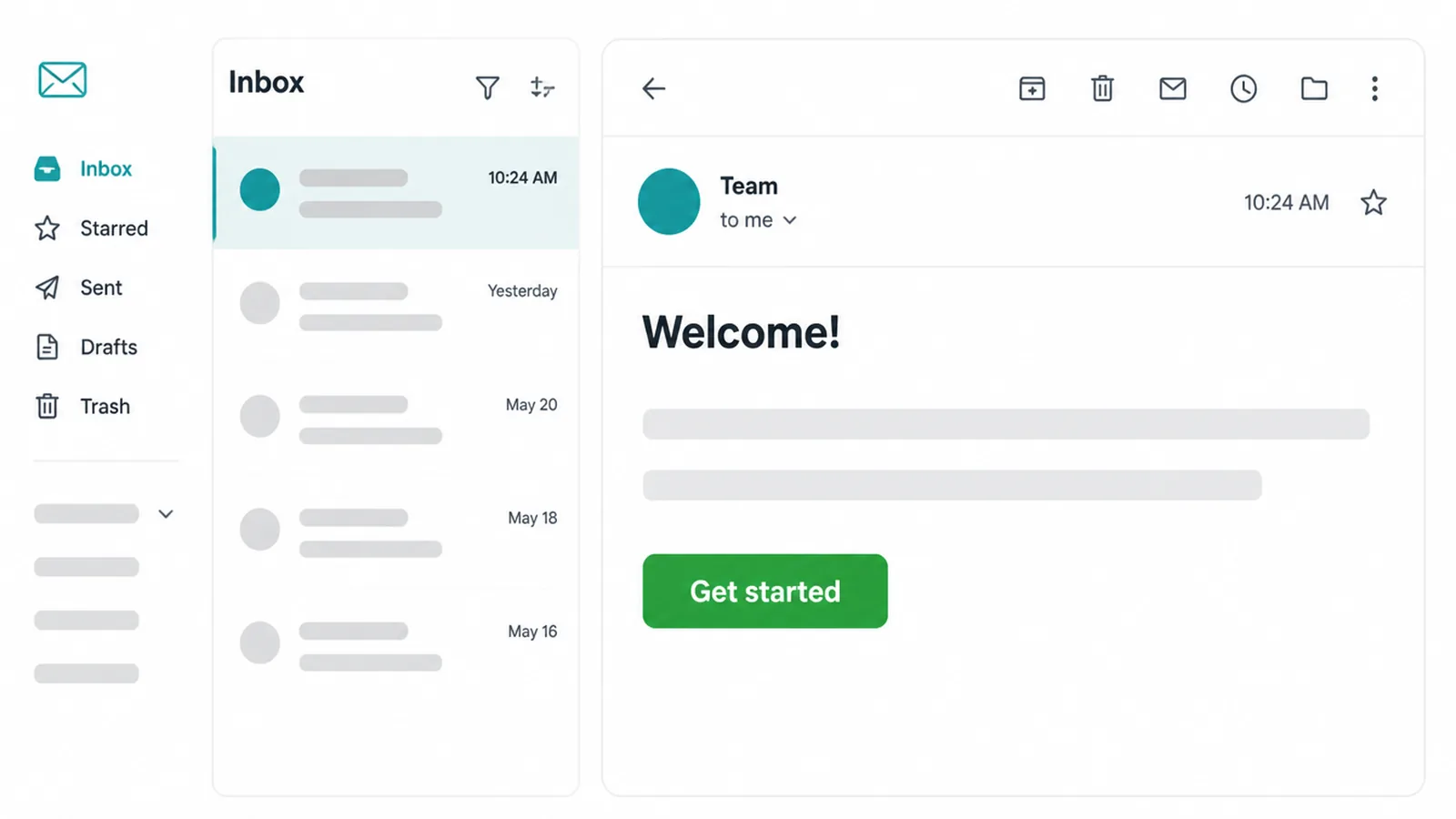
Keep it short and warm. Say thank you, remind them what they will get and how often, and deliver whatever you promised at signup. One clear next step is plenty, like a link to your best guide or your most popular product. You are setting the tone, not making the sale.
Set this up once and your tool sends it forever. That is the magic of automation for a busy owner. While you serve customers, your welcome email does the introductions. After that, the rhythm of a regular newsletter keeps the relationship alive, which is the next step.
6. Step 4: start a simple monthly newsletter
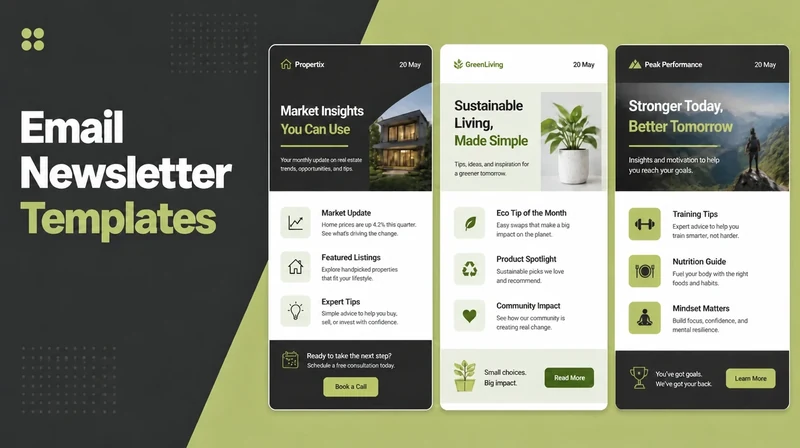
A newsletter sounds like a big commitment. It is not. For most small businesses, one short, useful email a month is the sweet spot. It keeps you top of mind without flooding anyone, and it is a pace you can actually keep.
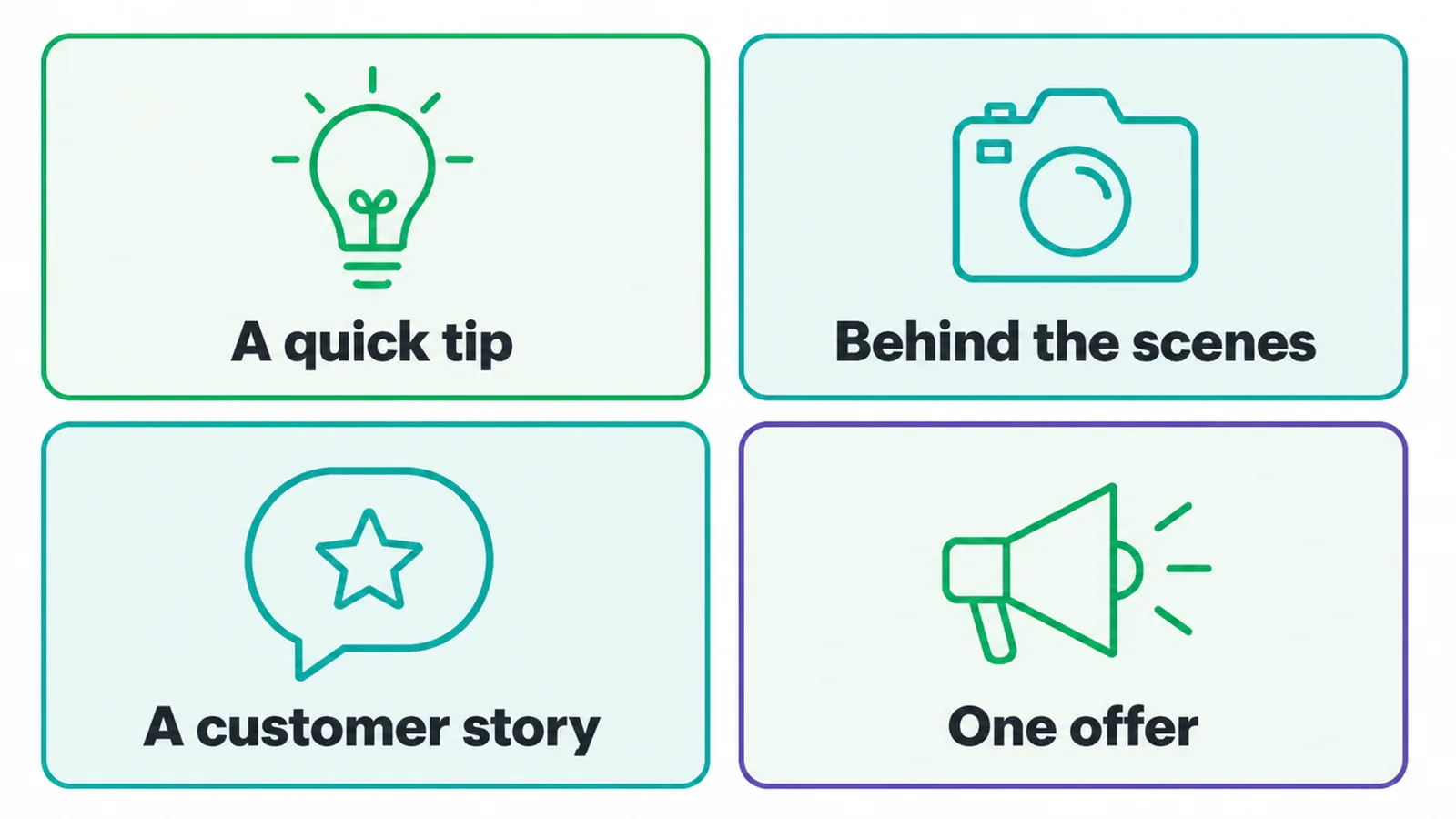
So what goes in it? Mix helpful with promotional. Share a quick tip, a behind-the-scenes look, a customer story, and one offer or update. The rule of thumb is to give more than you ask. If every email sells, people tune out. If most emails help, they open the one that sells.
Consistency beats frequency every time. One reliable email a month trains people to expect you, while a random flurry trains them to ignore you. Pick a date, like the first Tuesday, and protect it. To turn a steady list into steady sales, pair this with our digital marketing approach.
7. Step 5: basic segmentation (two groups is enough)
Segmentation just means sending different messages to different groups. It sounds advanced, but at the start you only need two groups. Relevance is what gets emails opened, and even a little of it pays off.
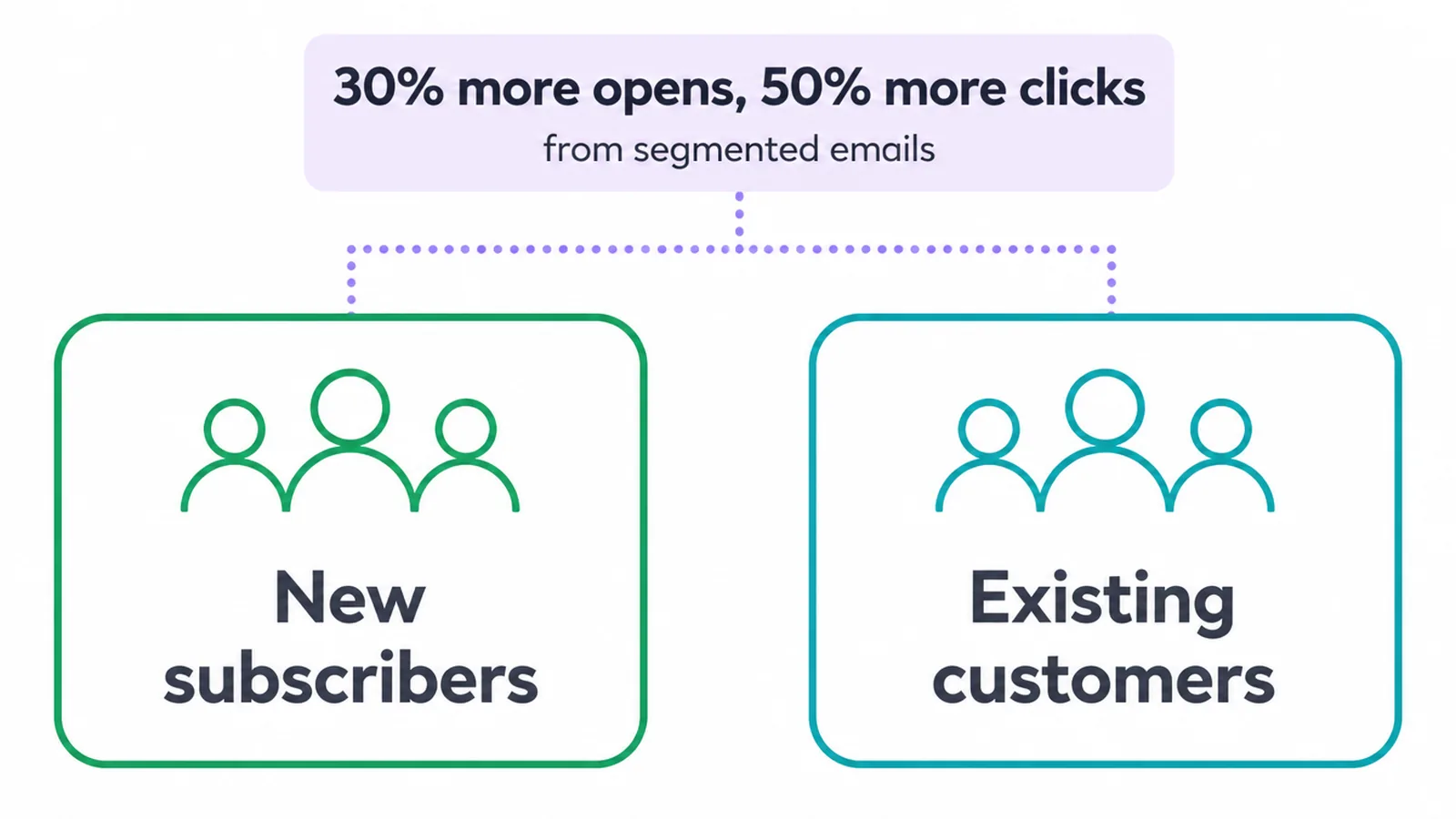
The proof is clear. Segmented emails drive 30% more opens and 50% more clickthroughs than unsegmented ones (HubSpot). That is a big lift for a small bit of effort. So start with the simplest split that makes sense for you.
For most owners, two groups do the job: new subscribers and existing customers. New subscribers get a warm intro and your best free stuff. Existing customers get loyalty perks and new releases.
Later, you can split further, but two groups is a strong, easy start. Do not let the idea of segmentation scare you into doing nothing.
8. Step 6: the few metrics that matter (clicks over opens)
Your email tool will show you a wall of numbers. Ignore most of them. Only a few actually tell you whether your email worked, and chasing the rest just burns time you do not have.
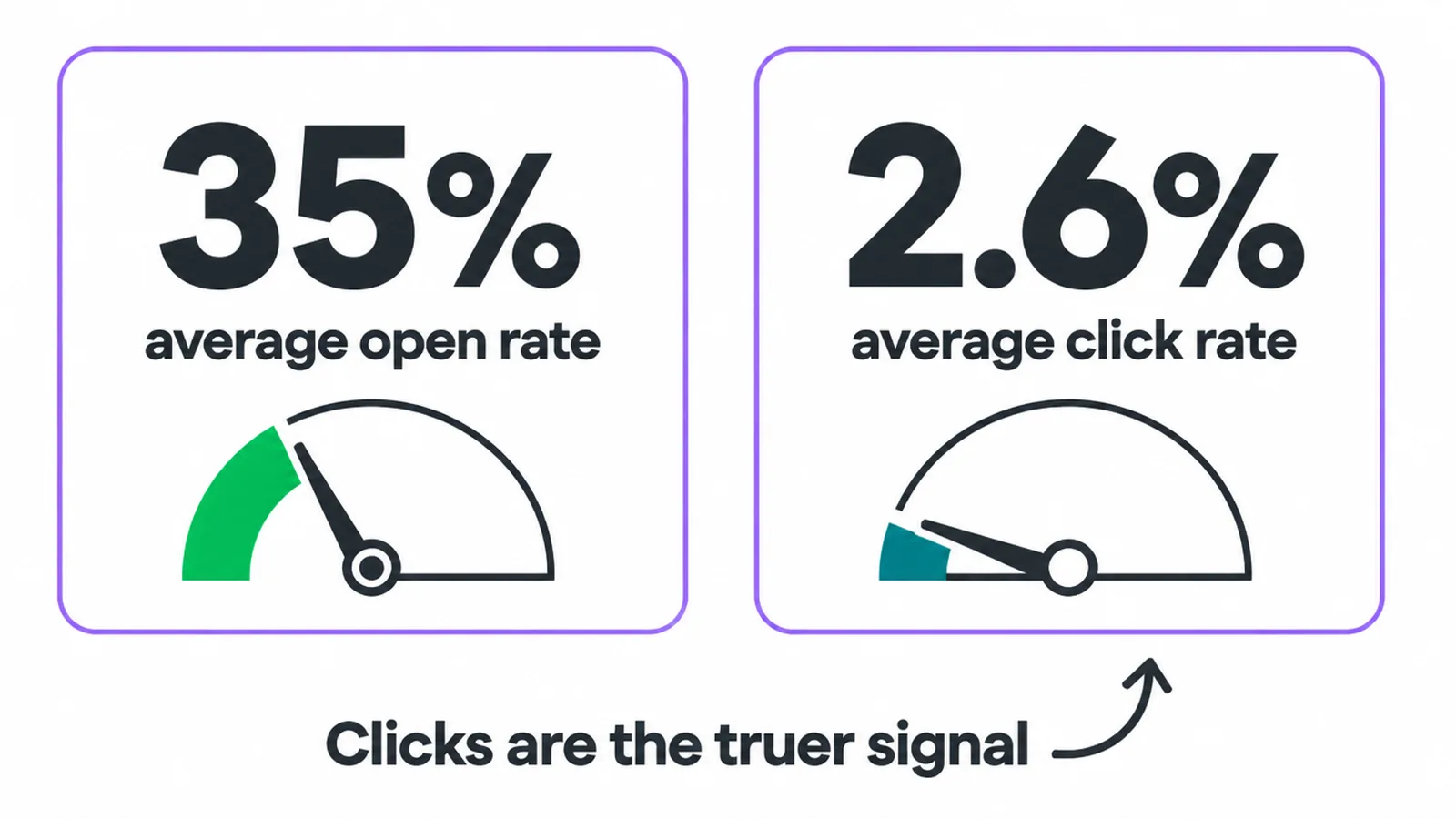
Start with the benchmarks. The all-industry average open rate is about 35%, and the average click rate is about 2.6% (Mailchimp benchmarks). Use those as rough goalposts, not as a grade. Honestly, your own trend over time matters more than any industry average.
Clicks matter more than opens
Open rates have become shaky, because some inboxes pre-load images, which can fake an open. A click is the truer signal. It means someone read your email and wanted what you offered. So watch your click rate, your replies, and your unsubscribes more closely than your opens. Together they tell you the real story.
Keep it simple: are clicks holding or growing, and are unsubscribes low? If yes, you are on track. If clicks slide, change what you send inside the email, starting with the offer. For the bigger measurement picture across channels, see our digital marketing guide.
9. Step 7: stay permission-based
Permission is the foundation of everything above. Email only works because the people on your list chose to be there. The moment you start emailing people who did not ask, you trade trust for spam complaints, and your delivery falls apart.
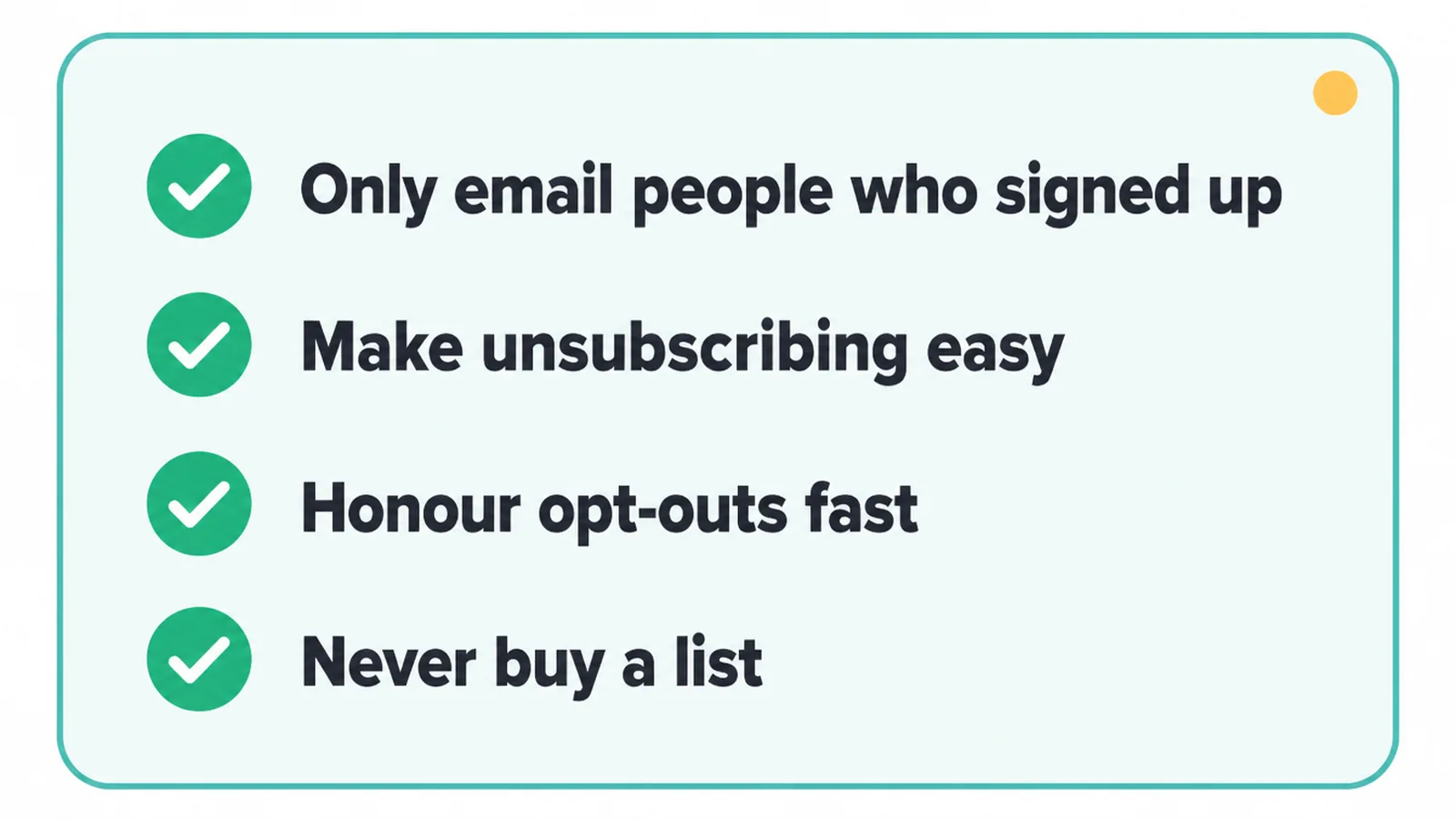
So follow a few plain rules. Only email people who signed up. Make unsubscribing easy and obvious, never hidden. Honour every opt-out fast. And never buy or scrape a list, no matter how tempting the shortcut looks. A clean list of willing readers protects your sender reputation.
This protects your numbers as well as your ethics. Inboxes watch how people react to you. Low complaints and real engagement keep you landing in the inbox instead of the spam folder.
The same trust principle drives your reviews and your Google Business Profile, which you can build with our guide on how to get more Google reviews.
10. A getting-started checklist
Here is the whole guide as a checklist. Work through it in order. You can finish the first few rows in a single afternoon, then add the rest over your first month.
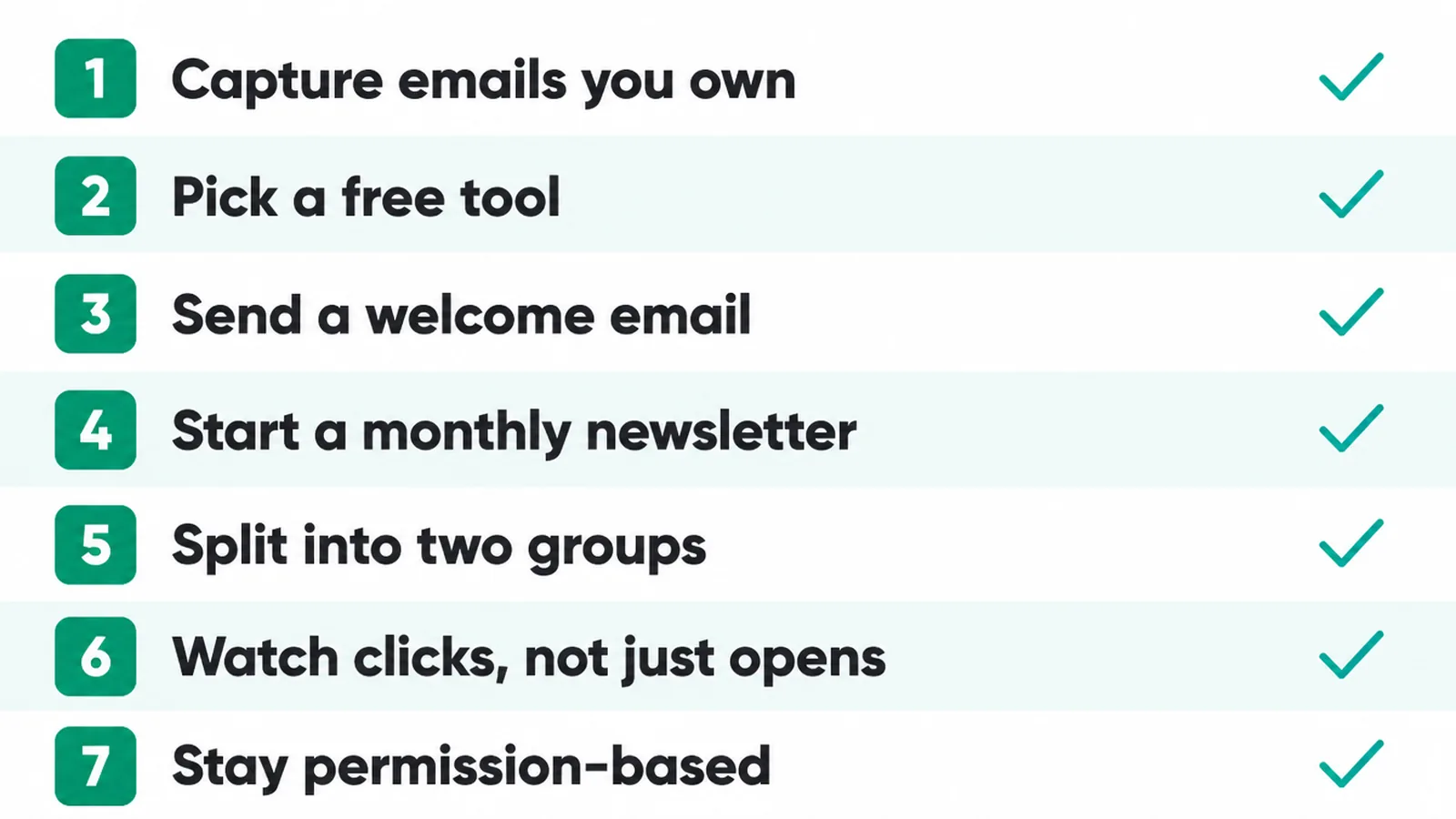
| Step | What to do |
|---|---|
| Step 1 | Capture emails you own with a website form and a counter card or QR code |
| Step 2 | Pick one free tool with templates, a sign-up form, and automation |
| Step 3 | Set up an automatic welcome email that thanks people and delivers your offer |
| Step 4 | Plan one short, useful newsletter a month and protect the date |
| Step 5 | Split your list into two groups, new subscribers and existing customers |
| Step 6 | Track clicks, replies, and unsubscribes |
| Step 7 | Stay permission-based, with easy unsubscribes and no bought lists |
That is it. Seven steps, no jargon. For more practical guides, browse the Seed Light blog or read about local SEO for small businesses to bring nearby customers to your list.
Frequently asked questions
1. Is email marketing still effective for small business?
Yes, and it is one of the best-value channels you have. Email returns about 36 times what you spend, more than any other channel (Litmus). It also reaches a huge audience, with about 4.6 billion email users worldwide, and it is the second most-used channel among marketers (HubSpot). Best of all, you own your list, so no platform can hide your audience or change the rules overnight.
2. What is the best free email marketing tool?
The best free tool is the one you will actually use. Look for a generous free plan, simple drag-and-drop templates, an easy sign-up form, and basic automation so you can send a welcome email without code. Mailchimp, Brevo, and MailerLite all have free tiers that fit a small list. Pick one with a clean editor, start there, and only upgrade when your list outgrows the free plan.
3. How do I build an email list?
Give people a clear reason and a clear place to sign up. Add a sign-up form to your website, put a printed card or QR code on your counter, and ask happy customers in person. Offer something small and useful in return, like a checklist or a first-order perk. Never buy a list. A short list of people who chose to hear from you beats a big list that never asked.
4. What is a good email open rate?
The all-industry average open rate is about 35%, and the average click rate is about 2.6% (Mailchimp). Those are useful goalposts, but compare yourself to your own numbers over time rather than chasing a benchmark. A small, engaged list often beats those averages. If your opens drop, work on your subject lines and clean out people who never engage.
5. How often should I send emails?
Pick a pace you can keep, then keep it. For most small businesses a monthly newsletter is the right starting point, with the odd extra email for a real reason like a sale or a new product. Consistency matters more than frequency. One useful email a month beats a flurry of emails you cannot sustain, which trains people to ignore you.
6. Should I worry about open rates?
Watch them, but do not obsess. Open tracking has become less reliable since some inboxes pre-load images, so opens can be inflated. Clicks are the truer signal, because a click means someone actually wanted what you offered. Watch clicks, replies, and unsubscribes more closely than opens, and use opens only to spot big trends in your subject lines.
7. Does segmenting my email list really make a difference?
Yes, even a little. Segmented emails drive 30% more opens and 50% more clickthroughs than unsegmented ones (HubSpot). You do not need a complex setup. Splitting your list into just two groups, like new subscribers and existing customers, lets you send each group something more relevant, and relevance is what gets emails opened and clicked.