Hiring In House or Using an Agency

In house vs agency is decided by the shape of the work, not the price. Constant daily work that one person can own suits a hire. Work that arrives in bursts, or needs several skills at once, suits an agency. Seed Light sees the same split either way: whoever you pick, somebody has to brief and review them.
At some point the marketing stops fitting into the gaps in your week. That is usually when this question arrives.
This guide covers what each option actually gives you, what neither will do, and the three artefacts that decide whether either works.
By the end you will know which shape your work is. That is the part that settles it.
Key Takeaways
- The shape of the work decides it. Constant work suits a hire. Work in bursts suits a contract.
- Salary is not the cost. US figures put wages at 70% of what an employer pays, with benefits as the rest.
- Someone has to manage whichever you pick. An unbriefed agency and an unmanaged employee fail the same way.
- Outsourcing part of it is normal. The CMO Survey found a third of digital marketing work sits with outside providers.
- People leave. Median US tenure is just over four years, so write down how things are done.
Most comparisons of this start with price, then invent a number. I want to start with the work itself, because that is what the decision actually turns on.
In House vs Agency: The Short Verdict
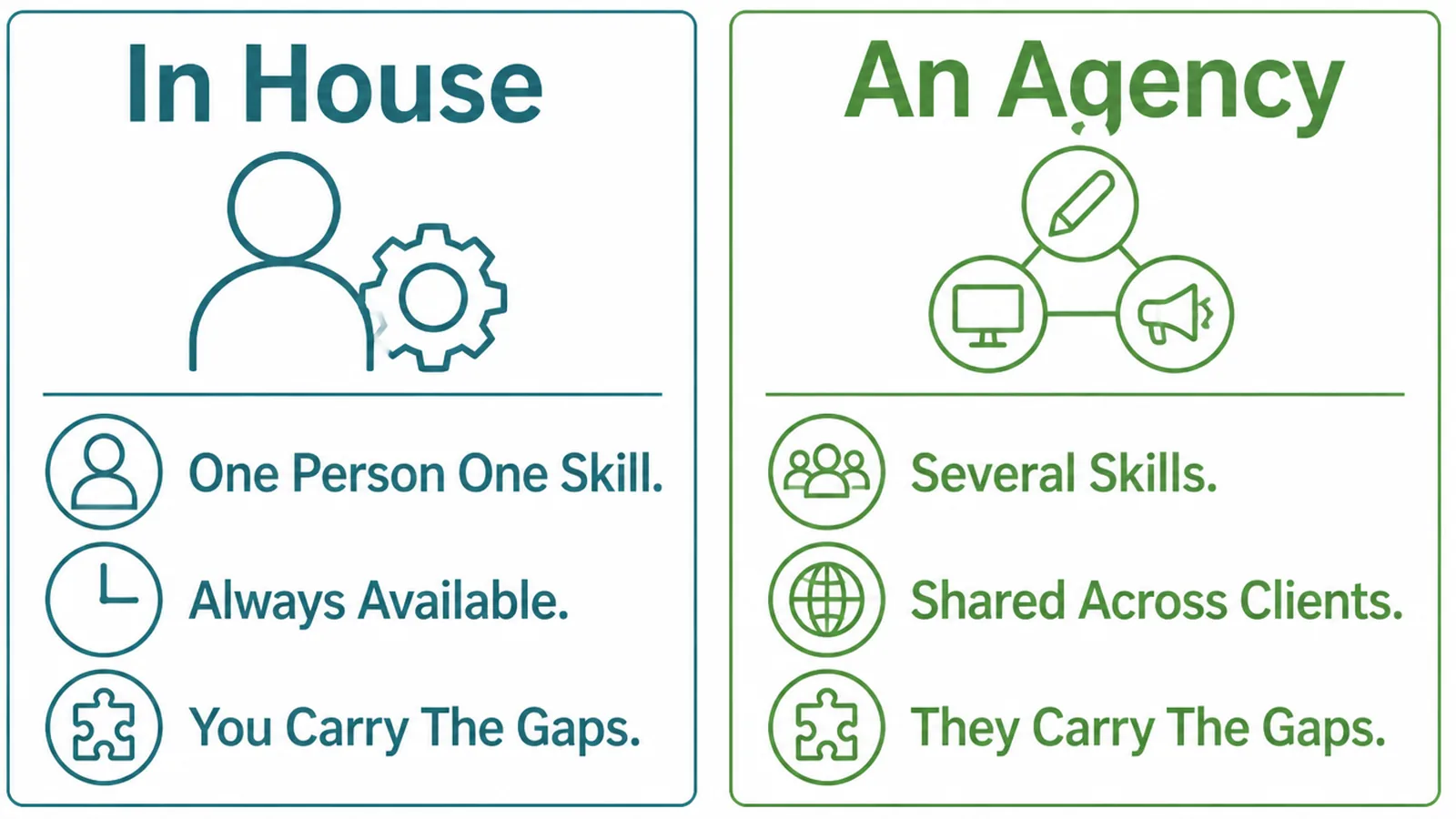
An in house marketing team, even one of a single person, buys you attention. They are there every day, they learn the business, and they answer immediately.
An agency buys you range. Several skills arrive at once, shared across clients, and the gaps in any one skill are somebody else's problem to cover.
That trade is the whole thing:
- In house gives you one person, one skill set. Deep on your business, narrow on craft.
- An agency gives you several skills, part time. Broader on craft, shallower on your business.
- In house, you carry the gaps. When the work needs a skill they lack, it stops or you buy it in anyway.
- With an agency, they carry the gaps. That is most of what the margin pays for.
Neither is the safe option. They fail differently. Knowing how is more useful than knowing which is cheaper.
In house vs agency is usually framed as buying the same thing from two places. You are not. You are choosing between depth on your business and breadth of craft, and no budget converts one into the other.
At A Glance
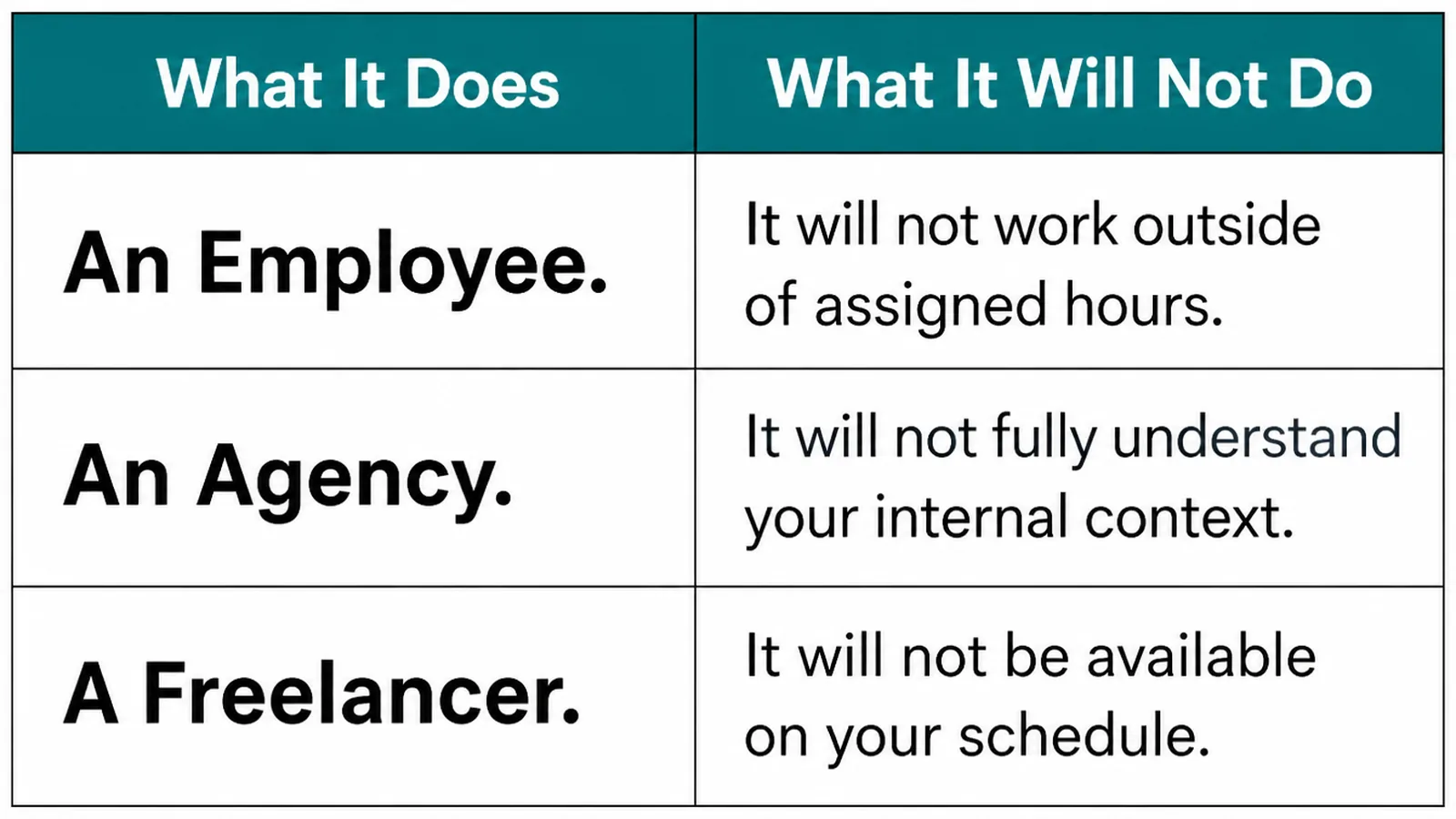
Read the second column first. Marketing agency vs employee is usually argued on strengths, and the limits are what actually bite.
| What it is | What it will not do |
|---|---|
| An employee | Work outside their hours, or cover a skill they do not have |
| An agency | Know your business the way someone sitting in it does |
| A freelancer | Be available the week you suddenly need them |
| Any of the three | Decide what the business is trying to achieve |
That last row is the one that sinks most arrangements. None of these options supplies the decision about what matters this quarter.
The CMO Survey, fielded in January 2026, found a mean of 33.59% of digital marketing activities performed by outside agencies and partners, from 198 responses.
So the realistic question is not whether to use outside help. It is which parts, and who holds the thread.
Who Does The Work
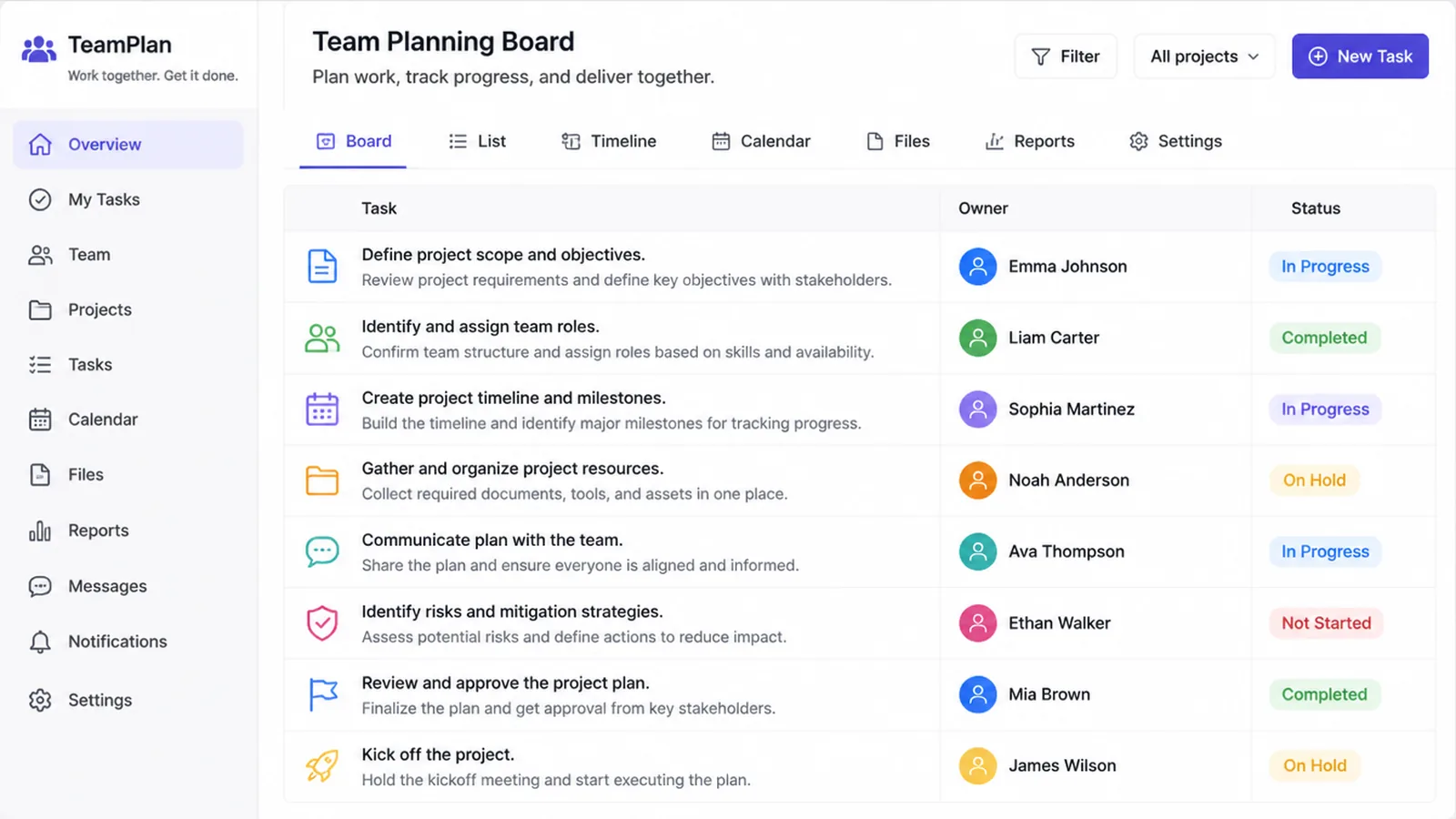
Open a planning board and put a human name beside every recurring task. Not a department, not a tool, a person.
Most of the time that exercise answers the question on its own, because the gaps become obvious.
The cost of an in house marketer is where people get the sums wrong. Salary is the headline, and it is not the total. What sits on top of it:
- Statutory contributions. Paid by you, on every salary, whatever the month looked like.
- Paid leave and insurance. Real cost, invisible in the salary line you compared against.
- Your management time. Briefing, reviewing and developing the person, every week.
US Bureau of Labor Statistics figures for June 2026 put wages and salaries at 70.0% of total employer costs for private industry workers, with benefits making up the remaining 30.0%.
Where I am in Malaysia the statutory layer is explicit. Employers contribute 13% of wages to EPF at RM5,000 and below, plus 1.75% to SOCSO.
Then add the part no spreadsheet shows: your own hours spent directing the work. That cost exists with an agency too, and it is the one nobody budgets.
There is a second line people forget: what happens when the role turns over. Median tenure runs by occupation: BLS put sales and office roles at 3.7 years and professional roles at 4.6 in January 2026.
Every one of those endings costs a recruitment round and a ramp-up before output returns to where it was.
It still may be worth it. Marketing leaders in the CMO Survey ranked having the right talent first among five drivers of organic growth, ahead of budget or technology.
What You Are Agreeing To
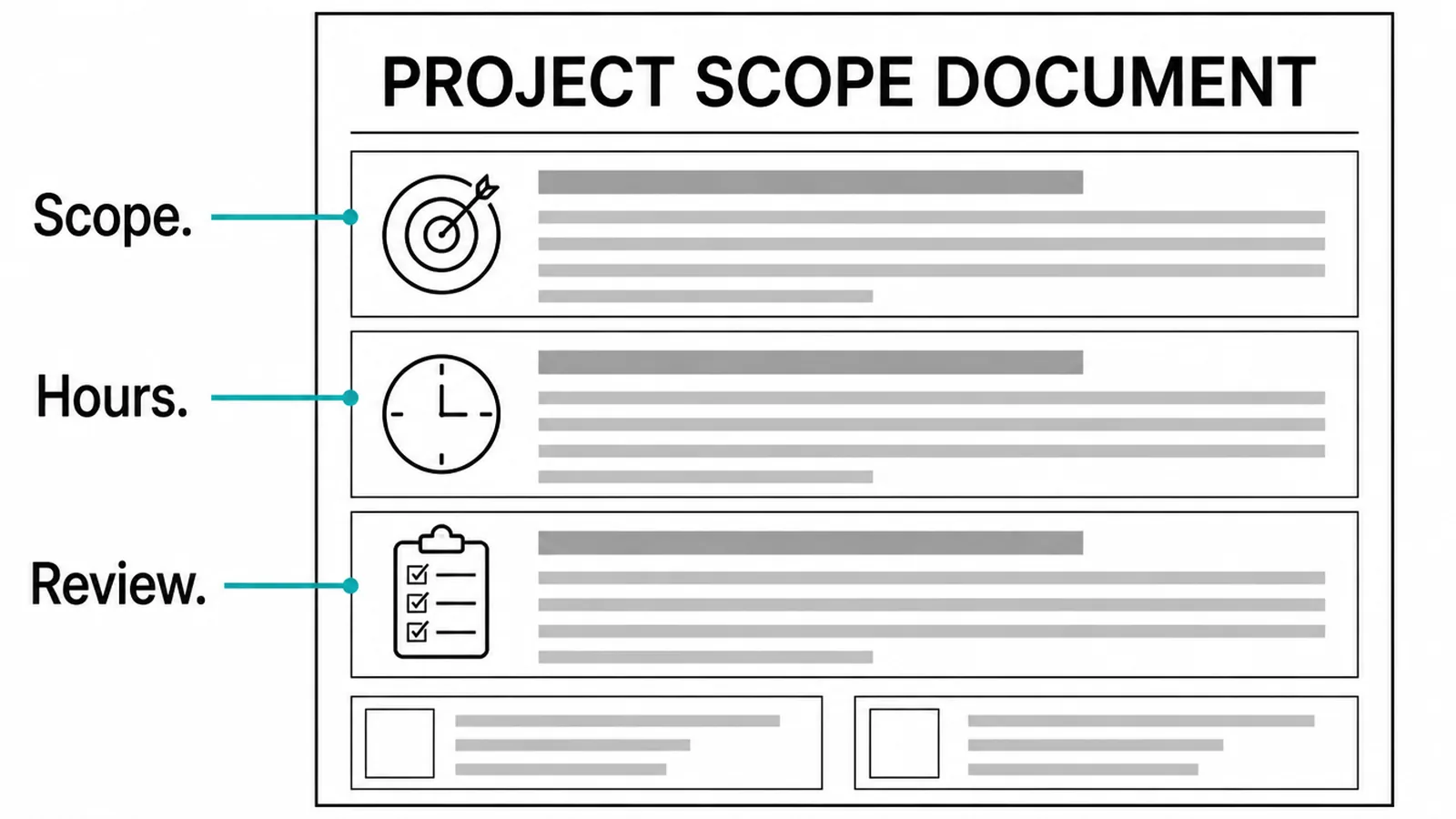
An agency relationship lives or dies on its scope document. A job description does the same work for a hire.
Three things have to be written down:
- Scope. The named deliverables, and plainly what is excluded.
- Hours or volume. How much of the thing, in a period you can check.
- Review. When you look at it together, and against what.
Ask directly what is not included. Landing pages, creative and tracking setup are the three most often assumed and least often covered.
Ask who owns the accounts too. The ad account, the analytics property and the website logins should be in your name, whoever is doing the work in them.
That single question separates an agency you can leave from one you cannot. It costs nothing to ask before you sign and a great deal to discover afterwards.
For a hire, the same document prevents the slow drift where a marketing role quietly becomes general office help.
Write the review date into it. A quarterly conversation against something you agreed in advance is worth more than a monthly report nobody reads.
How Work Gets Started
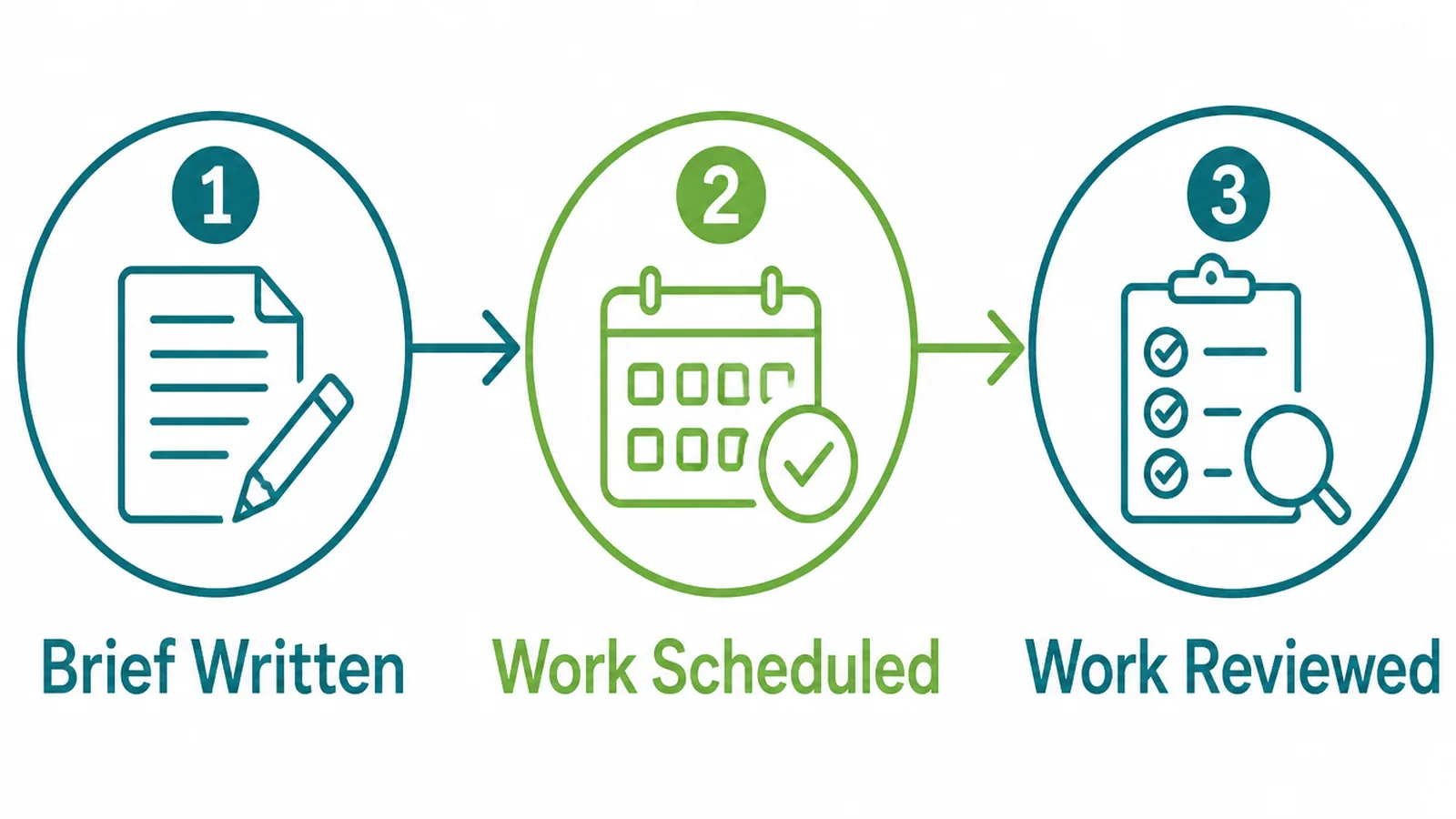
Work arrives the same way in both models, and this is the part owners underestimate.
A brief gets written. What is wanted, for whom, by when, and how you will know it worked.
The work gets scheduled. Into a week that already has other things in it.
The work gets reviewed. Against the brief, not against taste on the day.
An agency cannot write the first box for you, though a good one will help shape it. An employee cannot either, in their first months.
The CMO Survey also found marketing teams spend a mean of 3.80% of their budget on training and development. Skills are rarely funded to grow. Worth knowing before you plan to hire junior and develop them.
Who Each One Suits
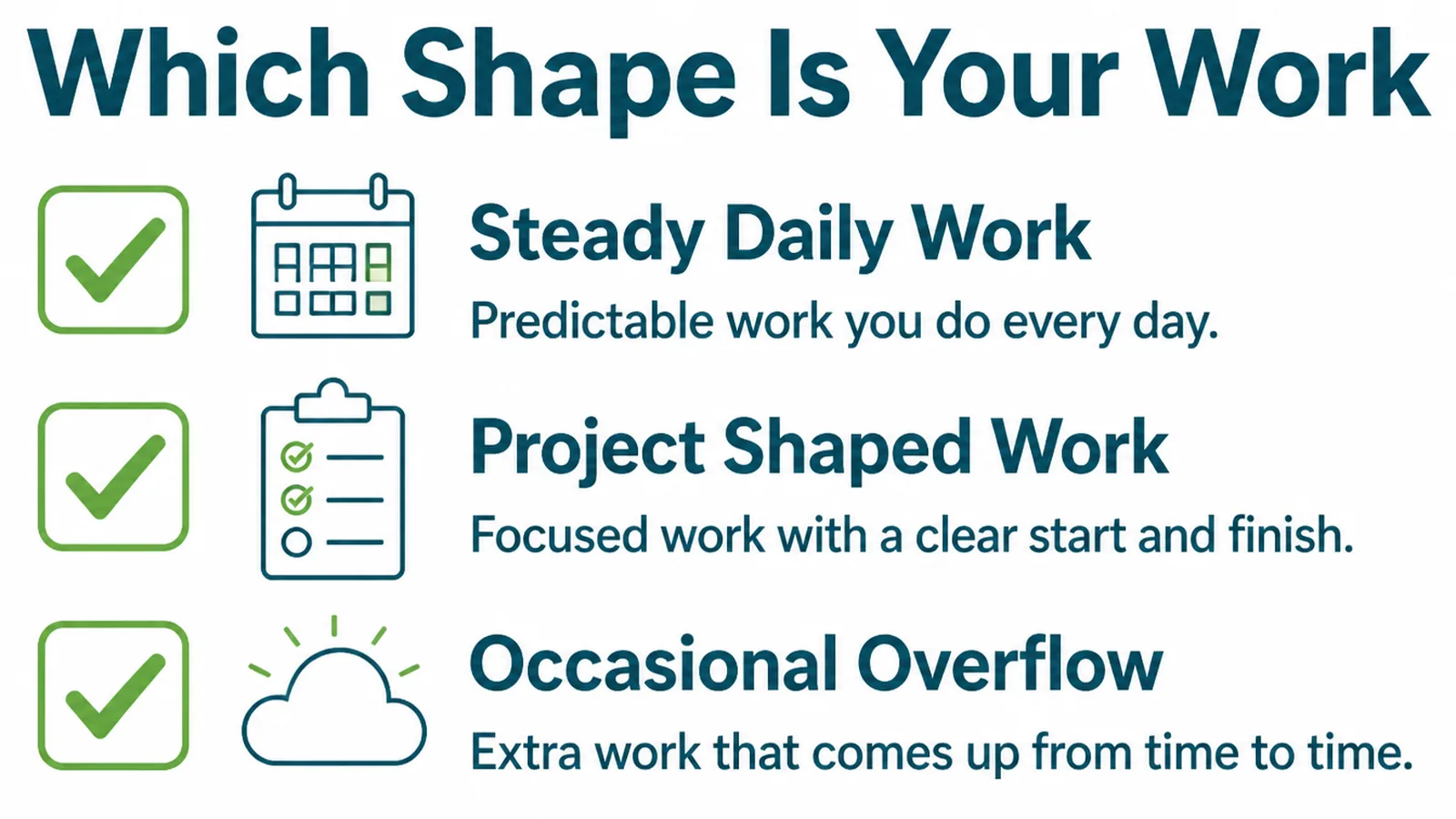
Look at last quarter and ask which of these your marketing actually looked like.
- Steady daily work. Posting, replying, updating, reporting, every week without fail. This suits a hire.
- Project shaped work. A site, a campaign, a rebrand, with a start and an end. This suits an agency.
- Occasional overflow. Real but irregular. This suits a freelancer or a retainer with a small floor.
Most small businesses discover they are the second or third, and were about to hire for the first.
Knowing when to hire a marketing agency is mostly this: the work is real, it is not daily, and it needs more than one craft.
Headcount is a long commitment against work that may not be. The CMO Survey recorded median marketing team growth of 0% over the previous year, with a mean of 2.49%.
Budget shape matters as much as budget size, and the spread here is wide. The same survey put marketing spend at a mean of 8.96% of company revenue against a median of 5.0%.
That gap tells you most firms spend modestly while a few spend heavily. If you are nearer the median, a salary is a large share of the whole marketing budget, committed before any work is chosen.
An agency retainer is not automatically better value. It is simply easier to stop. That is worth something when the work itself is uncertain.
How To Decide
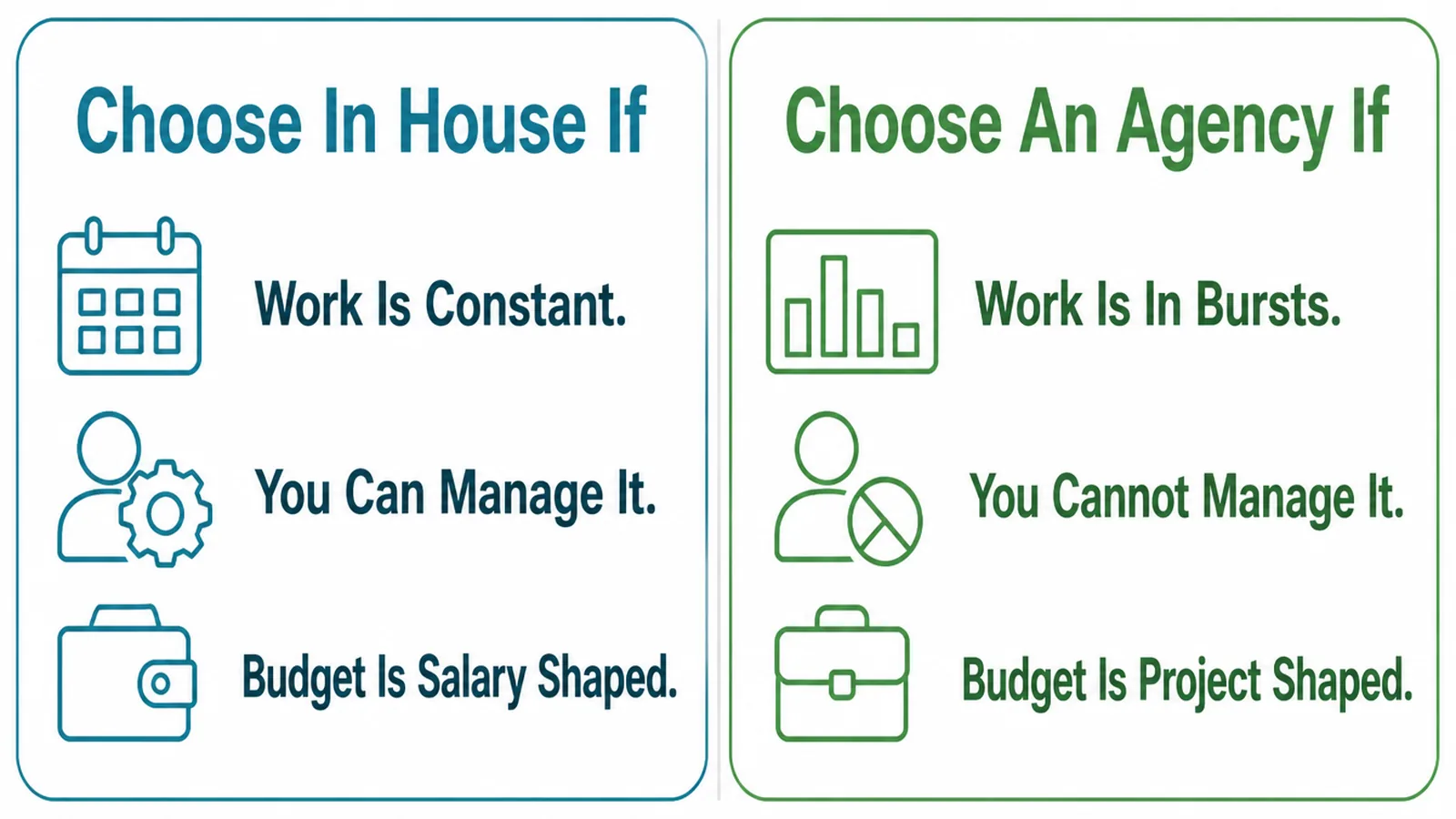
Choose in house if all three are true:
- The work is constant. Enough to fill the role every week, in a quiet month as well as a busy one.
- You can manage it. Somebody senior enough will brief, review and develop the person.
- The budget is salary shaped. A committed monthly cost that does not flex when a quarter is quiet.
Choose an agency if all three are true:
- The work arrives in bursts. Projects and campaigns rather than a steady daily load.
- You cannot manage a specialist. Nobody in the business can judge the craft or set the direction.
- The budget is project shaped. Tied to pieces of work you can start and stop.
If you hire, plan for the person leaving. US median tenure with one employer was 4.1 years in January 2026, with 20.6% of workers in post a year or less.
That is not a reason to avoid hiring. It is a reason to write down how things are done while the person who knows is still sitting there.
FAQs
Is an agency cheaper than hiring someone?
Not reliably, and anyone quoting a precise saving is guessing. What is documented is that salary is only part of an employee cost. US figures put wages at 70% of total employer cost, with benefits making up the other 30%, before you add the time spent managing the person.
Can I do both at once?
Yes, and it is common. A coordinator in house who owns the calendar and the brand, with an agency doing the specialist work, suits a lot of businesses. The thing that breaks it is nobody owning the brief, so decide that before you sign anything.
How long does it take to hire a marketing person?
SHRM puts the median time to fill a nonexecutive role at 39 calendar days, across a survey of more than 4,600 organisations. That is from opening the role to an accepted offer, so add notice periods and ramp-up before any work actually ships.
What happens when my in house marketer leaves?
You lose the knowledge with them. US median tenure with one employer was 4.1 years in January 2026, and one in five workers had been in post a year or less. Write down how things are done while the person is still there.
Conclusion
In house vs agency is not a cost comparison with a right answer. It is a question about whether your work is constant or lumpy, and who is going to direct it.
Write the tasks down, put a name against each, and the gaps will tell you which column you are in.
If you want a second read on it, see how we work with small teams, or get in touch and we will tell you honestly whether the work you have is worth an agency at all.