


Key takeaways
- The trigger is a number, not a look. Slow on a phone, unusable, or getting traffic that never converts. Age on its own proves nothing.
- The phone is the version being judged. Mobile is 52.57% of worldwide traffic, and Google ranks the mobile version of your site.
- Speed has a price tag. Google puts abandonment at 53% past three seconds, and Shopify measures about 3.5% lower conversion for every extra 100 milliseconds.
- Protect the rankings you already have. Keep the URLs, redirect what moves, and watch Search Console for a month after launch.
- A refresh and a rebuild are different jobs. Match the scope to the fault instead of starting over by default.
Most websites are replaced for the wrong reason. Someone decides the design looks old, and a project starts.
A redesign is worth doing when the site is measurably failing at its job: it loads slowly, it is awkward on a phone, or it brings visitors who never contact you. Those three faults can be checked this afternoon, and they are what this guide works through.
If none of them apply, keep the site and spend the money somewhere it changes a number.
1. Five signs a redesign is overdue
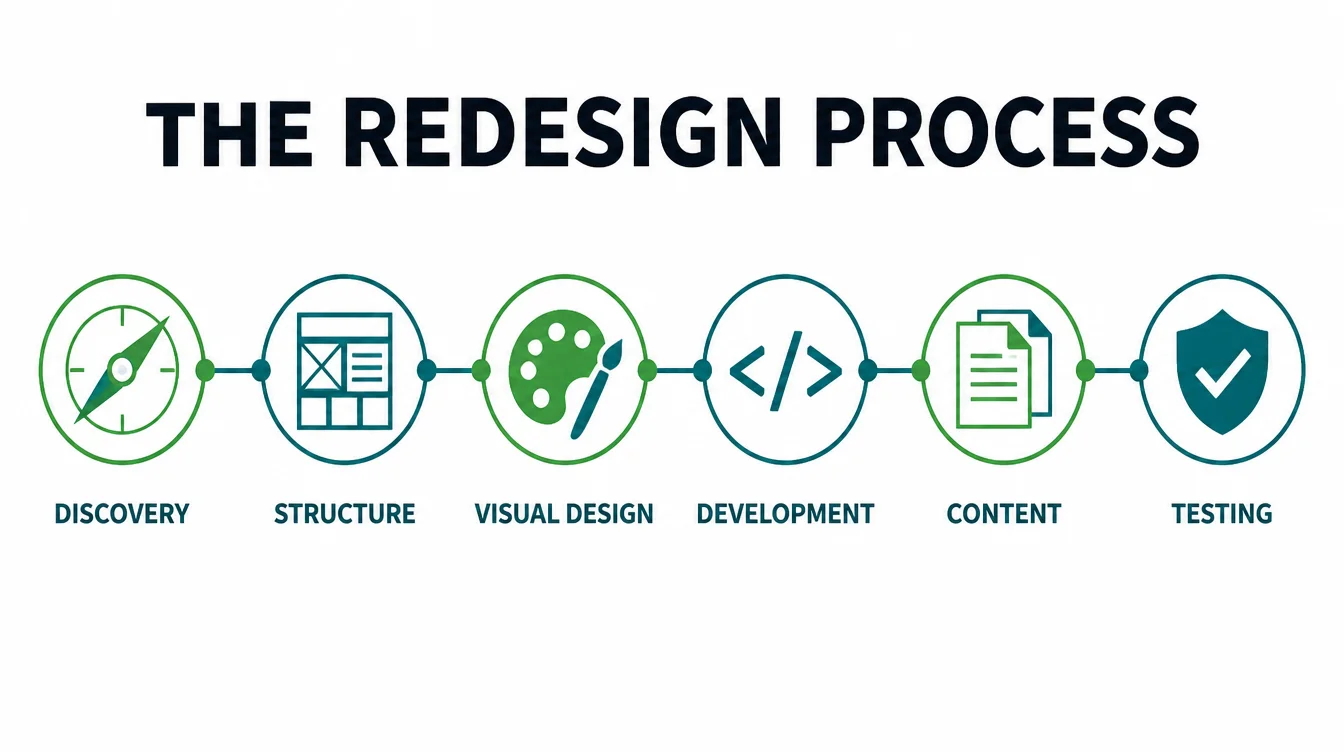
Each of these can be measured. Check them in order and write down what you find, because the list you end up with decides whether you need a refresh or a rebuild.
1. It is slow, and slow has a price
Google's own guidance states that "53% of visits are likely to be abandoned if pages take longer than 3 seconds to load" (Google AdSense Help).
Shopify measured its live stores across 28 days in early 2026 and found "for every 100 milliseconds slower a store loads, conversion tends to be about 3.5% lower" (Shopify, 2026).
Google publishes the target too: the main content of a page should appear within 2.5 seconds (Google Search Central). Run your busiest page through PageSpeed Insights on the mobile tab.
If the page is bloated with a page builder, unsized images and a stack of plugins, the fixes usually cost as much as rebuilding on a clean base. Our guide to Core Web Vitals explains each score.
2. It fights back on a phone
Mobile devices account for 52.57% of worldwide web traffic against 45.93% for desktop, on StatCounter's latest published month (StatCounter, July 2026). Google uses the mobile version of your site to decide rankings (Google Search Central), so the mobile version is the site as far as search is concerned.
Test it on a real handset. Can you tap the phone number, open the menu with a thumb, read the body text without zooming, and finish the form one-handed? Our guide on making a website mobile friendly lists the checks in order.
3. People cannot use it
WebAIM tested one million home pages in February 2026 and found 95.9% had detectable failures against WCAG 2, averaging 56.1 errors per page (WebAIM Million, 2026). Low contrast text was the most common fault, found on 83.9% of pages, with missing image alt text on 53.1%.
These are quiet faults. Nobody emails to say your grey-on-grey caption is unreadable, they just leave. A rebuild is the cheapest moment to fix them, because contrast, labels and headings are decided once in the design and then repeated everywhere. Our guide to website accessibility covers what to check.
4. Visitors arrive and nothing happens
Traffic without contact is the most expensive fault on the list, because you are already paying for the visitors. Look at your analytics for the pages people land on, then for how many reach the contact page.
If the gap is wide, the problem is usually the path rather than the paint: no clear next step, a form that asks for too much, or a page that never says what you sell.
In shops the same gap shows up at the basket. Baymard's review of 50 studies puts the average documented cart abandonment rate at 70.22% (Baymard Institute). That is the benchmark to judge your own checkout against before anyone redesigns a homepage.
5. You cannot change it yourself
If adding a page means paying someone, you are renting your own website. Over three years that ties up more money than the rebuild would, and it means the site slowly stops matching the business. Any modern build should let you edit text, swap a photo and publish a post without help.
2. What a redesign actually changes
A redesign is worth buying for what it fixes, so be specific about which of the five faults you are paying to remove. Three outcomes are reliable, and one is not.
Speed improves, and speed is measurable. A rebuild on a clean base drops the weight a page builder added and the plugins nobody uses. You can prove the change with the same PageSpeed report you ran before.
Search performance usually improves. Faster loading, working mobile layouts and a clear page structure are all things Google rewards, and a rebuild is when you fix the titles, headings and internal links at the same time. Our on-page SEO checklist is the list to work through while pages are being built.
The path to contact gets shorter. One clear action per page, a form that asks for what you actually need, and a phone number that is always reachable.
What is not reliable is a headline conversion figure. Any agency quoting a fixed percentage lift is guessing, because the number depends entirely on where your current site is losing people. Ask instead which specific fault they are fixing and how they will measure it afterwards.
3. Do the planning before the design
A rushed redesign produces a good-looking site that performs exactly like the old one. Four decisions come first.
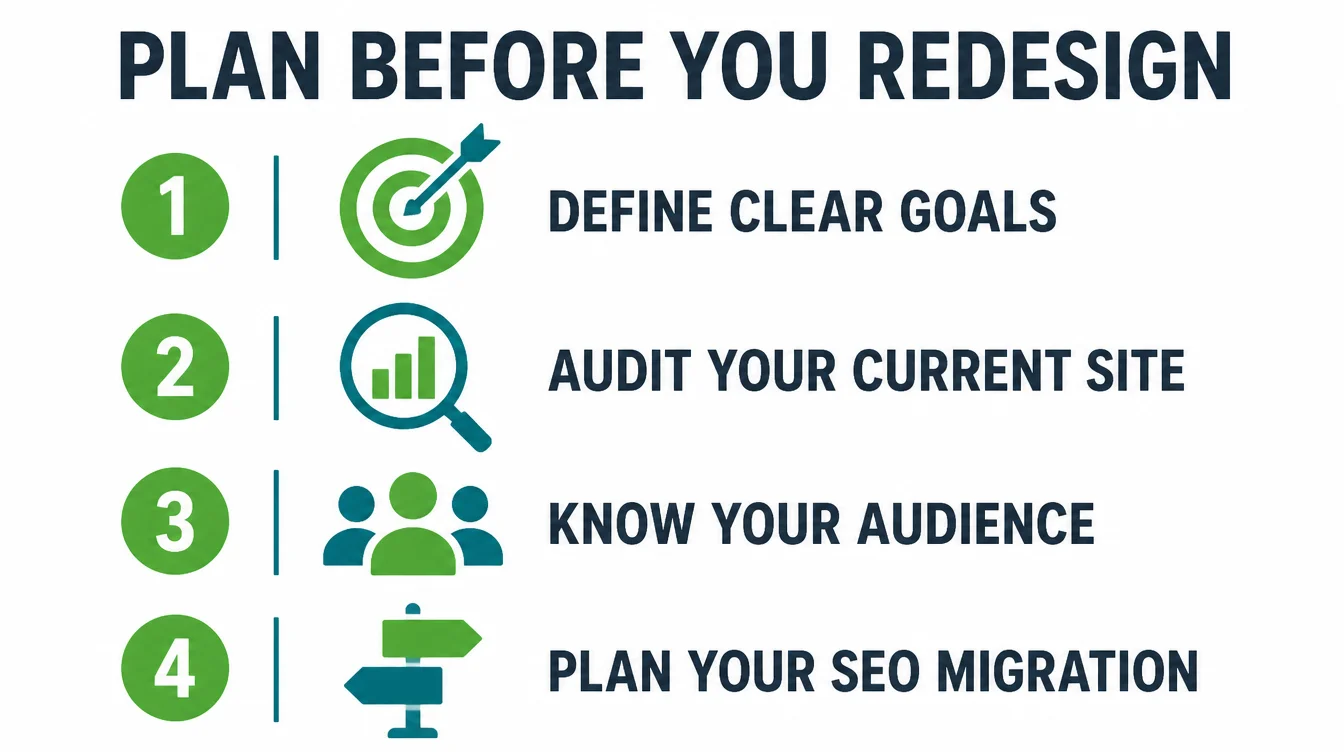
Name the goal in one sentence. More booked calls, more online orders, fewer support emails. One goal, so that every later argument about a colour or a section has an answer.
Audit what you already have. Export your top pages by traffic and by conversions. Those pages are assets. They keep their URLs, and their content gets improved rather than replaced. Everything else is up for discussion.
Write down who it is for. The customer you want more of, what they are trying to do, and the questions they ask before they buy. Design that ignores this ends up reflecting the owner's taste.
Plan the SEO migration on day one. This is the single most expensive thing to get wrong, so it gets its own section below.
4. How to keep the rankings you already have
The horror stories about redesigns are almost always migration stories. A site launches, the URLs have changed, nothing redirects, and search traffic falls off a cliff in week two. Google is clear that redirects are how you carry a page's history to its new address (Google Search Central).
- Keep every URL that already ranks. Changing an address for tidiness is a cost with no benefit.
- Build a redirect map before launch: old address on the left, new address on the right, one line per page. Every old URL points at the closest match, never at the homepage.
- Carry over the titles and meta descriptions that already earn clicks.
- Keep the content on your best pages. Rewriting a page that ranks is a gamble you did not need to take.
- Submit the new sitemap the day you launch and watch Search Console for four weeks. Our guide to SEO during a website migration covers the full sequence.
Expect a small dip for a fortnight while Google recrawls. What you are watching for is recovery, not a flat line.
5. Refresh or rebuild
These are different jobs with different prices, and picking the wrong one is how budgets get wasted.
A refresh keeps the structure and the platform. New colours, new type, better photos, rewritten headlines, a tightened contact form. It suits a site that performs reasonably and simply looks tired. It is quick and it is cheap.
A rebuild replaces the foundation. It is the right call when the site is slow because of how it was built, when the mobile layout is patched rather than designed, when you cannot edit anything yourself, or when the structure no longer matches what you sell.
A simple test: if your list of problems is mostly visual, refresh. If the list includes speed, mobile, or the platform itself, rebuild. Patching a broken base costs more over two years than replacing it once.
6. Doing it yourself or hiring someone
Builder tools have become genuinely good, and for a simple site with a few pages they work.
What you are buying from a professional build is the part builders do not do for you: a structure planned around what you sell, a redirect map that protects your traffic, pages that pass the speed and accessibility checks, and someone accountable when something breaks.
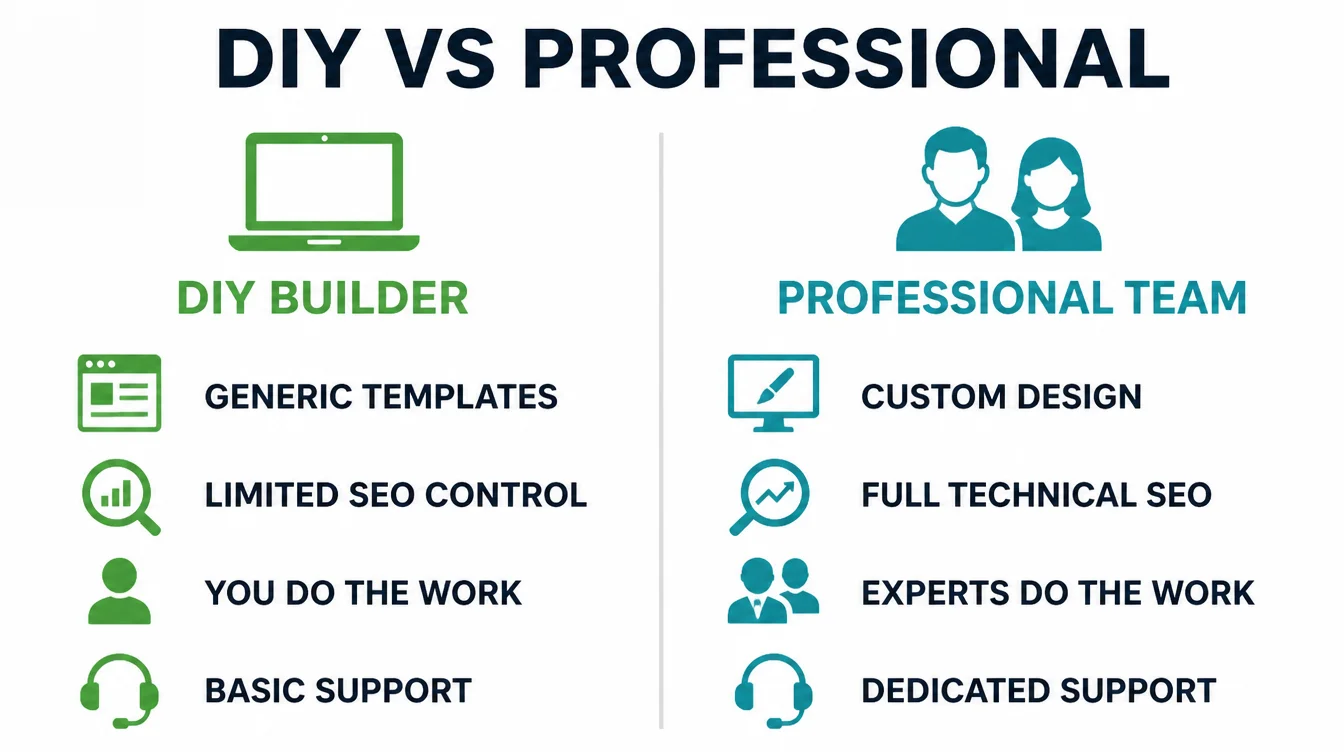
Be honest about your hours as well as your budget. A redesign done in the evenings takes months, and the half-finished version is live the whole time. Our guide to choosing a web design company covers what to ask before you sign anything, and how long a build takes sets expectations on the calendar.
7. What to do this week
Run three checks before you talk to anyone. Put your busiest page through PageSpeed Insights on mobile. Open your site on a phone and try to contact yourself. Pull the last three months of traffic and count how many visitors reached the contact page.
Those three results are your brief. Hand them to whoever quotes the work, ask which of the faults each line of the quote fixes, and keep the numbers so you can check the result in ninety days.
Our web design process guide shows what a full project looks like from the inside, and our recent work page shows finished sites.
Frequently asked questions
1. How often should you redesign your website?
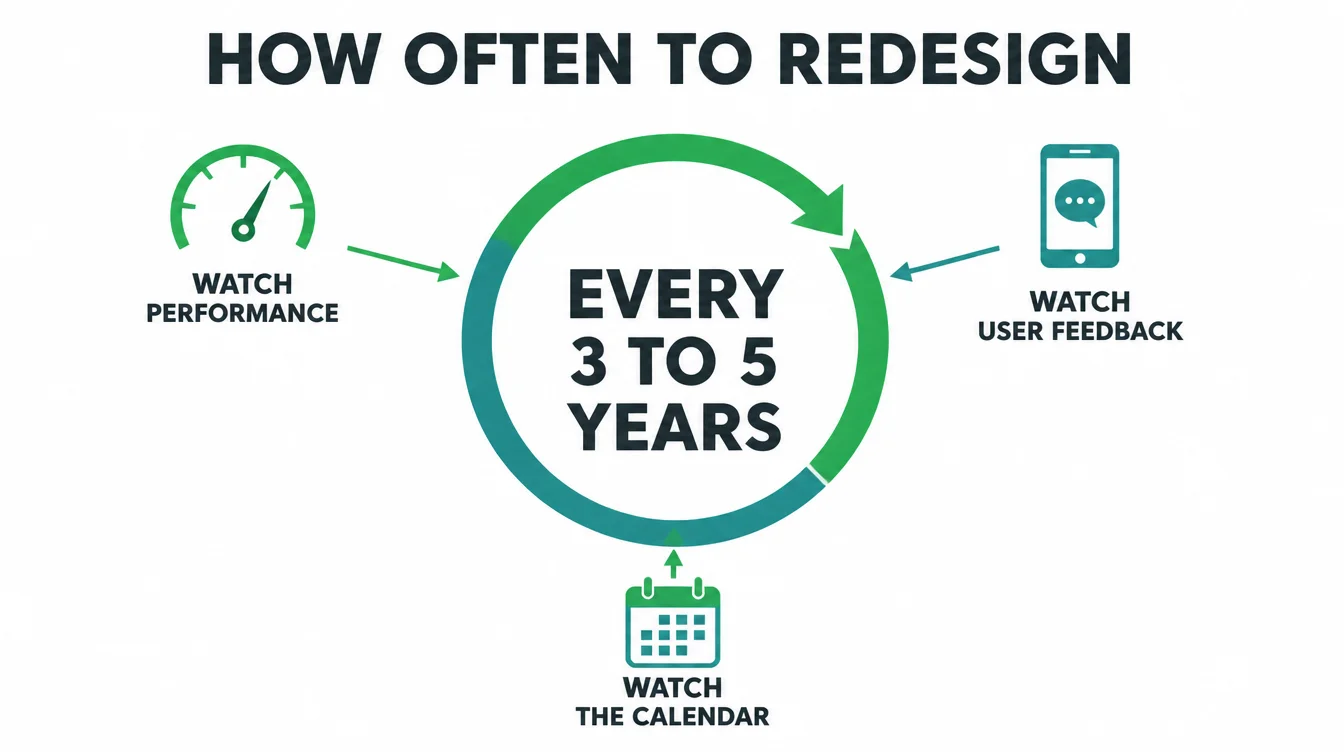
Let the numbers decide, not the calendar. Most sites reach a rebuild every three to five years, but the real trigger is measurable: slow pages on a phone, visitors who never contact you, or a design you cannot update without paying someone. A site that still performs does not need replacing because it is old.
2. Will a website redesign hurt my SEO rankings?
Only if the move is done carelessly. Keep the URLs that already rank, redirect anything that has to move with a 301, carry over the titles and descriptions, and check Search Console for the first month. Done properly a rebuild usually lifts rankings, because faster and more usable pages are what Google rewards.
3. How much does a website redesign cost?
It depends on how many pages move, whether the design is custom, and how much of the writing is being redone. A refresh of an existing structure costs far less than a rebuild with new pages and new features. You get an itemised quote after a short scoping call, so every line is visible before anything starts.