What Is Brand Strategy? Decide What Your Brand Stands For

A brand strategy is the long-term plan behind your brand: who you serve, what you stand for, how you sound, and how you want to be seen. It comes before a logo and it decides what you say yes and no to. Seed Light works through it with owners before any design starts.
Key takeaways
- Strategy is the plan, identity is the expression. Strategy decides why, who and how. Identity is how that looks and sounds.
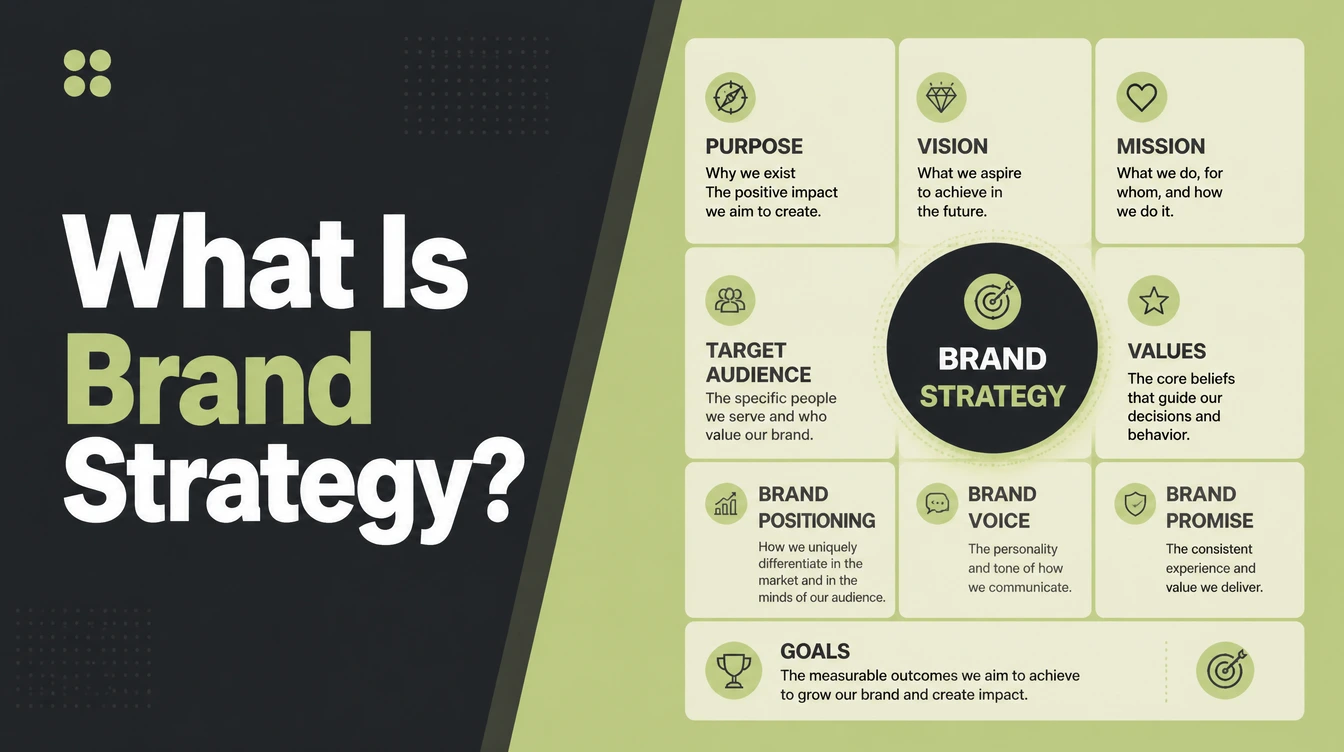
- It has six parts: purpose, audience, positioning, values, personality and messaging.
- Build it before the logo. A logo made before the strategy is just decoration.
- Write it down. A one-page strategy you actually use beats a fancy one nobody reads.
- Small businesses gain the most. It gives you focus and a way to stand apart, which is where your money is best spent.
1. What is a brand strategy?
Qualtrics describes brand strategy as the north star for "what you do, and just as importantly, what you don't do." It guides long-term choices about your purpose, message, voice and visual identity (Qualtrics).
In other words, it is the reasoning that should drive your logo, not the logo itself.
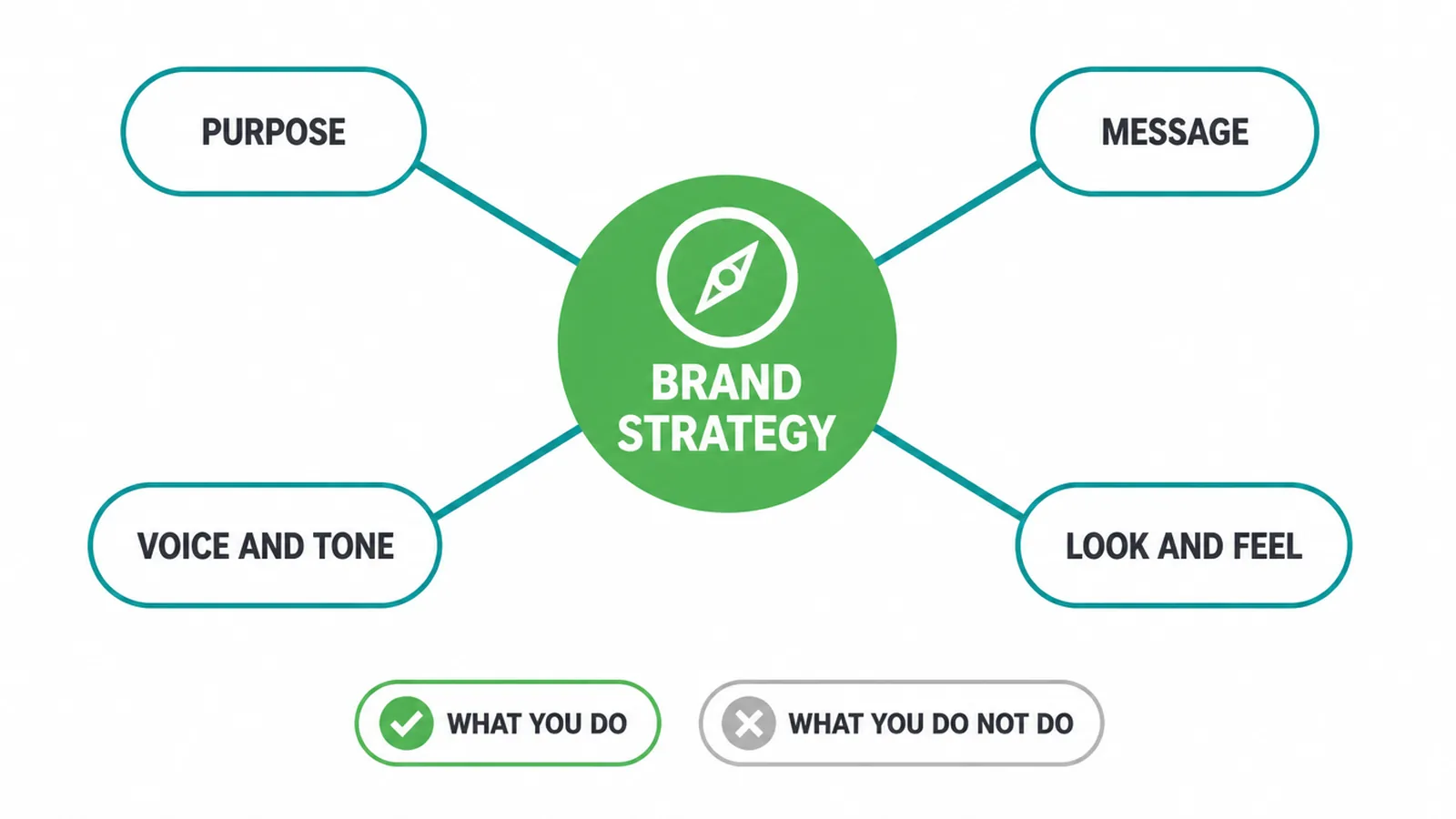
The useful way to think about it is as a north star. It helps you decide which choices fit the brand and which do not. That second half matters more than people expect.
A good strategy tells you which customers to chase and which to let go, which ideas to say yes to and which to skip. It is long-term and it is built around being consistent, so the same clear signal reaches people every time they run into you.
So a brand strategy is not a colour palette. It is not a tagline you liked. It is the set of choices underneath all of that. When those choices are clear, everything downstream gets easier and more consistent. When they are missing, you end up guessing, and your marketing pulls in six directions at once.
2. Brand strategy vs brand identity (the plan vs the look)
This is the split most owners miss, so let us make it plain. A clear brand strategy usually comes before identity work. Strategy defines the meaning: your positioning, your audience, what makes you different, and your message.
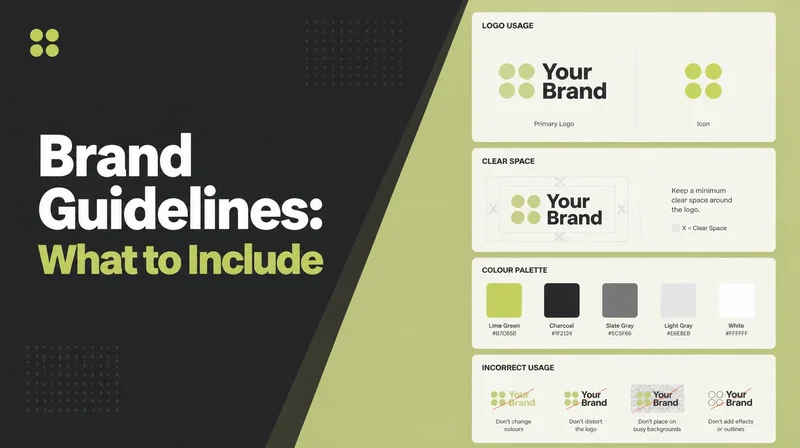
That is the why and the how. Identity expresses that meaning through your logo, colours, typography and tone. That is the what people see and hear, as Brightscout lays out.
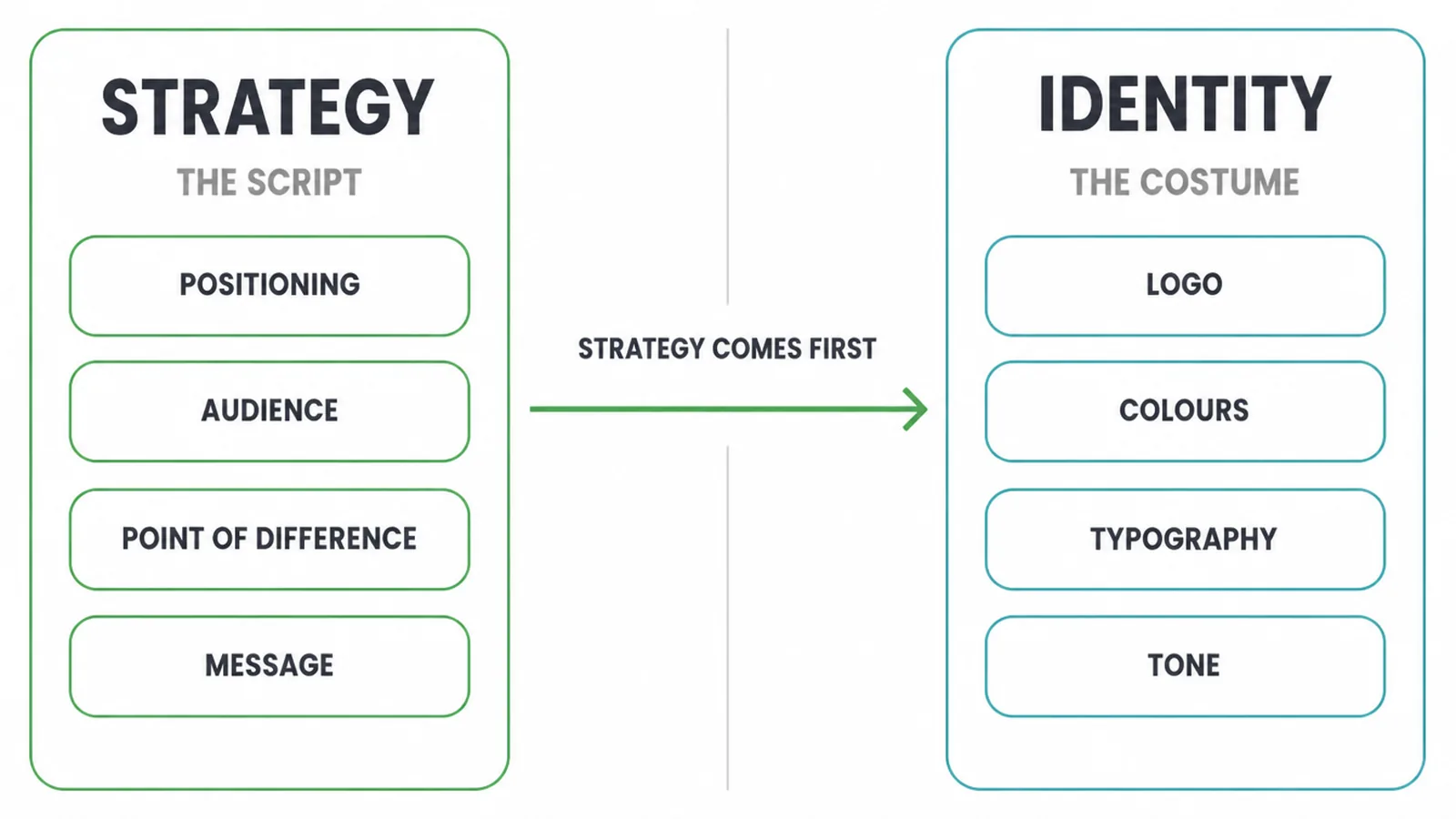
A quick analogy. Strategy is the script. Identity is the actor's costume and the way they deliver the lines. A great costume on top of a weak script still gives you a weak show. Get the script right first, and the costume finally has something real to dress up.
This is exactly why starting with a logo goes wrong. Without a strategy, a designer is guessing at a look for a brand that has not decided what it means.
Sort out the strategy, then let it steer every visual choice. If you want the full picture of the look-and-sound layer, our guide to brand identity picks up where this one leaves off.
3. Why a small business needs one
You might think brand strategy is a big-company luxury. It is the opposite. It matters more when you are small, because you have less money to waste and fewer chances to be remembered.
A clear strategy gives you focus. It helps you attract the right customers and spend your marketing budget more efficiently, which is a real edge for smaller businesses, as crowdspring points out about positioning.
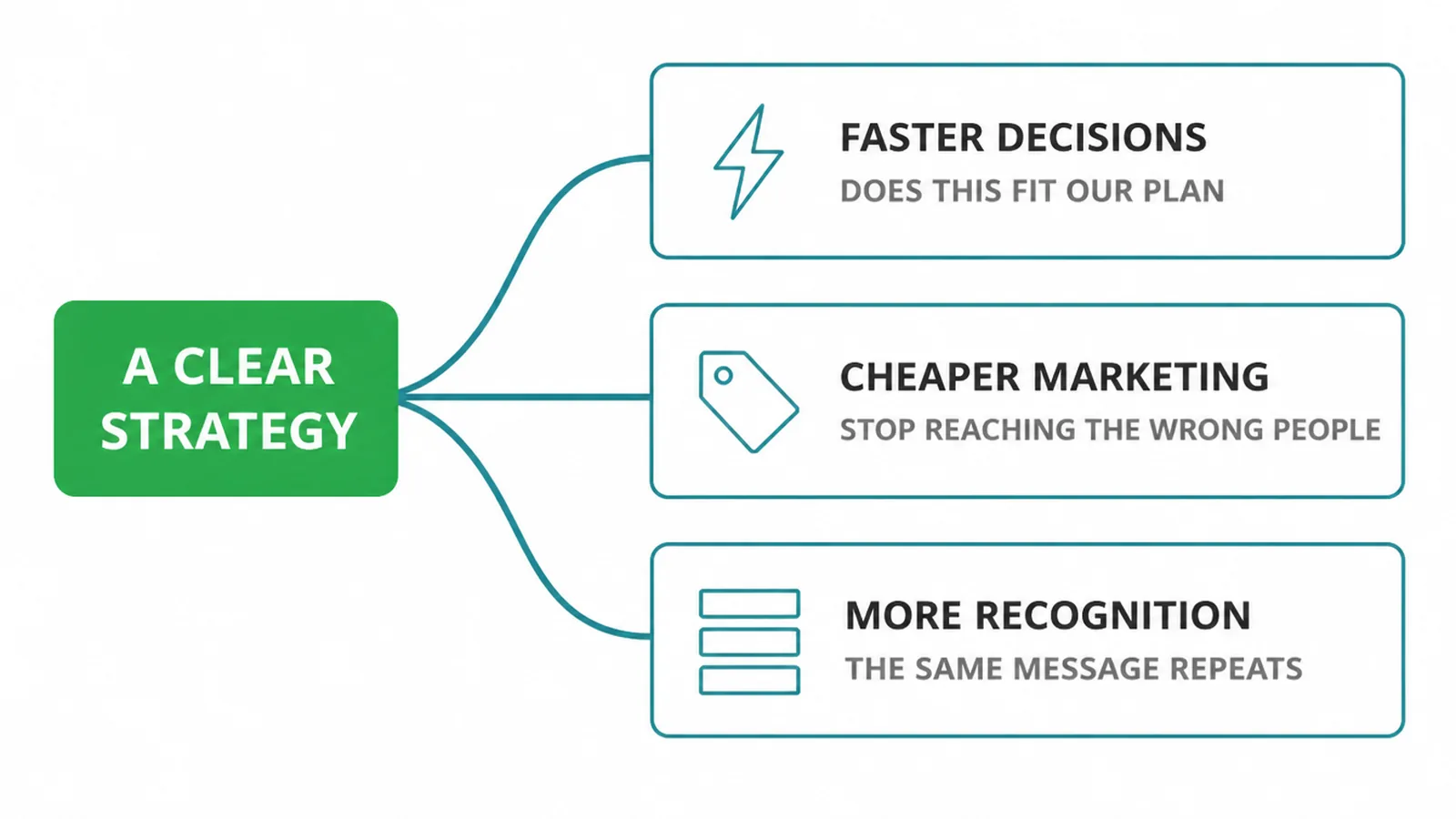
Here is what that looks like day to day. Decisions get faster, because you can ask "does this fit our strategy?" and get an honest yes or no.
Your marketing gets cheaper, because you stop paying to reach people who were never going to buy. And you start to build recognition, because the same clear message shows up again and again, so people remember you and slowly learn to trust you.
We will not pretend a strategy hands you a magic number. There is no honest single figure for "return on having a brand strategy", so ignore anyone who quotes one.
What it gives you is quieter and more durable: focus, difference and consistency. For the wider view of branding on a small budget, see our guide to small business branding.
4. The 6 components of a brand strategy
Most brand strategies cover six parts. The easiest way to build yours is to treat each one as a question your business has to answer honestly.
Answer all six and you have a real strategy, not a mood board. The table below is the spine of the whole thing. Read down the list, then work through the short notes underneath.
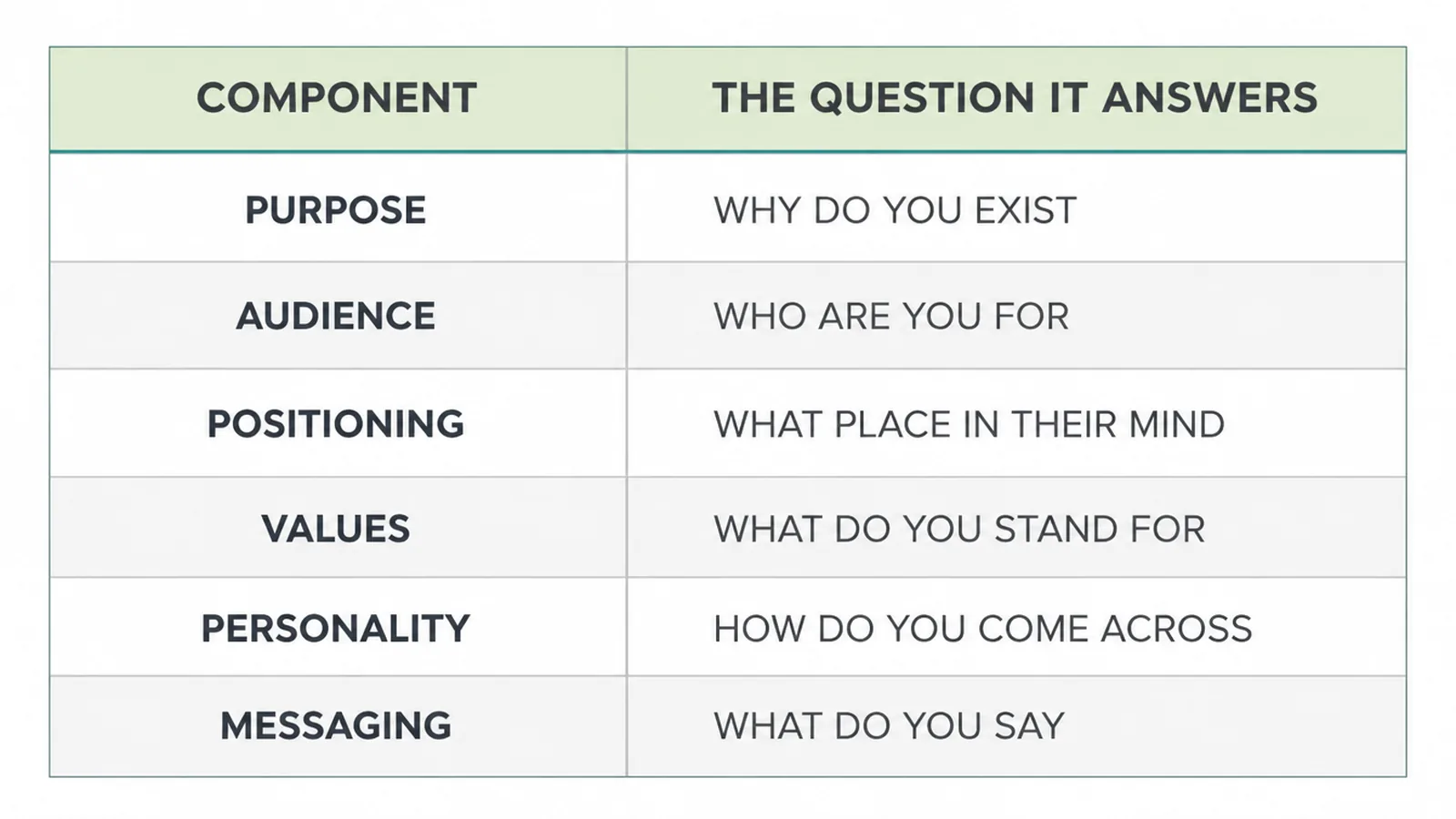
| Component | The question it answers |
|---|---|
| Purpose | Why do you exist, beyond making money? |
| Audience | Who exactly are you for (and not for)? |
| Positioning | What distinct place do you want in their mind? |
| Values | What do you believe and stand for? |
| Personality | How do you come across, if the brand were a person? |
| Messaging | What do you say, and how do you say it? |
Purpose
Purpose is the reason you exist, beyond the money, and Qualtrics puts it right at the heart of a strategy. It is the deeper "why" behind the work.
A clear purpose motivates the people who work with you and gives customers a reason to pick you over a cheaper option. Keep it true. A purpose you invented for a poster will not survive contact with real customers.
Audience
Audience is about getting specific on who you serve. Not "everyone", not "small businesses", but the real people you are best placed to help.
Just as useful is knowing who you are not for, because saying no to the wrong customer frees you to be brilliant for the right one. Your audience is the ground everything else is built on, so be honest here.
Positioning
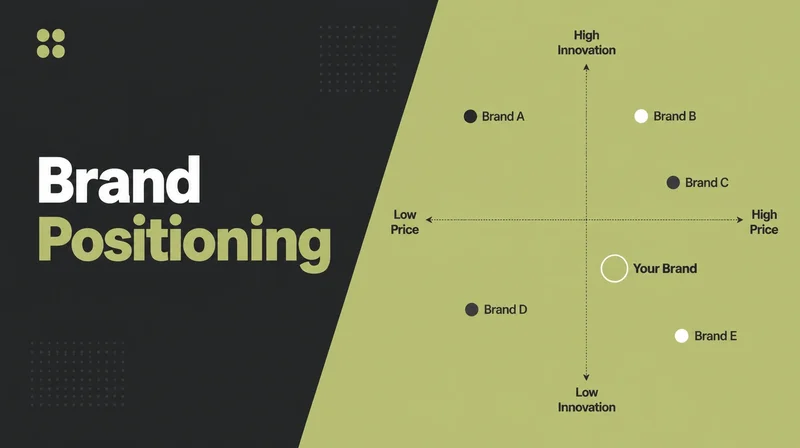
Positioning is about the mind of your customer. The goal is to make your brand occupy a distinct place, next to the competing brands, in their head, as Wikipedia explains. The idea was popularised by Al Ries and Jack Trout, whose classic book "Positioning: The Battle for Your Mind" came out in 1981.
Strong positioning is built on your target audience, the competitive context, your point of difference and the value you offer, per crowdspring. This is a big topic, so we gave it its own home. Read our deep dive on brand positioning for the full method and a statement template.
Values
Values are what you believe and stand for. Keep them real and keep them few. A wall of buzzwords that nobody in your business actually lives by is worse than nothing, because it makes you look hollow.
Pick a small handful of things you would defend even when it costs you, and let those guide how you hire, serve and behave.
Personality
Personality is the human character of your brand. If your brand were a person, how would it come across? Warm and plain? Bold and playful? Calm and expert?
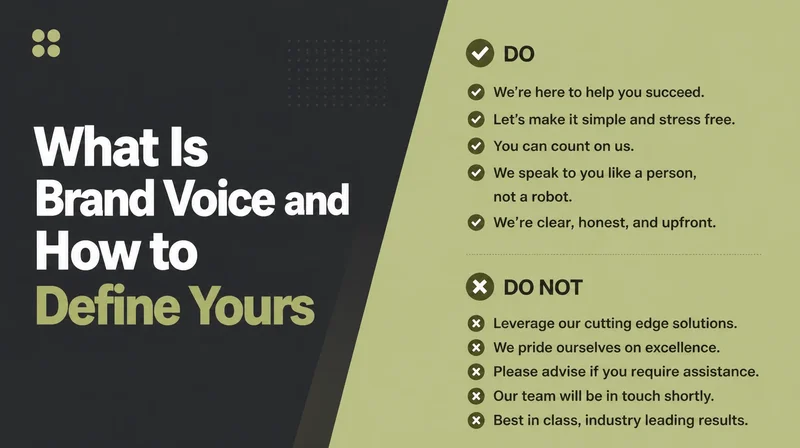
This is the choice that drives your tone and voice later. You do not need to nail every word here, just the character. The wording layer can be worked out once the personality is set.
Messaging
Messaging is what you actually say, and how you say it, phrased for the audience you chose. It is your core message plus the proof points that back it up.
Think of it as the bridge from strategy into real copy and campaigns. Once your message is clear, writing a homepage, an email or an ad stops being a blank-page guess, because the strategy already told you what to lead with.
5. How to build your brand strategy (step by step)
Here is a simple order you can actually run, even solo. You do not need a big budget to make a start.
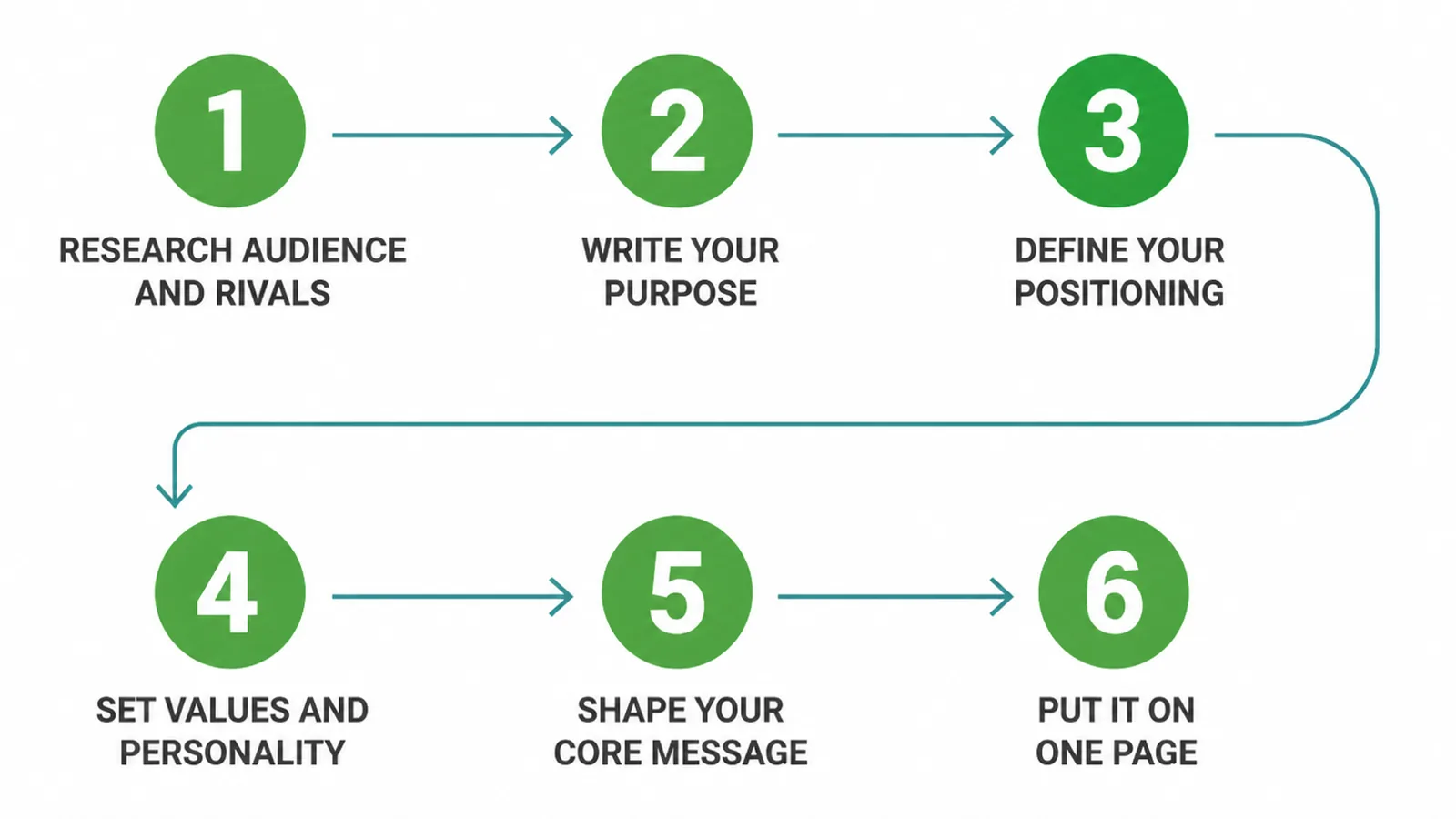
- Research your audience and competitors. Talk to real customers. Read reviews. Look at how rivals describe themselves. You are hunting for gaps and for the words your customers use.
- Write your purpose. One honest sentence on why you exist beyond the money.
- Define your positioning. Own one clear idea in the customer's mind, built on your audience, your rivals, and your point of difference. Our brand positioning guide has a template if you want a frame to fill in.
- Set your values and personality. A few real values, and a clear character.
- Shape your core message. The one thing you want people to remember, plus a couple of proof points.
- Put it on one page and pressure-test it. Hold it against real decisions. Would it help you choose a customer, turn down a project, or brief a designer? If not, sharpen it.
The whole thing only works if it is written down and used. A strategy that lives in your head quietly drifts. Once the plan is clear, build your identity on top of it, the logo, the colours, the voice, all steered by the strategy rather than picked on a whim.
If you would rather have a team run this with you and build the identity on top, that is exactly what our branding service does.
6. Common brand strategy mistakes to avoid
A few traps catch owners again and again. Watch for these.
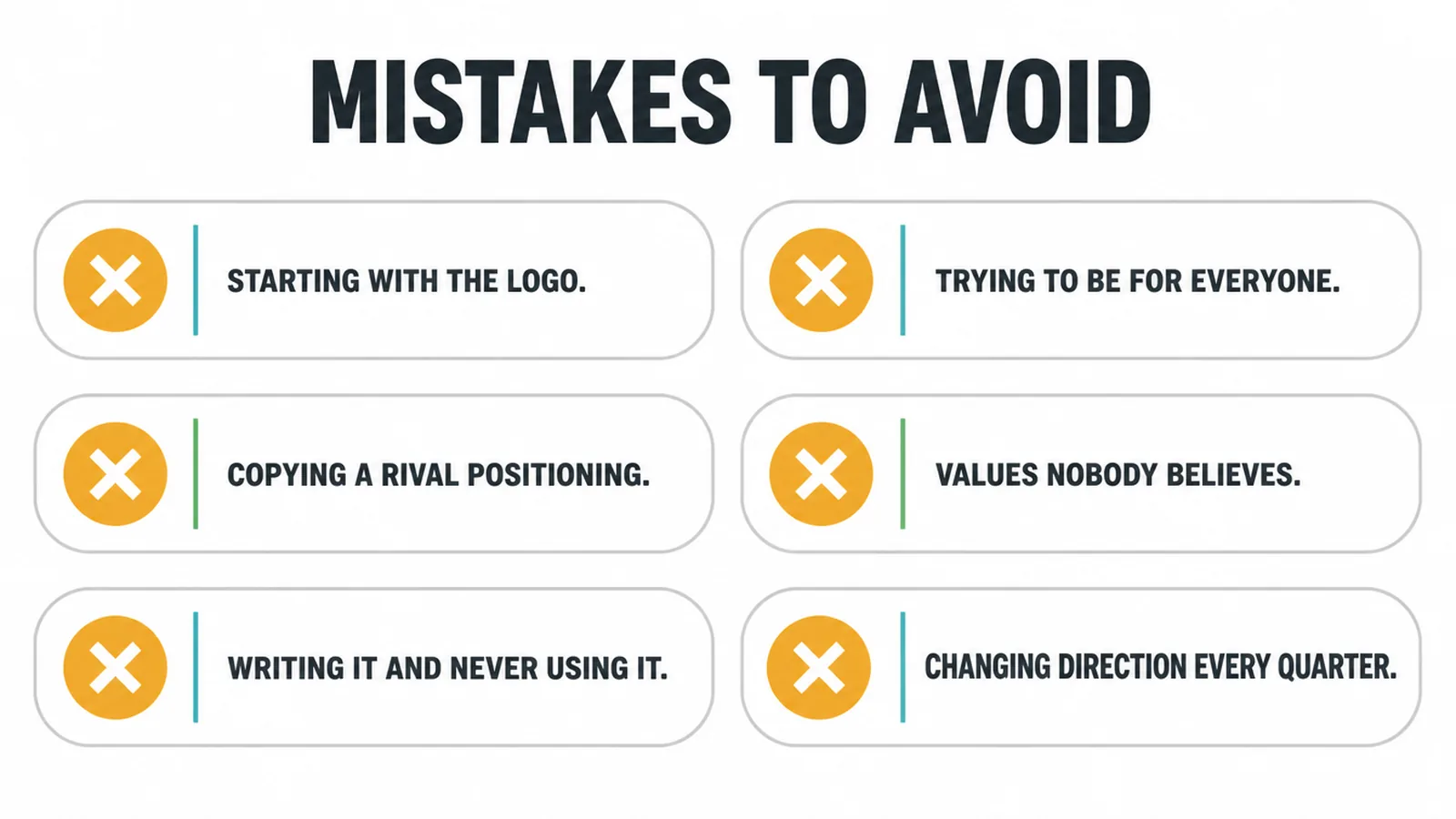
- Starting with the logo. The look should express the plan, not replace it.
- Trying to be for everyone. When you speak to everyone, you land with no one. Choose.
- Copying a rival's positioning. Their place in the mind is taken. Find your own.
- Values nobody believes. A list you do not live by reads as fake. Fewer, truer, better.
- Writing it once and never using it. A strategy in a drawer changes nothing. Keep it in front of you.
- Changing direction every quarter. Recognition needs repetition. Give it time to stick before you rip it up.
Frequently asked questions
1. What is a brand strategy in simple terms?
It is the plan behind your brand. It sets out who you are for, what you stand for, and how you want to be seen, before you design a single logo. Every later choice, from colours to ad copy, should trace back to it.
2. What is the difference between brand strategy and brand identity?
Strategy is the thinking (your purpose, audience, positioning, values, personality and message). Identity is how that thinking looks and sounds (logo, colours, type, voice). Strategy comes first and identity expresses it.
3. What are the main parts of a brand strategy?
Most strategies cover purpose, target audience, positioning, values, personality and messaging. Together they answer why you exist, who you serve, what makes you different, what you believe, how you come across and what you say.
4. Does a small business really need a brand strategy?
Yes, and it matters more when you are small. It gives you focus, helps you attract the right customers, and stops you wasting money on marketing that pulls in different directions.
5. Do I need to hire an agency to build one?
No. You can draft a solid one-page strategy yourself by answering the core questions honestly. An agency or specialist helps when you want outside perspective, research, or a full identity built on top of it.
6. How long does it take to create a brand strategy?
A simple, usable version can take a few focused sessions. A deeper one with customer research and competitor study takes longer. Start small, write it down, and refine it as you learn.
7. What comes first, the strategy or the logo?
The strategy. A logo made before the strategy is just decoration. When the strategy is clear, the logo and everything else have something real to express.
8. How do I know my brand strategy is working?
Watch whether the right people notice you, remember you, and describe you the way you intended. If customers echo your positioning back to you in their own words, it is landing.
See our branding service if you want help setting the direction.