What Is Brand Voice and How to Define Yours

Brand voice is the personality your business shows in words, steady across every page, email and reply. Tone flexes with the situation while voice stays the same. Define it with a few dimensions, a short do and don't word list, and real examples people can copy. Seed Light sets brand voice with clients and writes to it.
Key takeaways
- Brand voice is your personality in words. It is how you sound when you talk, and it shows up in every sentence you write.
- Voice is constant, tone flexes. Your voice stays the same everywhere. Tone is the mood you apply to it for the moment.
- Four dimensions make it measurable. Nielsen Norman Group maps voice on four sliders: formal to casual, serious to funny, respectful to irreverent, matter-of-fact to enthusiastic.
- Trust beats jokes. NN/g testing found about 52% of how desirable a site feels comes from how trustworthy it seems.
- Write it down. A short one-page guide keeps your voice steady across your website, email, social and support.
Brand voice is the personality your brand shows in its words. It is how you sound when you talk, the same way a person has a steady character. The cleanest way to think about it is simple: voice is constant, tone flexes.
Your voice is your fixed personality. Tone is the mood you apply to that voice for a moment, calm for an apology, upbeat for a launch.
In this guide you get a plain framework you can copy: four sliders to place your brand on, do and don't word lists to keep everyone on track, and the research on why it matters.
1. What is brand voice?
Brand voice is your personality expressed in words. Think of a friend who always sounds like themselves, whether they are texting you or telling a story at dinner. Your brand should feel the same.
Nielsen Norman Group defines tone of voice as "the way we tell our users how we feel about our message" (NN/g). That feeling is what people pick up on.
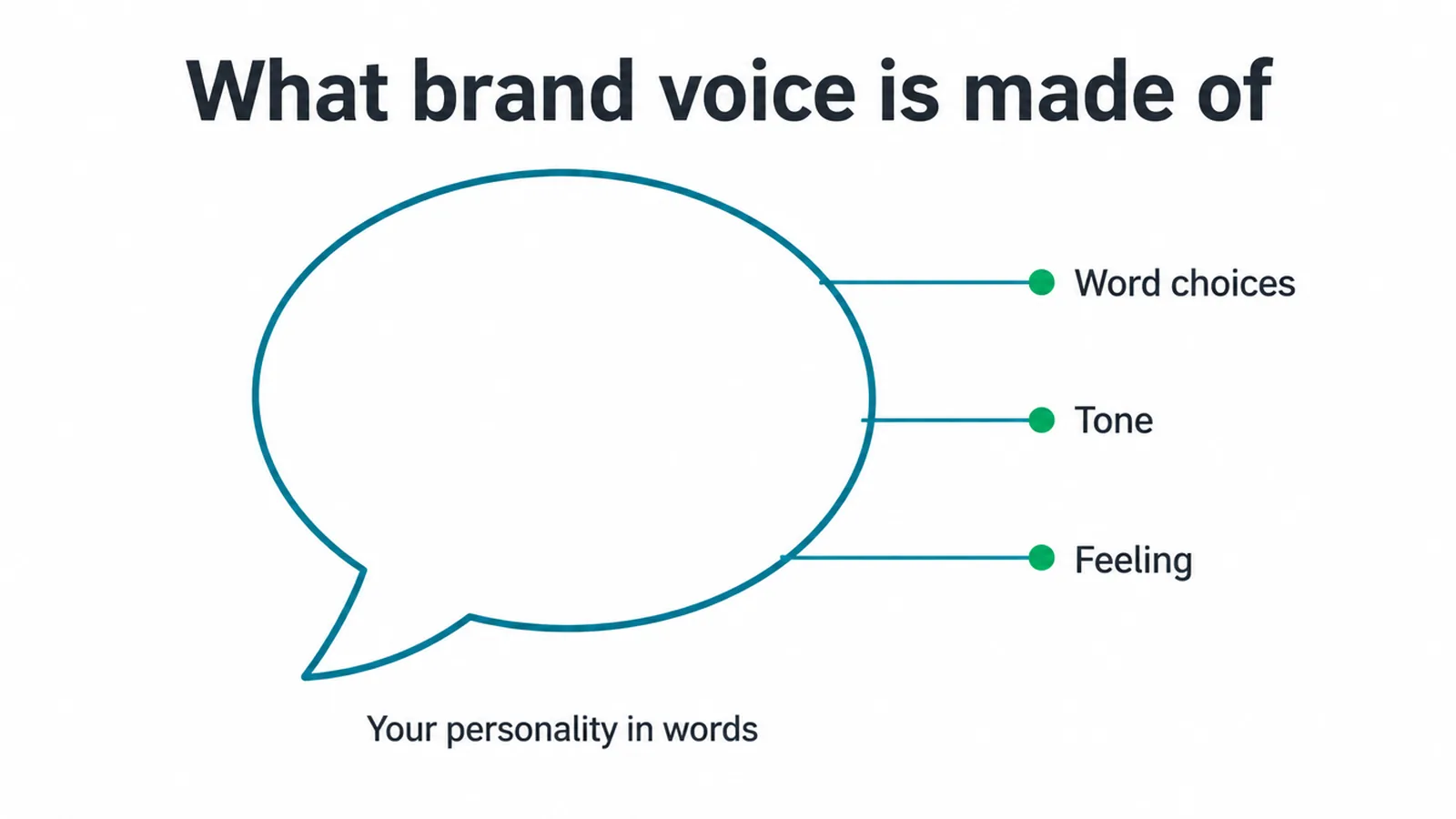
Voice lives in every button, every email subject line, every reply to a support ticket. If one page sounds warm and human and the next sounds like a legal contract, people notice, even if they cannot say why.
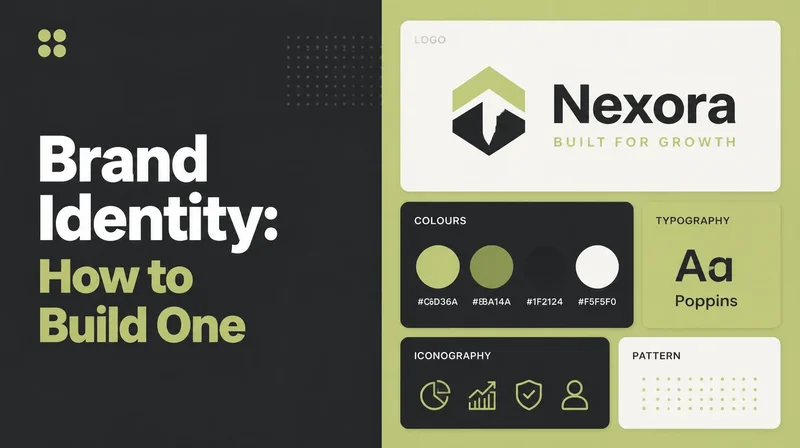
Voice is also part of a bigger picture. It sits inside your whole brand identity, next to your logo, colours and type. The look and the words should feel like they came from the same place.
2. Brand voice vs tone: the key difference
Here is the distinction that clears up most of the confusion. Voice is constant. Tone flexes. Picture a person. Their character does not change from Monday to Friday, but their mood does. They are upbeat at a party and gentle at a hospital. That steady character is voice. The shifting mood is tone.
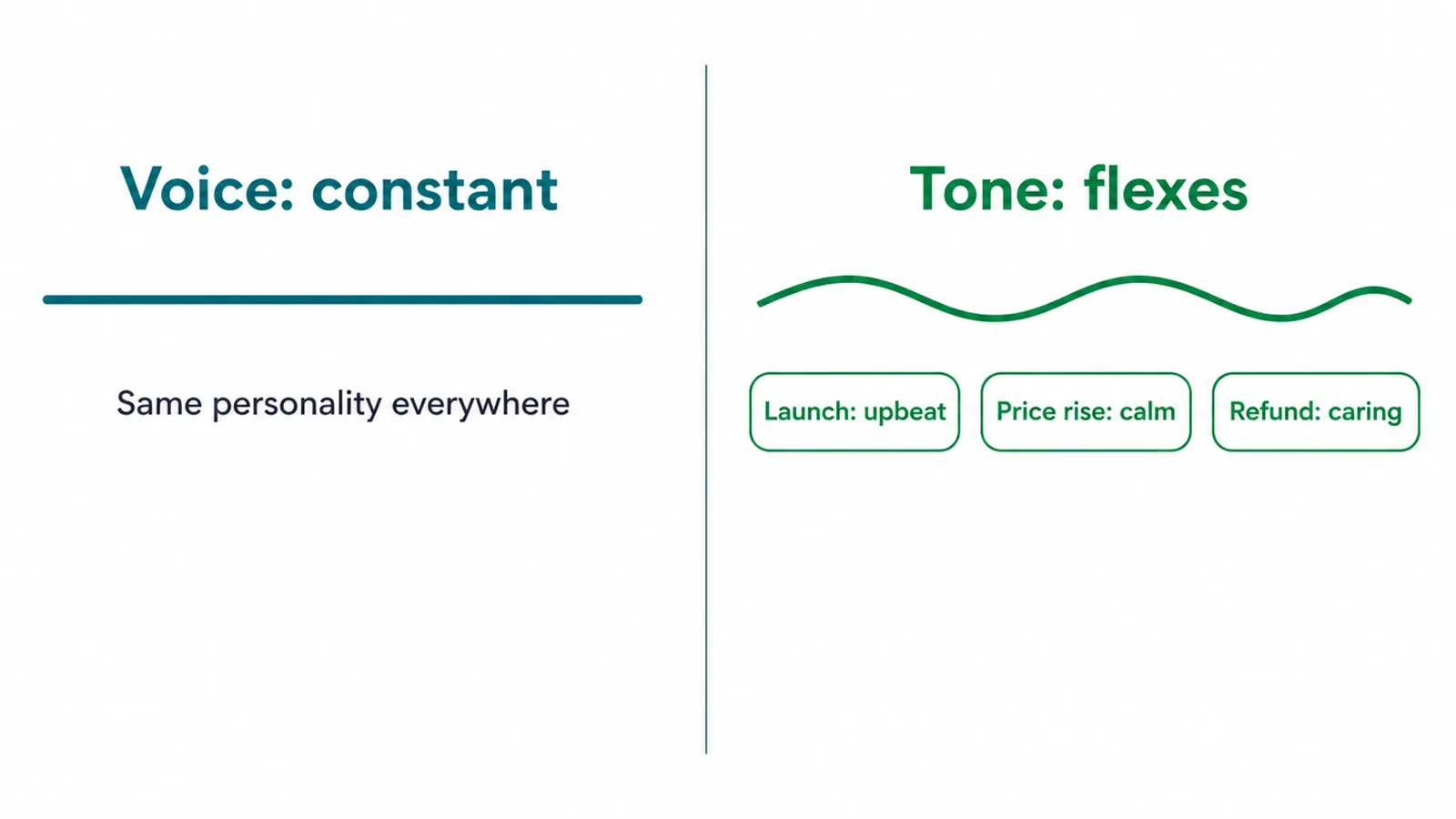
Your brand works the same way. Say your voice is warm, plain and confident. That stays fixed. But the tone you write in should move with the moment.
A product launch calls for energy. A price rise calls for honesty and calm. A refund reply calls for care. Same voice, different tone. Look at one message in two tones:
- Launch tone: "It is here. The thing you asked for, finally ready. Go take a look."
- Apology tone: "We got that wrong, and we are sorry. Here is exactly how we are fixing it."
Both sound like the same brand. Both are warm, plain and direct. Only the mood shifted to fit what the reader is feeling. Your voice should grow out of your wider brand strategy, so it is not a random style choice but a true reflection of who you are and who you serve.
3. The four dimensions of brand voice
You do not have to guess at your voice or argue about it. Nielsen Norman Group breaks tone of voice into four measurable dimensions: formal versus casual, serious versus funny, respectful versus irreverent, and matter-of-fact versus enthusiastic (NN/g).
Each one works as a scale with a neutral middle, so you place your brand somewhere along it rather than picking an extreme.
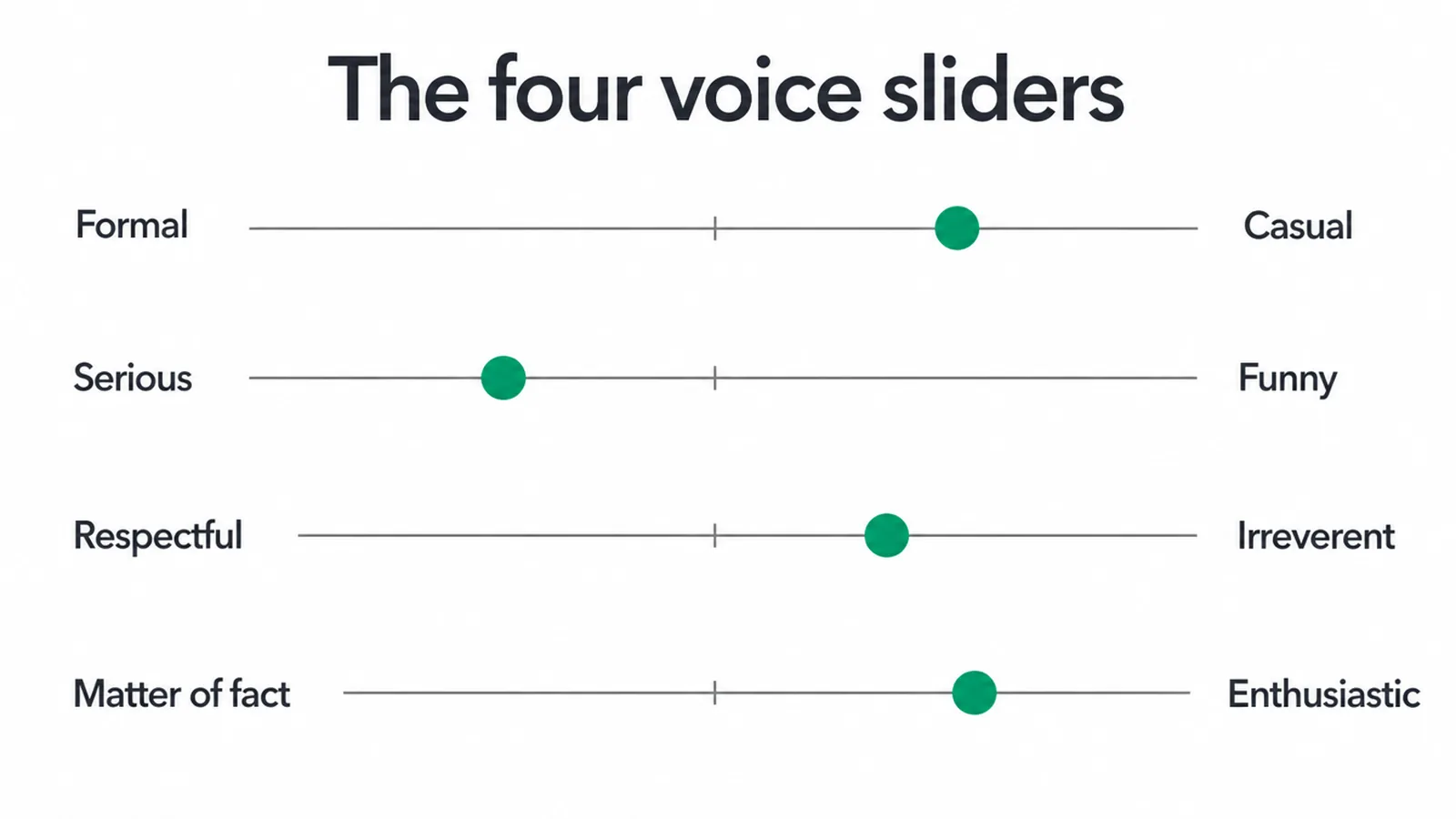
The evidence behind the four sliders
In a 50-person NN/g survey, variations along the four sliders produced statistically significant differences (p less than 0.05) in how people judged sites, suggesting that word choice can shift impressions.
Mark your point on each slider
Sit down and mark your point on each slider. Are you casual or formal? Serious or light? Plain-spoken or a bit playful? Matter-of-fact or full of energy? Write those four points down and you have the skeleton of your voice. Then turn it into do and don't guidance, like this:
| Trait | Do | Don't |
|---|---|---|
| Casual, not formal | Write the way you talk, use short everyday words | Reach for stiff corporate phrasing |
| Warm, not cold | Speak straight to "you" and sound human | Hide behind "we are pleased to inform you" |
| Clear, not clever | Say the thing plainly, one idea per line | Bury the point in jargon or hype |
| Confident, not loud | State facts and show proof | Shout, over-promise or use all caps |
| Lightly upbeat, not zany | Add a little warmth and energy | Force jokes where trust matters |
4. Does voice actually matter? What the research says
Yes, and the numbers back it up. Nielsen Norman Group found that trust drives desirability: about 52% of the variability in how desirable a site felt was explained by how trustworthy it seemed, with friendliness adding only about 8% more (NN/g). So sounding likeable helps, but earning trust matters far more.
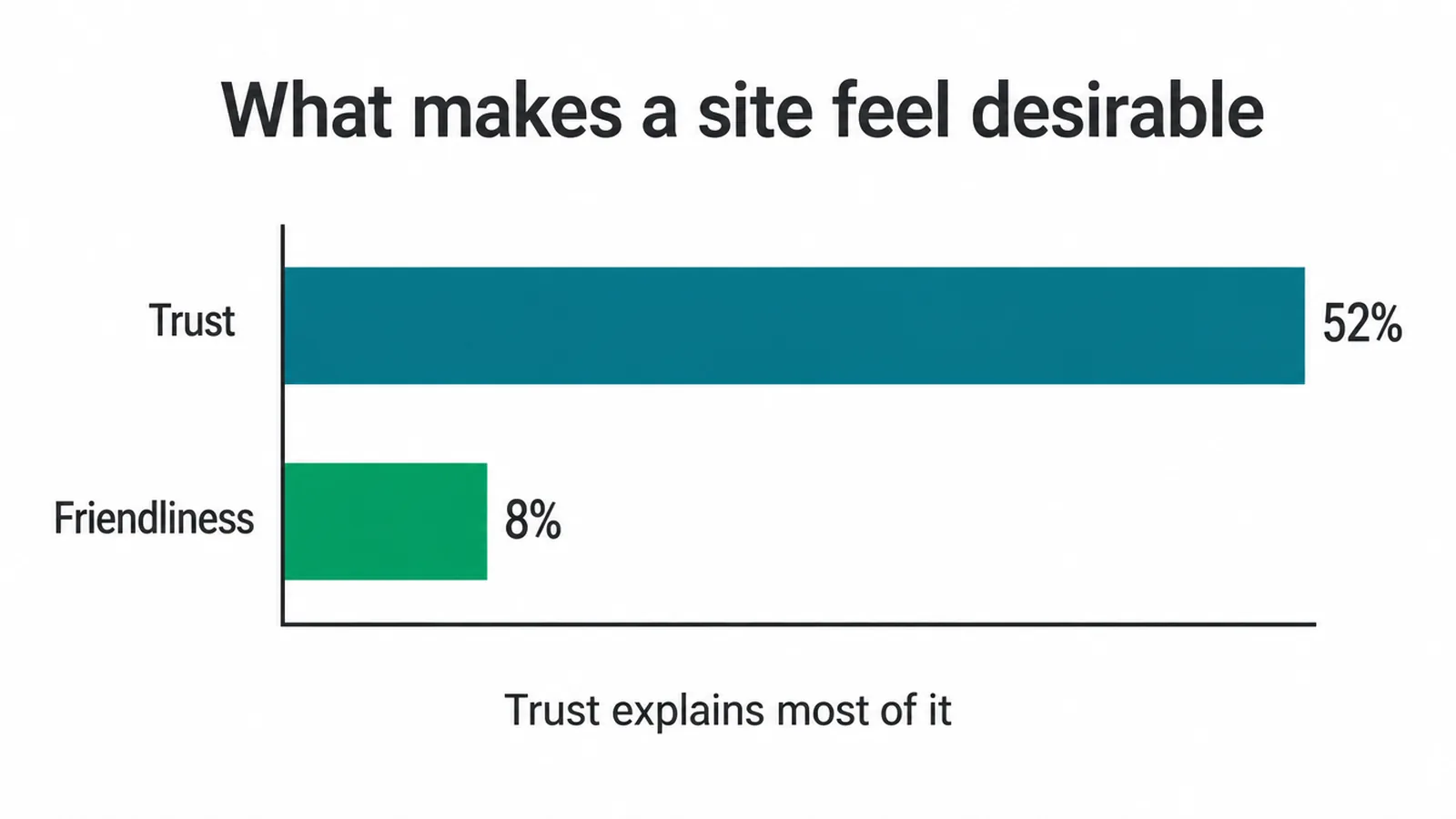
That same research found casual, conversational, and moderately enthusiastic tones generally performed best, and even formal industries benefit from more approachable language.
When humour backfires
But there is a real warning here. In a serious context, an insurance site, being friendly and irreverent actually undermined how trustworthy and professional the brand seemed. So do not be funny for the sake of funny. NN/g advises choosing tone by thinking about your readers' concerns and their emotional state.
The takeaway is plain: sound human, but earn trust first, and match the mood to what your reader is going through.
5. How to define your brand voice, step by step
You can build a working voice in an afternoon. You do not need a big workshop or a fat document. Follow these five steps and you will have something real you can use tomorrow.
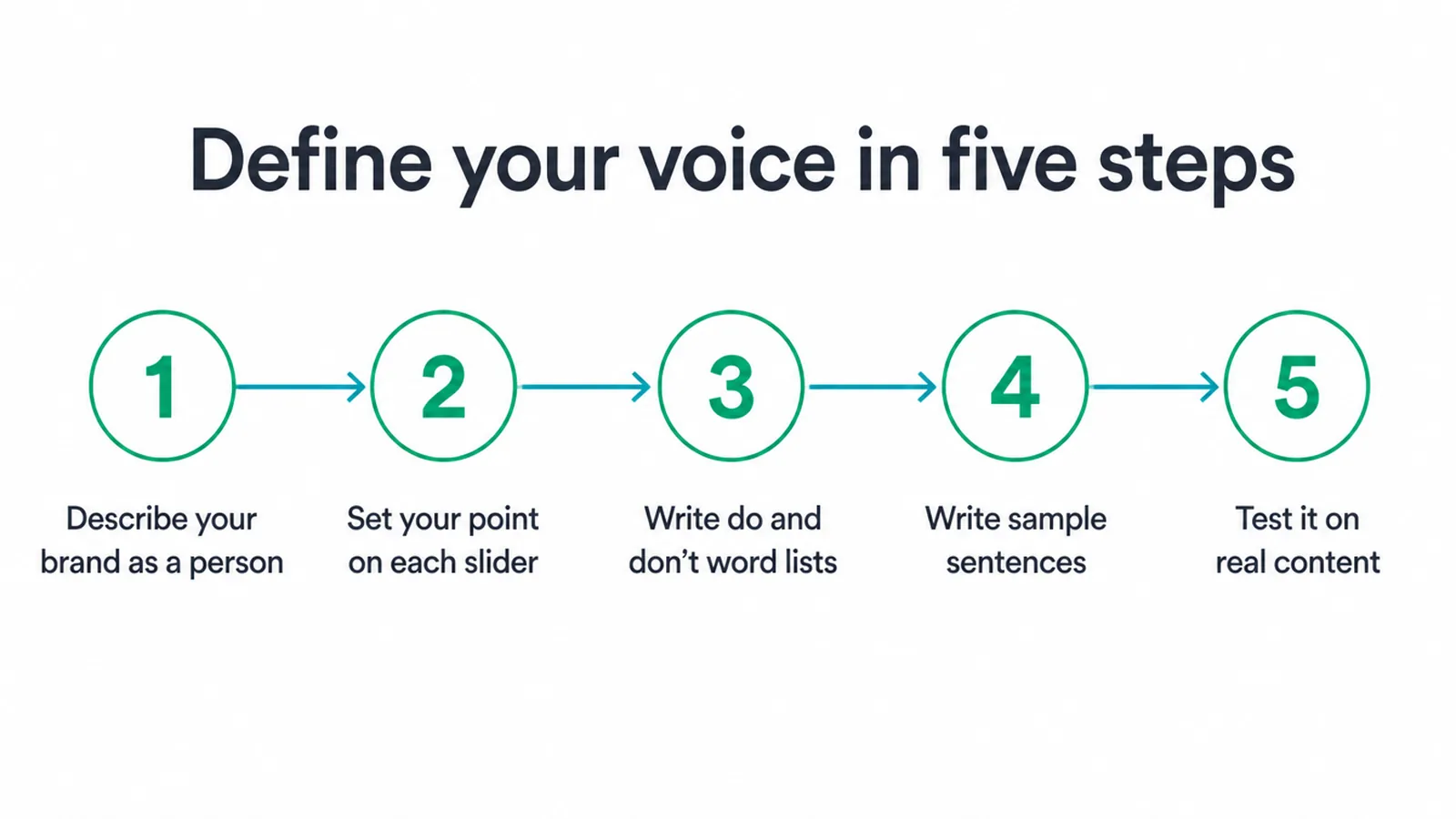
- Describe your brand as a person. Pick three adjectives. Is it the calm expert? The friendly guide? The straight-talking pro? Three words is enough to start.
- Set your point on each slider. Use the four dimensions above. Mark where you sit on formal to casual, serious to funny, respectful to irreverent, matter-of-fact to enthusiastic.
- Write do and don't word lists. List the words you use and the words you avoid. Words are testable in a way adjectives never are.
- Write two or three sample sentences. Show your voice in action. A hero line, a button, a support reply. These become the model everyone copies.
- Test it on real content. Rewrite an existing page in your new voice. If it reads better and sounds like you, you have it.
If you would rather have a team shape this with you, our branding work covers voice alongside the visual side, so the words and the look match from day one.
6. Do and don't word lists
Word lists are the most useful thing you can hand a writer. Adjectives like "friendly" or "professional" are vague, and two people will read them two different ways.
Actual words are not vague. You can point at them and check any sentence against them. That is why a short list beats a long description every time.
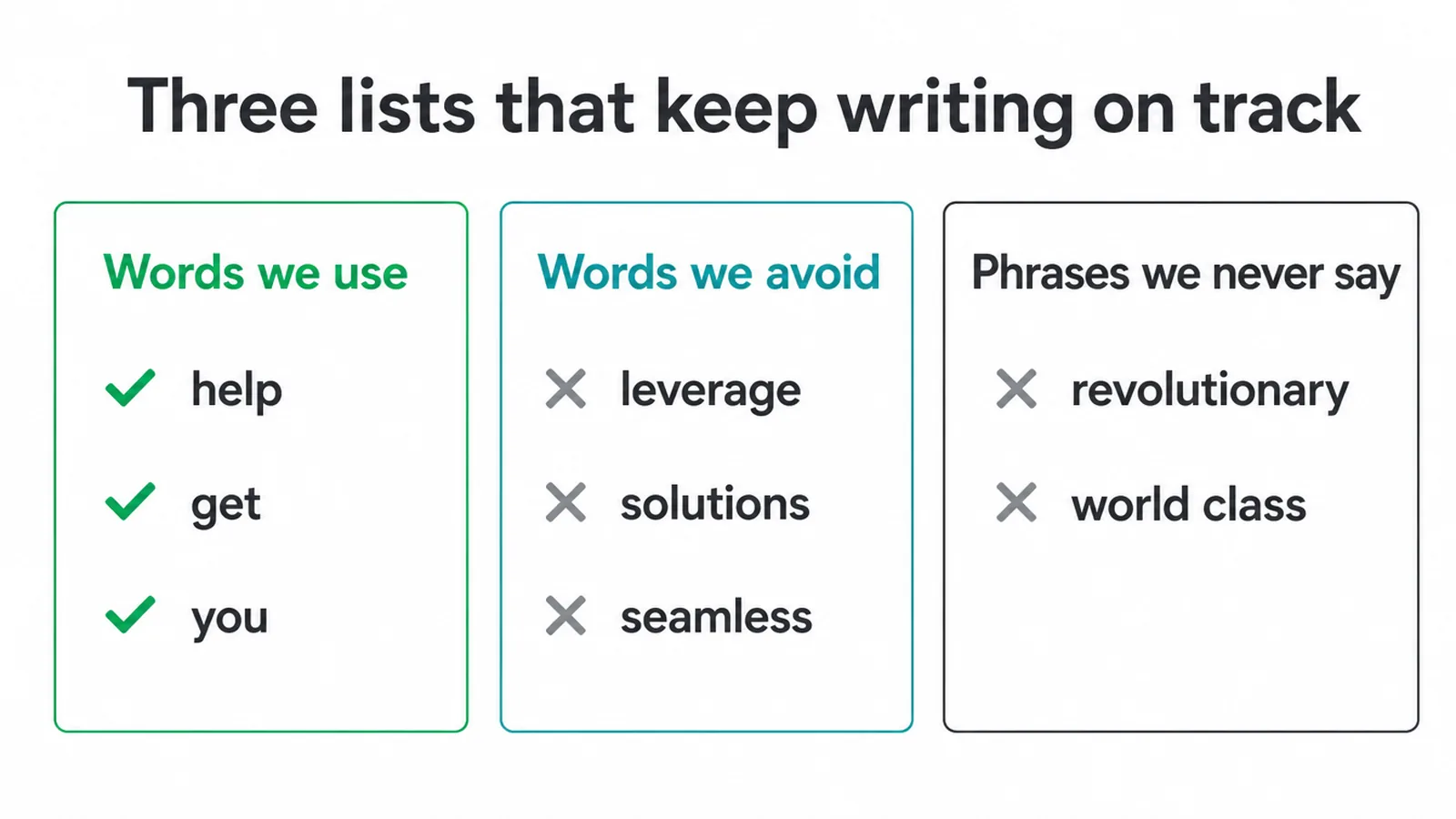
Three simple parts
Keep it to three simple parts.
- Words we use: the everyday, plain-English words that sound like your brand.
- Words we avoid: the corporate filler and jargon that make you sound like everyone else.
- Phrases we never say: the clichés and over-promises that quietly kill trust.
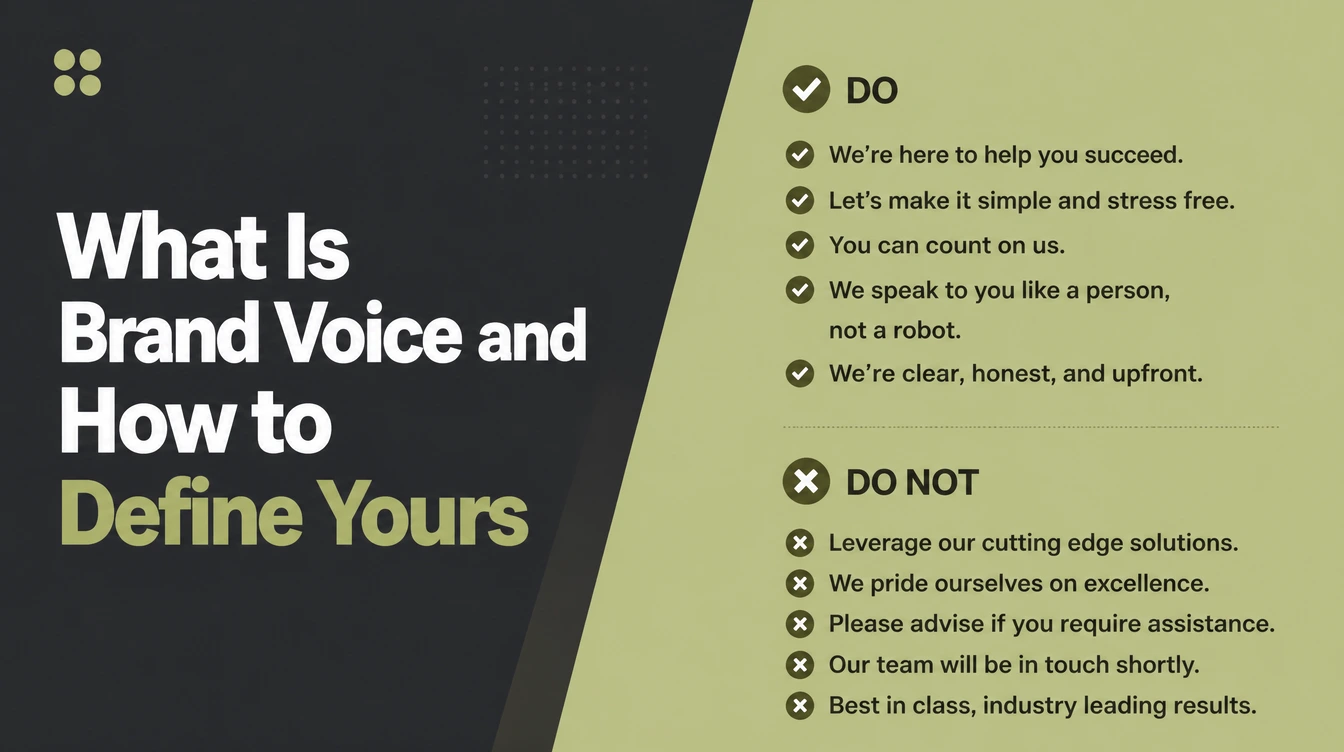
For example, a plain-spoken brand might use "help" and "get" and "you", avoid "leverage" and "solutions" and "seamless", and never say "revolutionary" or "world-class".
Pick a spelling standard and stick to it
One note on style: British spelling is fine if that is your voice. "Colour" and "organise" are only wrong if they clash with the rest of your brand. Pick a spelling standard and stick to it, so the brand reads as one voice everywhere.
7. Keeping your voice consistent across channels
Your website, email, social posts, ads and support replies all need to sound like one brand. This is where voice earns its keep.
NN/g's survey linked trust with how desirable a site felt. A voice that changes on every channel can weaken that impression, so keep the voice steady while the tone adapts to fit the channel.
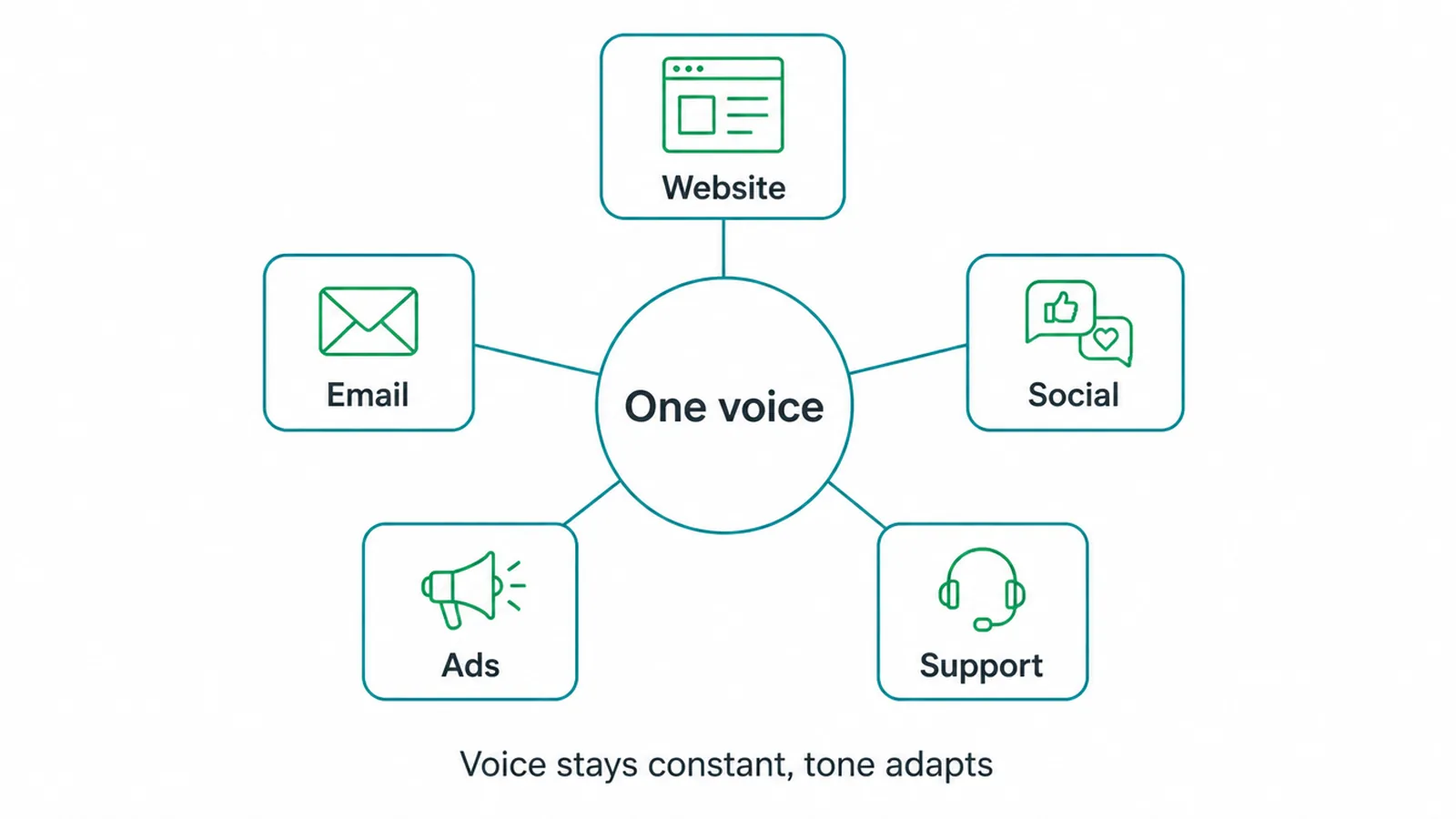
What does that look like in practice? On social you might be a touch more playful. In a support reply you slow down and get more careful. In an ad you get punchy. But the underlying personality, the plain words, the warmth, the way you speak to "you", never moves.
Email is where a lot of brands drift, because different people write it at different times. Our guide to email marketing for small business shows how to carry your voice into every message without it going flat or generic.
One page is enough
You do not need a giant style manual to pull this off. A single page is plenty to start: your four sliders, your do and don't word lists, and a handful of sample sentences.
Everyone who writes for you reads that page and follows it. That is how a brand ends up sounding like one person instead of a committee.
Want a hand shaping a voice that holds up across every channel? Tell us about your brand and we will help you define it.
8. Common brand voice mistakes
Most voice problems come down to a few repeat offenders. Spot them early and you save yourself a lot of rewrites.
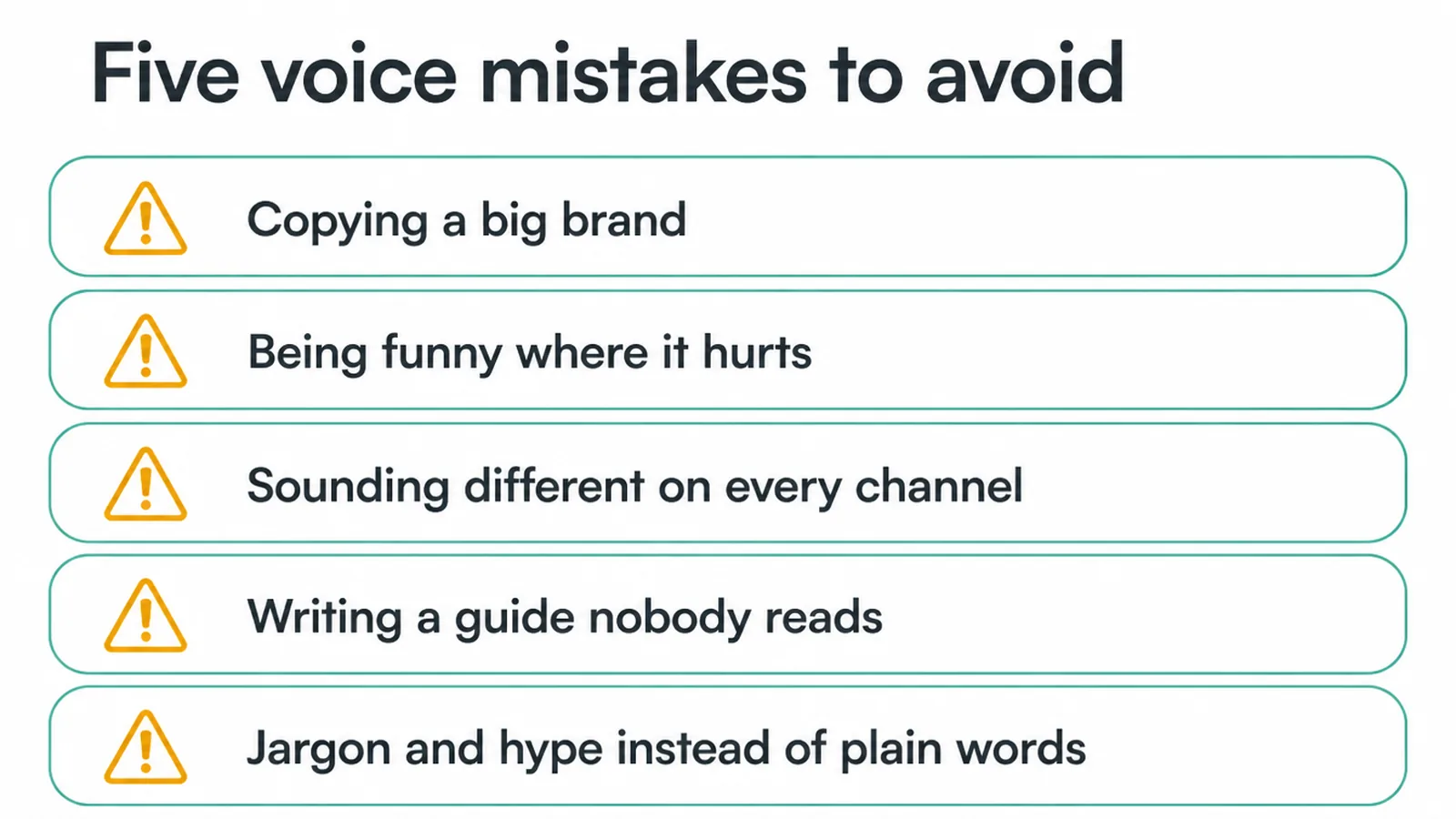
- Copying a big brand. A voice that fits a global giant will feel fake coming from you. Build one that fits your own personality and your own customers.
- Being funny where it hurts. As the NN/g research showed, humour can lower trust in serious moments. Read the room before you crack a joke.
- Sounding different on every channel. A warm website and a cold, robotic email break the spell. Keep the voice steady, flex only the tone.
- Writing a guide nobody reads. A 40-page voice bible gathers dust. One clear page beats a document nobody opens.
- Jargon and hype instead of plain words. "Leverage synergies" says nothing. Plain, honest words win more trust than big claims.
FAQ
1. What is brand voice?
Brand voice is the personality your brand shows in its words. It is how you sound when you talk, the same way a person has a steady character. It covers your tone, your word choices, and the feeling your writing gives off across your website, emails, and social posts.
2. What is the difference between brand voice and tone?
Voice is constant and tone flexes. Voice is your fixed personality. Tone is the mood you apply to that voice for a moment. Your voice stays the same in a launch post and an apology, but the tone shifts from upbeat to calm and caring.
3. How do I define my brand voice?
Start with your brand personality, then place yourself on a few sliders. Nielsen Norman Group uses four: formal to casual, serious to funny, respectful to irreverent, and matter-of-fact to enthusiastic. Pick a point on each, write a short do and don't word list, and save two or three sample sentences.
4. What are the four dimensions of tone of voice?
Nielsen Norman Group lists formal versus casual, serious versus funny, respectful versus irreverent, and matter-of-fact versus enthusiastic. Each one is a scale with a neutral middle, so you can place your brand anywhere along it rather than picking one extreme.
5. Does brand voice really affect trust?
Yes. In a 50-person Nielsen Norman Group survey, tone changed how people judged sites, and trust had the strongest relationship with desirability. The small sample means the result should be read as evidence from one test, not a universal rule.
6. Should my brand voice be funny?
Only if it fits. Nielsen Norman Group found casual, conversational tones generally work well, but humour can backfire. In a serious context like insurance, being funny and irreverent actually lowered how trustworthy and professional the brand seemed. Match the tone to what your reader is feeling.
7. How do I keep brand voice consistent across channels?
Write it down and share it. Put your voice sliders, do and don't word lists, and example sentences in a short one-page guide. Everyone who writes for you, on the website, email, social, or support, follows the same guide, so the brand sounds like one person everywhere.
8. Is brand voice the same as brand identity?
No, but they work together. Brand identity is the whole visible and verbal system, including your logo, colours, type, and voice. Brand voice is the verbal part: how you sound in words. Voice sits inside identity and should match the look and feel of everything else.