
Key takeaways
- Two jobs, not one. You reduce cart abandonment by removing the reasons people leave, then winning back the ones who still go.
- Most carts are lost, but not all. The documented average abandonment rate is 70.22 percent across 50 studies (Baymard).
- Surprise costs are the number one killer. Show shipping, tax and fees early, not on the final step.
- Browsing is one reason carts get left. About 42 percent of US online shoppers have abandoned a cart because they were just browsing (Baymard).
- Recovery is the bonus round. Reminder emails and light retargeting bring some leavers back, but they never replace fixing the cart itself.
You reduce cart abandonment in two ways. First, you remove the reasons people leave: surprise costs, forced accounts, a slow or scary checkout. Second, you win back the ones who go anyway, using save-cart links, reminder emails and gentle retargeting. That is the whole job, and most stores only do half of it.
Here is the scale of the problem. The documented average online cart abandonment rate is 70.22 percent, worked out as the mean of 50 separate studies (Baymard). So roughly seven in ten carts do not turn into a sale.
That number sounds brutal, but browsing is only one reason carts get left. About 42 percent of US online shoppers have abandoned a cart because they were just browsing (Baymard).
Your job is to remove the barriers that stop shoppers who wanted to buy.
This guide covers the whole path from cart to purchase, plus what to do after someone leaves. For the checkout step in detail, we point you to our checkout optimization guide as we go.
1. Why shoppers abandon carts (the real reasons)
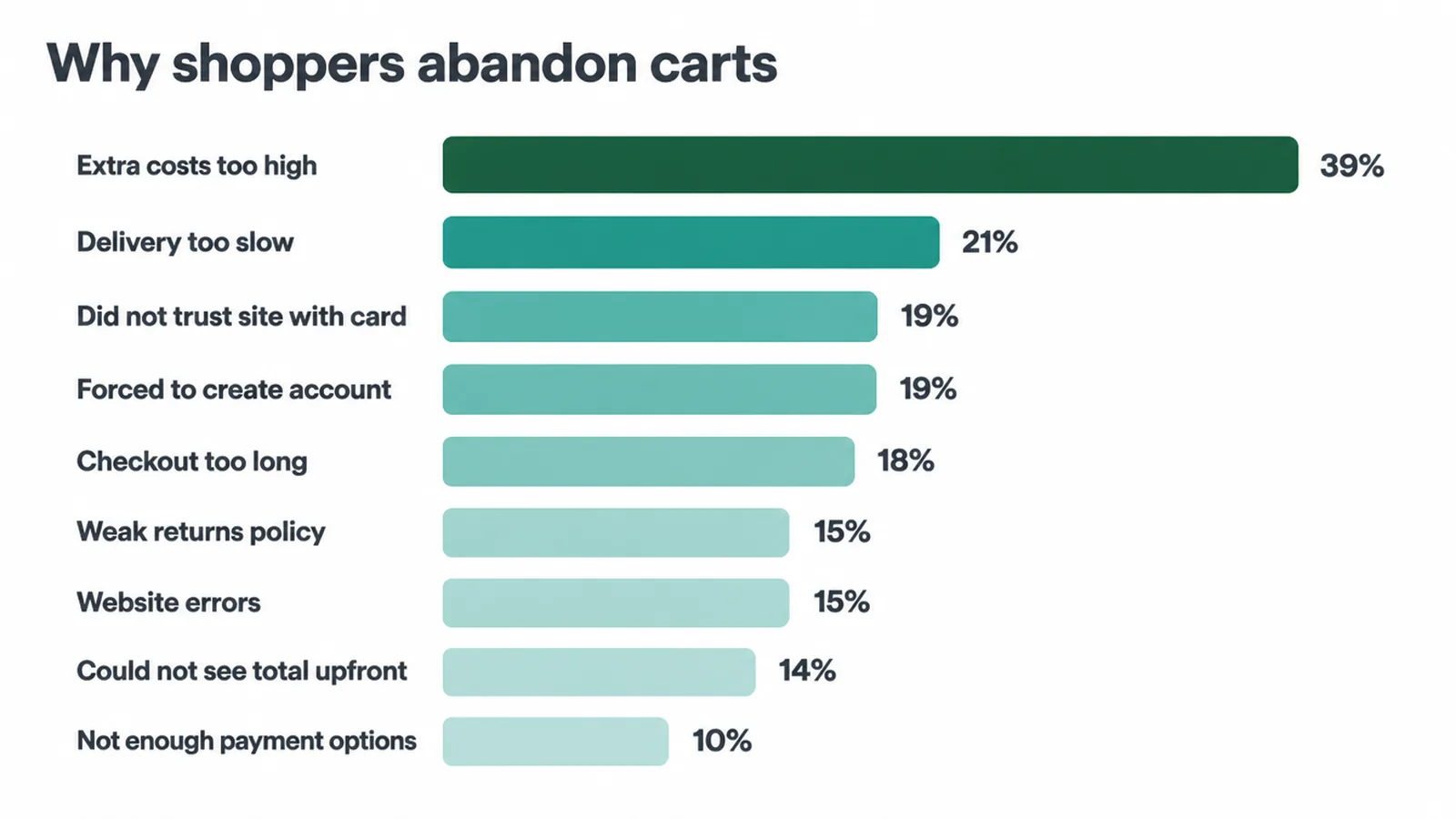
Before you fix anything, you need to know why people bail. Baymard asked shoppers who abandoned during checkout, setting aside the ones who were only browsing.
The answers point to a handful of fixable problems, and surprise costs top the list by a wide margin. The table below sorts them, tells you what each one really means, and links to the section that fixes it. Read it as your to-do list.
| Reason | Roughly how common | What it really means | The fix |
|---|---|---|---|
| Extra costs too high (shipping, tax, fees) | 40 percent | The total jumped at the last step and felt like a trap | Show the full cost early |
| Delivery too slow | 20 percent | They wanted it sooner than you offered | Show delivery dates and shipping options |
| Did not trust the site with card details | 19 percent | The page did not feel safe enough to hand over a card | Buy fast and feel safe |
| Forced to create an account | 18 percent | A wall of sign-up between them and the buy | Buy fast and feel safe |
| Checkout too long or complicated | 17 percent | Too many steps and fields to bother finishing | Buy fast and feel safe |
| Unsatisfactory returns policy | 13 percent | Getting money back looked hard, so they did not risk it | Buy fast and feel safe |
| Website errors or crashes | 17 percent | The page broke and they gave up | Make the cart do its job |
| Could not see the total upfront | 12 percent | No way to work out what they would actually pay | Show the full cost early |
| Not enough payment options | 9 percent | Their preferred way to pay was missing | Buy fast and feel safe |
Source for all of the above: Baymard. Notice how many of these are about cost and clarity, not price. People will pay a fair total. They hate being surprised by it. So the biggest single win is simple: no surprises. Let us start there.
2. Show the full cost before the cart is built
Extra costs are the top reason people abandon, cited by 40 percent of checkout abandoners (Baymard). Someone adds an item, feels good about the price, then watches shipping, tax and fees pile on at the last step.
That jump feels like a bait-and-switch, so they leave. The fix is not always to charge less. It is to show the real total sooner, so nothing jumps.
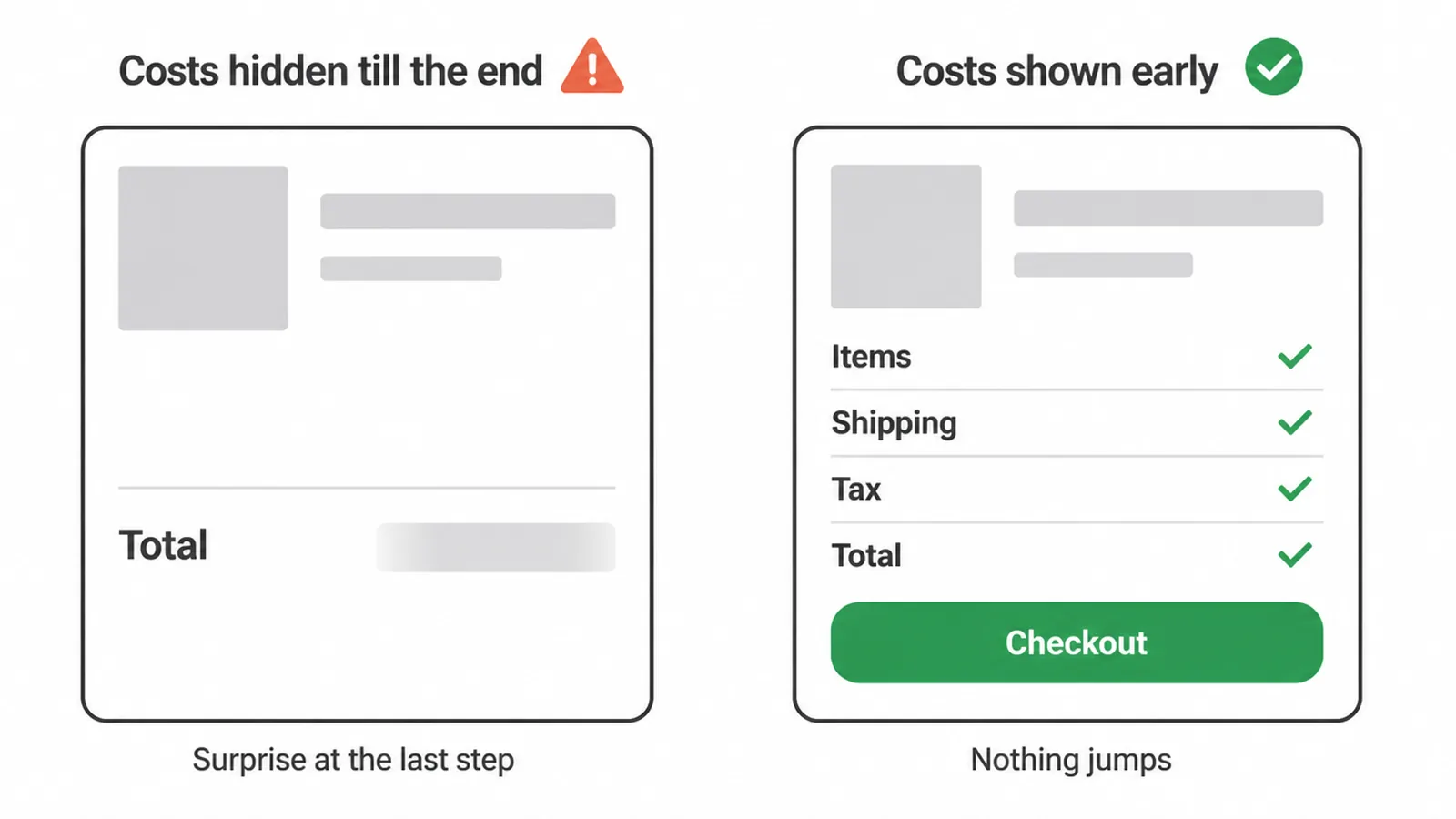
Put the honest cost in front of people while they still feel calm. Add a shipping estimator on the cart or product page so they can see delivery before they commit. Show tax and any fees in the cart, not only on the pay screen.
Give a clear delivery date when you can. Slow delivery is the second most common reason people quit, at 20 percent (Baymard). Another 12 percent leave when they cannot see the total upfront (Baymard). Showing both details removes those surprises.
Free-shipping thresholds also work well, because a round "spend a bit more and shipping is free" line turns a cost into a small goal.
If you are weighing up how to price and structure delivery in the first place, our guide to ecommerce shipping walks through the options. The rule to remember: reveal every cost as early as you can, and you defuse the single biggest reason carts die.
3. Let them buy fast and feel safe
Three of the top reasons for abandonment sit at the checkout step itself: a forced account (18 percent), a checkout that feels too long (17 percent), and not trusting the site with card details (19 percent) (Baymard). Each one is a wall you can pull down.
You do not need to re-teach every field-level trick here, so we keep this short and hand the deep work to our checkout optimization guide, which covers the checkout step in detail.
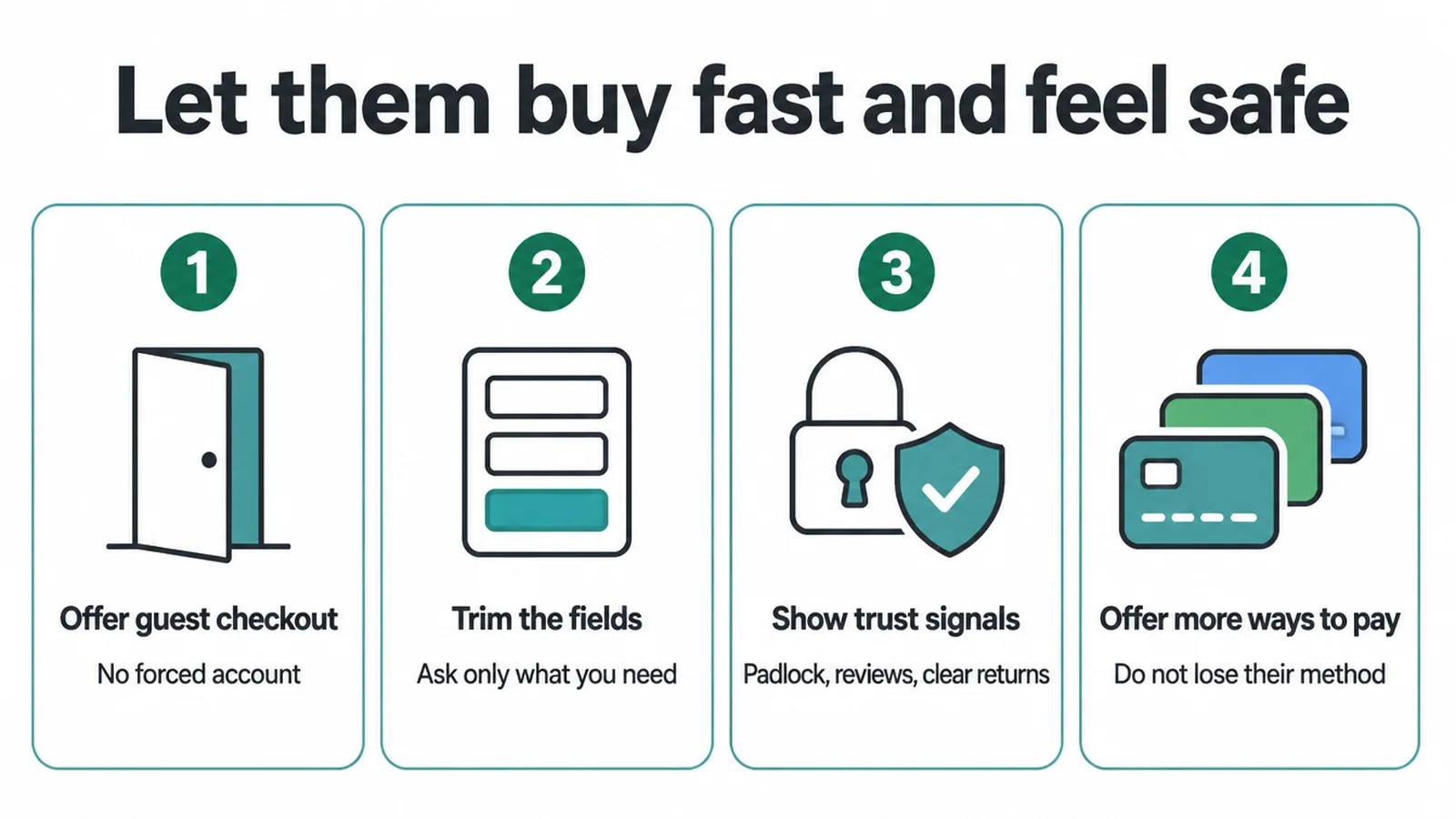
- Start with guest checkout. Being forced to make an account is one of the most common reasons people quit, so let them buy first and offer an account after.
- Then trim the fields to what you truly need, because every extra box is a reason to give up.
- Next, build trust on the page. A visible padlock, a clear returns policy, real reviews and recognised payment logos all tell a nervous shopper this is safe. Remember, 13 percent leave over a weak returns policy alone (Baymard), so say your policy in plain words right where they can see it.
- Finally, offer more than one way to pay, since 9 percent abandon when their preferred method is missing (Baymard).
Fast and safe is the whole idea: as few steps as possible, and enough proof that handing over a card feels normal.
4. Make the cart do its job
The cart page itself is easy to ignore, yet it is where the shopper decides whether to push on. Site errors and crashes send 17 percent of people away (Baymard), so first, make sure the cart simply works, on every screen.
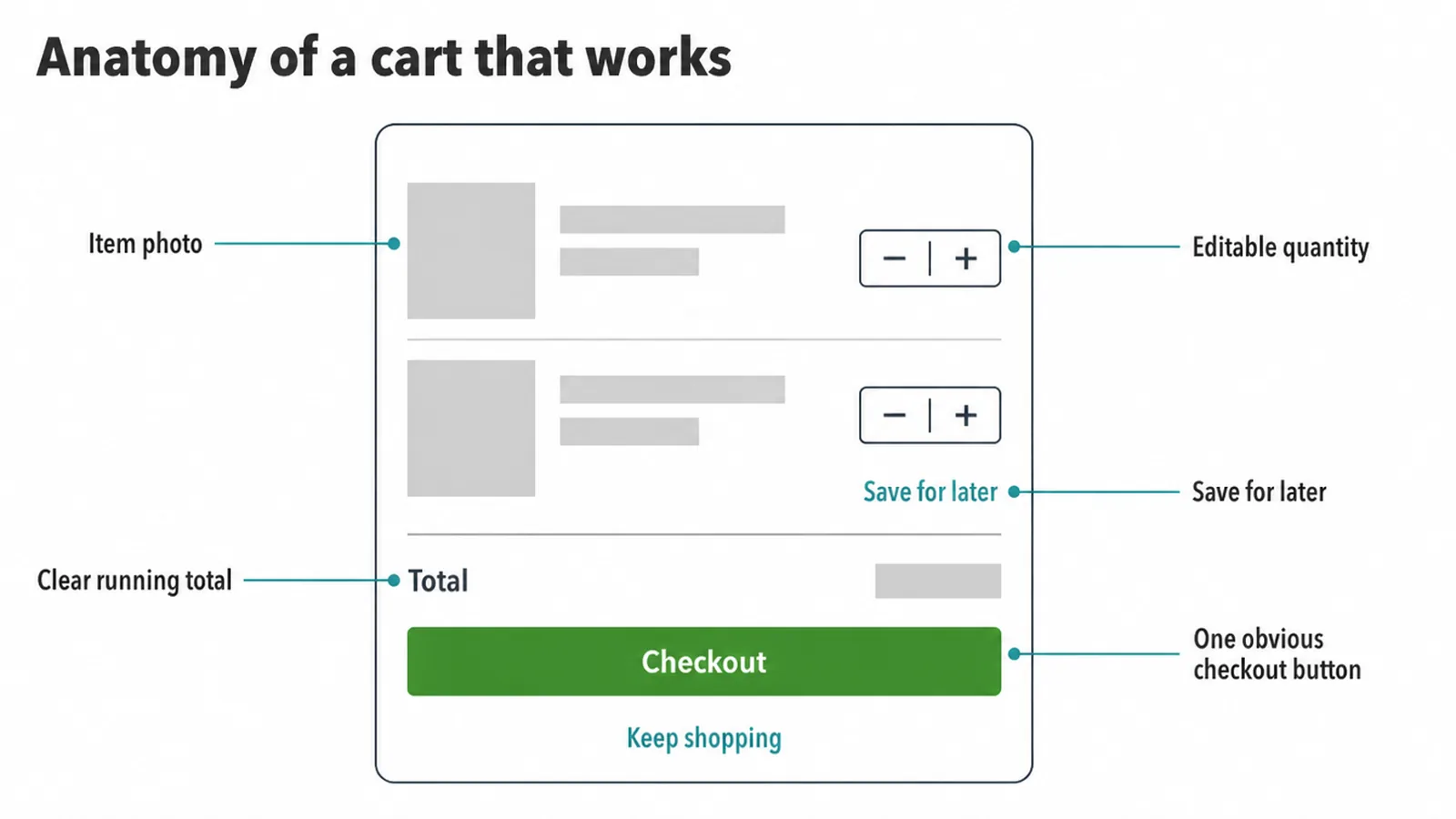
Then make it clear. Show a photo of each item, editable quantities, an obvious running total, and one prominent "checkout" button. Add a "keep shopping" link so nobody hits a dead end. A confusing cart makes people doubt, and doubt is where sales die.
Give people a way to come back
A "save for later" or saved-cart option lets a shopper who is not ready park their items and return to a full cart instead of starting over. That matters because a big share of abandoners were only browsing. If their cart is still there next week, some of them finish the job on their own.
On phones, keep tap targets big and fields simple, since a fiddly mobile cart loses people fast. If your store needs this built properly from the ground up, our ecommerce website design work bakes a usable cart in from day one.
5. Win back the ones who leave
Baymard found that 42 percent of US online shoppers have abandoned a cart because they were just browsing (Baymard). This is the part the checkout guide does not cover: recovery. It is how you bring some of those people back after they have gone, and most small stores skip it entirely.
The abandoned-cart email
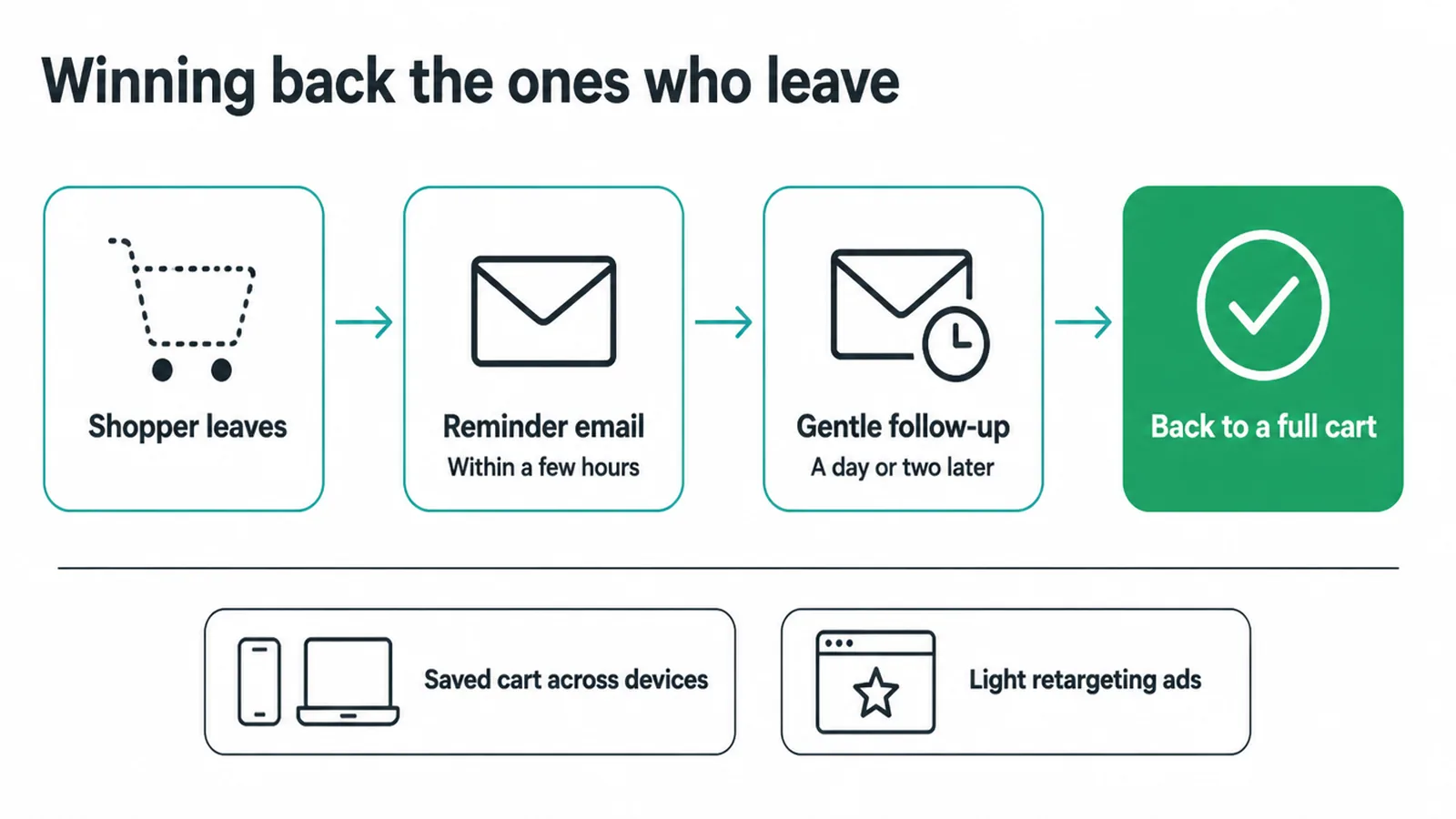
The simplest tool is the abandoned-cart email. It is a friendly reminder to someone who added items but did not buy, with a link straight back to their full cart so finishing takes one click.
Timing matters more than cleverness. A first nudge within a few hours, while it is fresh, then one gentle follow-up a day or two later. Keep it helpful, not naggy. If you want the email side set up properly, our guide to email marketing for small business shows how, without it feeling like spam.
Save-cart links and retargeting
Two more recovery tools stack on top. Save-cart links and persistent carts keep a shopper's items alive across devices, so they can start on a phone and finish on a laptop.
And retargeting ads follow a leaver around to remind them of the exact items they left behind. Use retargeting with a light touch, cap how often the ads show, and pair it with email rather than leaning on ads alone.
One honest note: recovery is a bonus, not a substitute. If your cart leaks badly upstream, you are just spending money to drag people back into a broken funnel. Fix the leaks first, then recover.
6. Track it without obsessing
You cannot improve what you do not review, but you also should not chase one magic number. Your cart abandonment rate is the share of carts that do not become orders. The documented average sits at 70.22 percent across 50 studies (Baymard), so use that as a rough sense of scale, not a target.
The number that actually matters is your own trend. Is this month better than last month? That is the scoreboard.
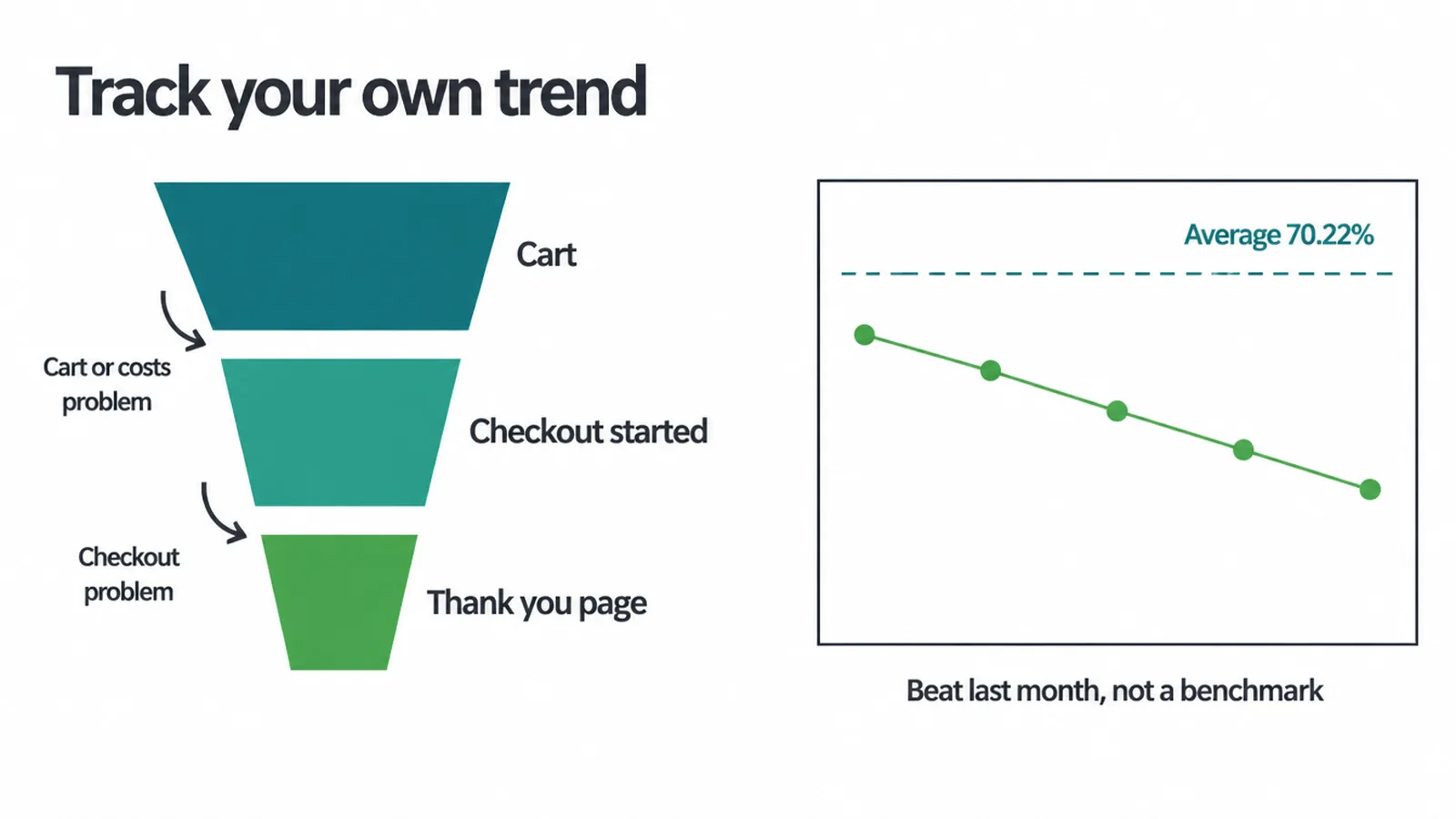
Open your analytics and watch where people drop off between the cart and the thank-you page. If loads of people reach the cart but few start checkout, your cart or your costs are the problem. If they start checkout and quit, the checkout step needs work, and our checkout optimization guide is the deep-dive.
Keep browsing in perspective. Baymard found that 42 percent of US online shoppers have abandoned a cart for that reason (Baymard). Fix one leak at a time, measure your own rate, and beat your last month rather than someone else's screenshot.
Two from our own builds. The Thamlev checkout was cut to the shortest run of steps that still collects everything an order needs. On Ban Zen Motors the checkout was designed and tested at phone width first, since that is where most orders start.
FAQ
1. What is a good cart abandonment rate?
Cart abandonment averages 70.22 percent across 50 studies documented by Baymard, so use that figure as a benchmark rather than assuming a fixed rate for each store. A lower rate is welcome, but the useful measure is whether your own rate improves after each checkout change.
2. Why do customers abandon their carts?
The top reason is surprise costs like shipping and tax showing up late. Other big ones are slow delivery, not trusting the site with card details, being forced to make an account, and a checkout that feels too long.
3. Is cart abandonment always a lost sale?
An abandoned cart may still lead to a sale. Baymard reports that 42 percent of US online shoppers have abandoned a cart because they were just browsing. Reminder emails and retargeting give shoppers a route back, so track recovered carts rather than treating each unfinished order as a final loss.
4. How do I stop shipping costs from scaring people off?
Show shipping, tax, and any fees as early as you can, ideally on the product page or cart, not on the final step. No nasty surprise means fewer people bail. Free-shipping thresholds also help.
5. Should I let people check out as a guest?
Yes. Being forced to create an account is one of the most common reasons people quit. Offer guest checkout and let them make an account after they buy if they want.
6. What is an abandoned-cart email?
It is a reminder you send to a shopper who added items but did not buy. It links them straight back to their full cart so finishing takes one click. It is the simplest recovery tactic most stores are missing.
7. Does retargeting help recover abandoned carts?
It can. Ads that follow a shopper around after they leave remind them of what they left behind. Use it lightly and pair it with email so you are not only relying on ads.
8. How is cart abandonment different from checkout abandonment?
Cart abandonment is anyone who adds to cart and does not buy. Checkout abandonment is narrower: people who start the checkout steps and drop out. Fixing the checkout step is a big part of the wider job.