Choosing a Payment Gateway in Malaysia

Choosing a payment gateway in Malaysia comes down to three things: which payment methods your buyers already use, how the fees are structured, and when you get paid. Seed Light starts with the buyers, because a gateway missing the method they prefer costs you more than any fee difference.
Most comparisons of this start with a fee table. Within six months half the numbers in it are wrong, and the table was never the hard part anyway.
This guide covers what you are actually choosing between, how Malaysian payment methods differ for a small seller, and the question nobody asks until the first month ends.
By the end you will know which methods you need, what to ask about fees, and how to check when you get paid.
Key Takeaways
- Start with your buyers, not the rate. A missing method costs more than a fee difference.
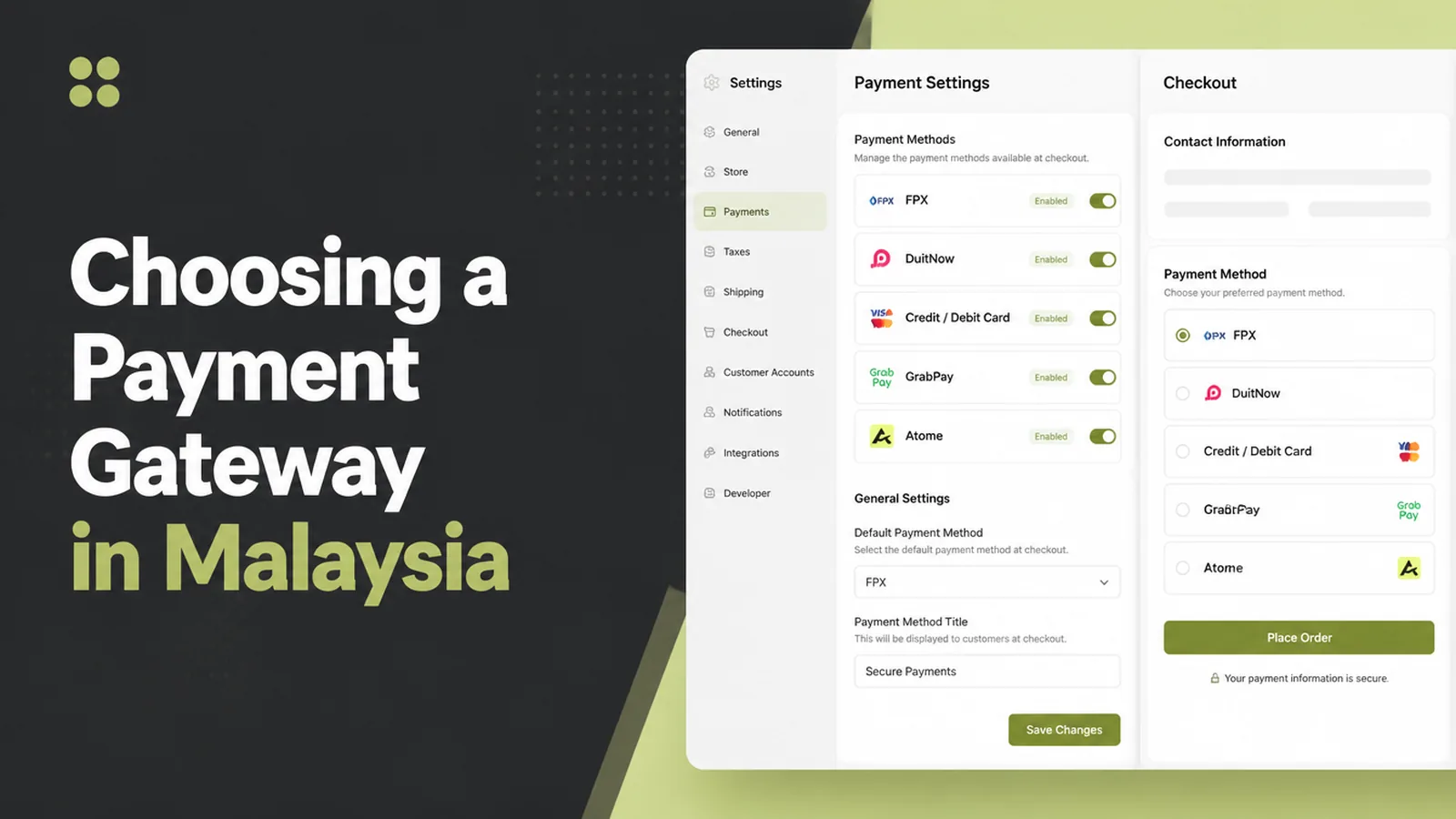
- FPX is the rail, not the gateway. PayNet describes it as a real time system using participating banks.
- DuitNow QR is one code for many wallets. It is Malaysia's national QR standard.
- Payout timing varies by provider. Two working days, five, or seven calendar days, depending who you sign with.
- Most rates are quote only. Two providers publish Malaysian pricing openly. The rest tell you after you ask.
A gateway is plumbing. You notice it only when a buyer cannot pay the way they expected to, or when the money takes longer to arrive than you planned for.
Both of those are avoidable, and both are decided before you sign anything.
The Question You Are Actually Asking
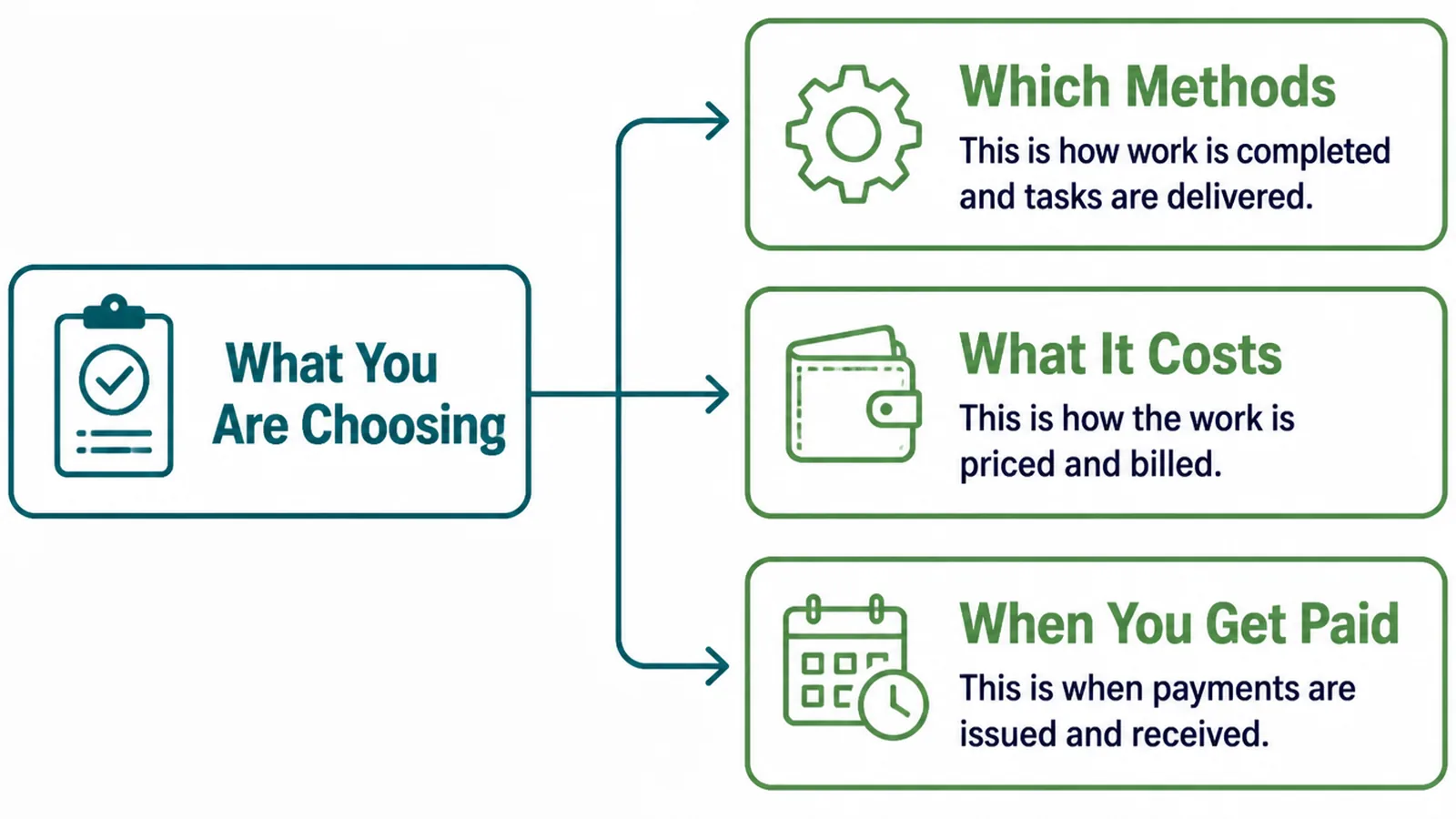
Behind "which payment gateway" sit three separate decisions, and they do not have the same answer.
- Which methods. Cards, FPX bank transfer, e-wallets, QR, instalments. Your buyers have habits.
- What it costs. Not one rate but a structure: per transaction, per method, sometimes with a floor.
- When you get paid. Authorisation is instant. Settlement into your account is not.
That third one is the one owners discover late. A sale on the first of the month may not be money you can spend until the second week.
It is also the only one of the three that is hard to change later. Methods can be switched on in an afternoon; a settlement cycle is whatever your provider does.
Choosing a payment gateway in Malaysia is mostly about matching the first question to the third, within a cost you can live with.
Get those three straight and the shortlist writes itself. Skip them and you are comparing rate cards that measure different things.
The regulator sits behind all of it, and is worth understanding once. Bank Negara Malaysia issued a policy document on merchant acquiring services in September 2021, covering acquirers registered under the Financial Services Act.
Separately it issued a policy document on payment system operators in December 2022, covering operators approved under section 11 of that Act.
The distinction is useful when a salesperson says they are "Bank Negara approved". Acquirers are registered, operators are approved, and the two are not interchangeable.
You are not required to understand the difference to sell online. It is useful because it tells you whether a claim on a brochure is precise or decorative.
Bank Transfer Only
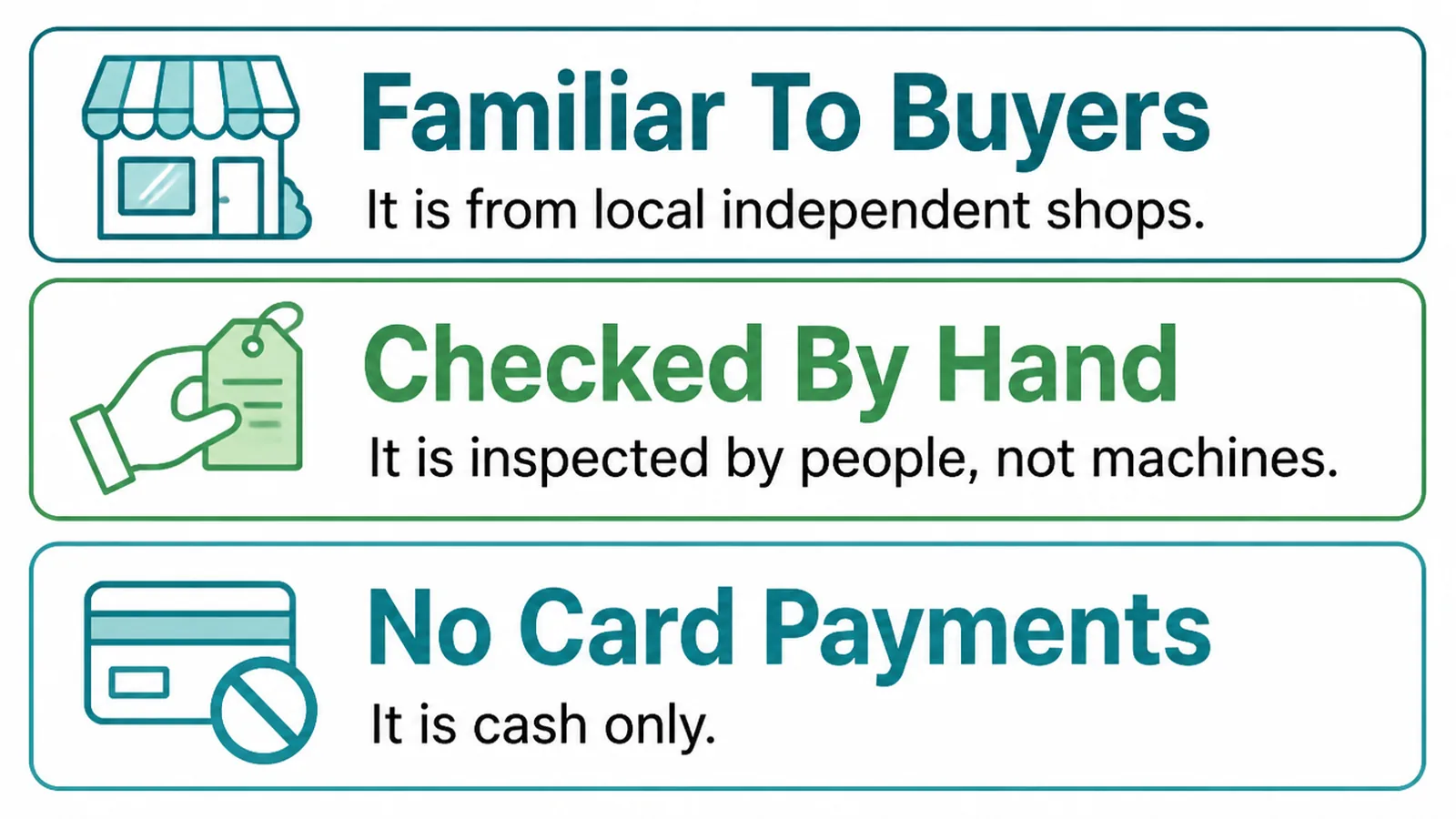
Plenty of Malaysian businesses take payment by bank transfer and nothing else. It works, and it is worth being honest about why.
It is familiar. Buyers know the apps, there is no checkout to trust, and nothing is deducted from the amount you quoted.
The cost is your time. Someone opens the statement, matches a transfer to an order, and confirms it by hand, every single time.
That is fine at five orders a week. At fifty it becomes a job, and it is the kind of job where a missed match is a customer chasing you.
It also rules out buyers who wanted to pay by card, and it gives you no record tied to an order beyond a reference someone typed.
Three things push a seller off bank transfer only:
- Volume. Matching payments by hand stops scaling at a surprisingly low number.
- Abandoned orders. Buyers who wanted to pay by card simply leave.
- Disputes. A typed reference is weak evidence when somebody says they paid.
None of that makes bank transfer wrong. It makes it a stage, and most sellers outgrow it rather than abandon it.
FPX changes part of this. PayNet describes it as a secure and real time payment system that leverages participating banks' internet banking, so the transfer is confirmed against the order automatically.
A Payment Gateway Malaysia Buyers Recognise
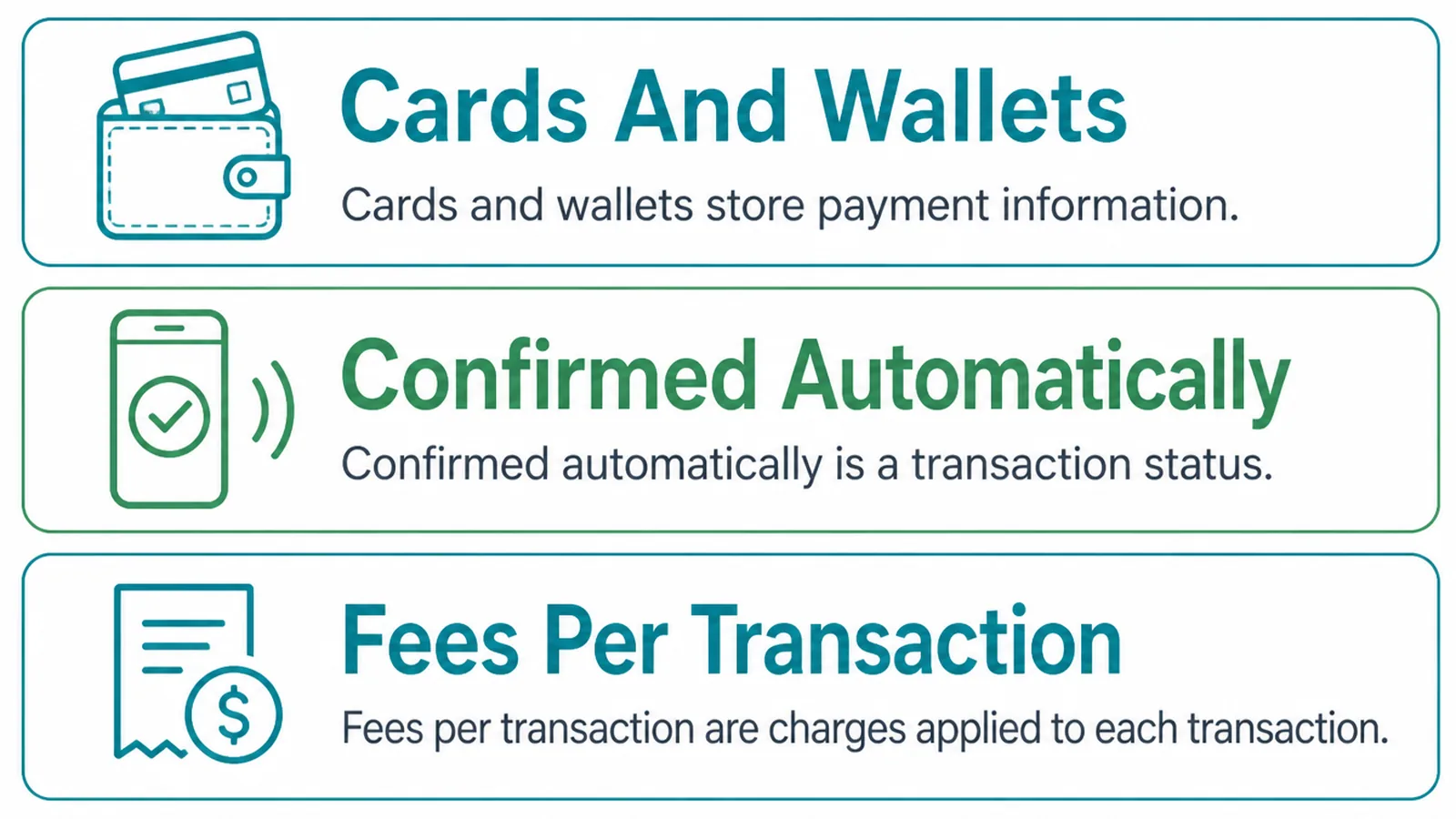
A gateway bundles the methods together, confirms payment against the order, and pays you out on a cycle.
In Malaysia that usually means cards, FPX, one or more e-wallets, and DuitNow QR, the national QR standard. One code is accepted by any wallet whose issuer has enabled it.
Fees are where published information runs out. Only two providers I could check publish Malaysian rates openly.
Stripe lists 3% plus RM1.00 for domestic cards and for FPX, and states it charges no setup fee, monthly fee or closure fee.
Boost publishes a merchant rate card with a different shape: a one-off activation, optional monthly terminal and link subscriptions, then a merchant discount rate that varies by method.
Those two shapes are not comparable on a single number. One is a flat per-transaction cost, the other is a subscription plus a rate that changes with how the customer paid.
Work out your own blended cost instead. Take last month's orders, apply each provider's structure to them, and compare the totals rather than the headline rates.
So a payment gateway Malaysia comparison built on published rates is comparing two providers against a blank. Curlec, Fiuu and the service formerly sold as iPay88, now Adaptis under NTT DATA Payment Services, publish no rates at all. Payment gateway fees there are quote only.
How To Choose
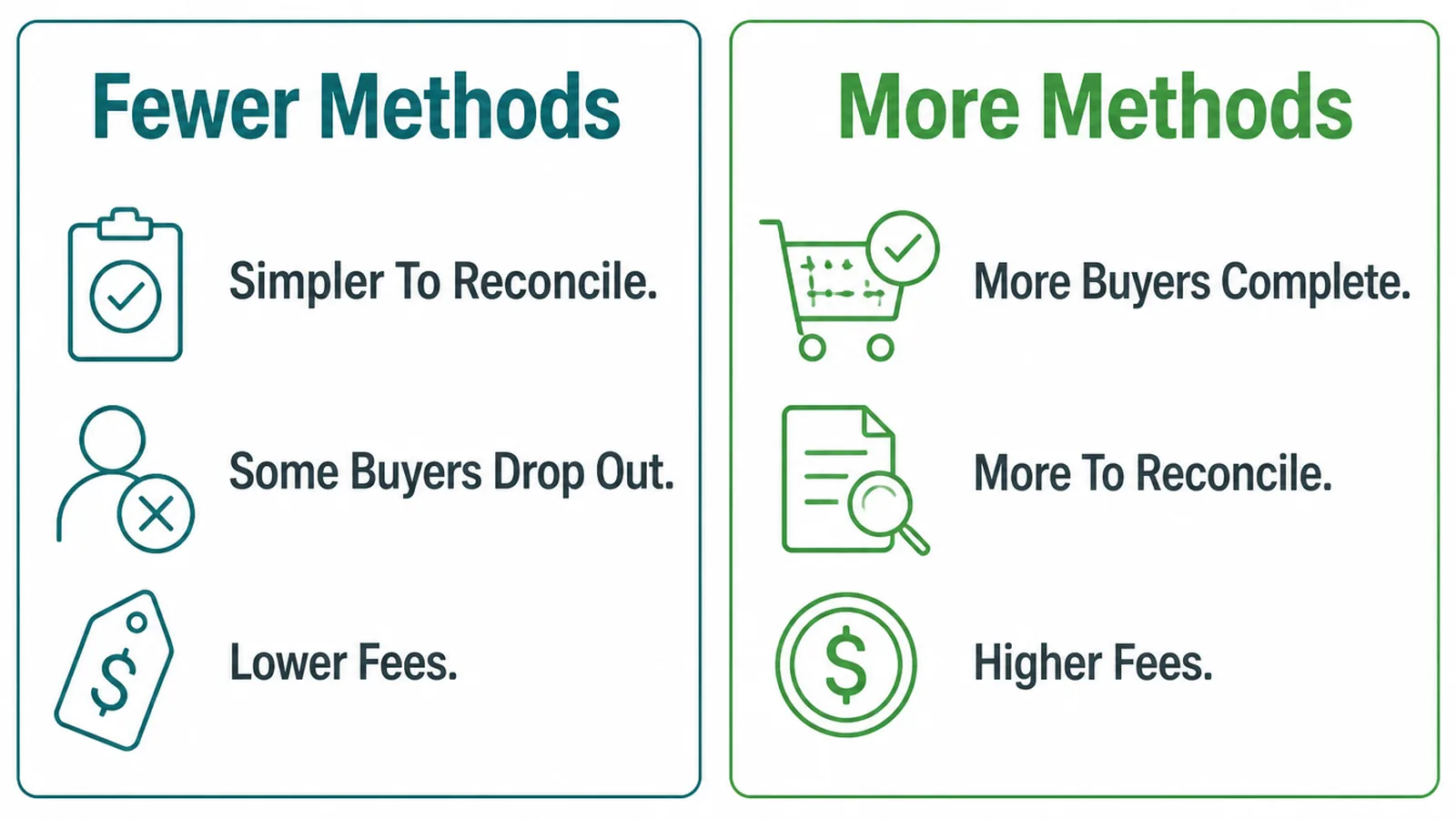
The instinct is to enable everything. It is worth thinking about once rather than defaulting to it.
| Fewer methods | More methods |
|---|---|
| Simpler to reconcile at month end | More reconciling, across more payout cycles |
| Some buyers abandon the checkout | More buyers finish, including impulse ones |
| Fewer per-method rates to track | Rates differ per method, so your blended cost moves |
For most small sellers the answer is: FPX, one card option, and the QR standard. That covers the common habits without three dashboards.
Instalment and buy-now-pay-later options are a separate decision. They raise average order value for some trades and are pure overhead for others.
Add wallets when you can see demand for them, not in advance. An enabled method nobody uses still appears in every reconciliation.
There is a quieter cost to enabling everything, and that cost is support. Every method is another thing a customer can be confused by and another thing you have to explain.
Online payment for small business works best when the checkout is boring and predictable, which argues for fewer, well-chosen options.
Working It Through
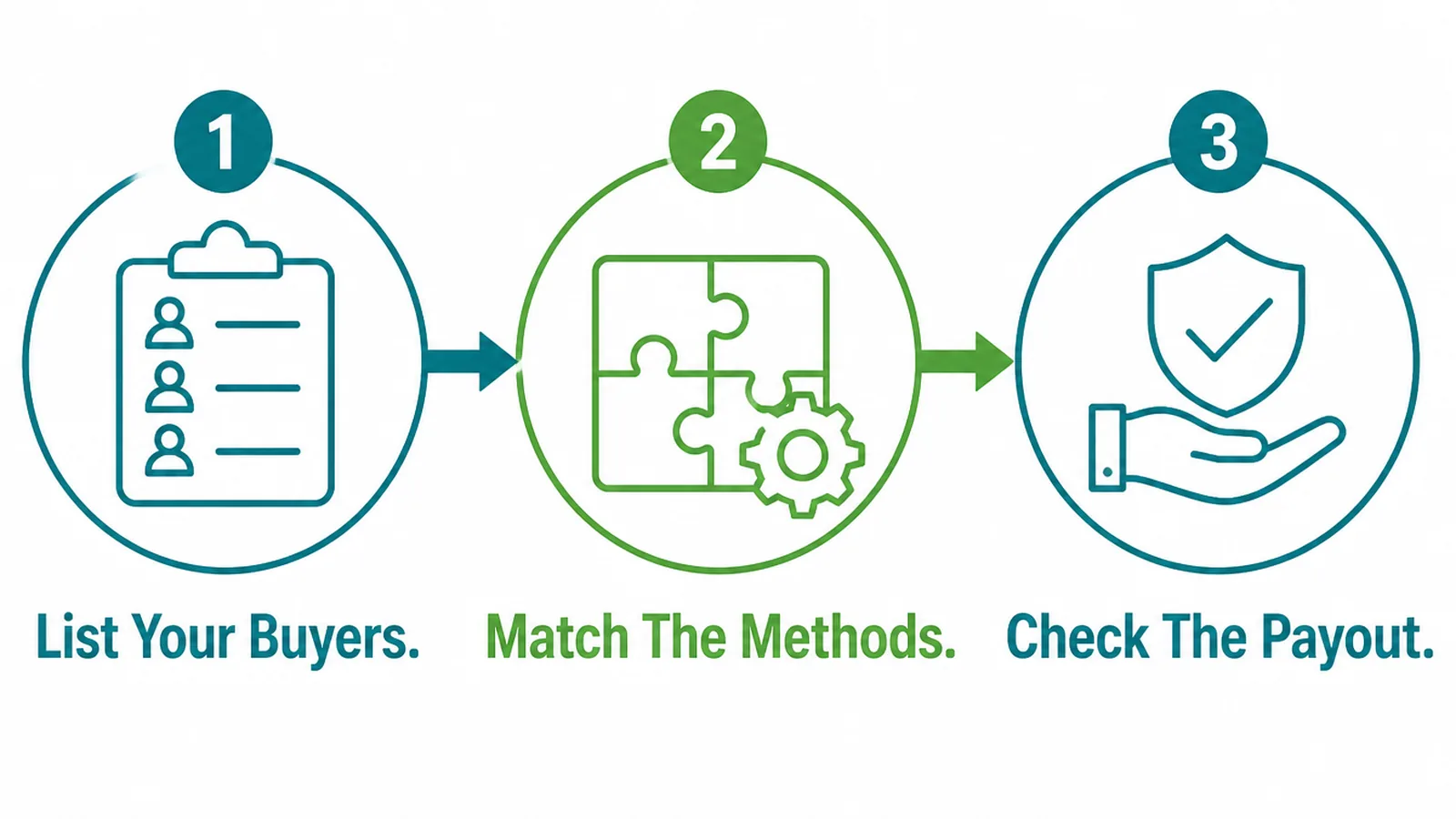
List your buyers. Take your last twenty orders and write down how each person actually paid you, or asked to.
Match the methods. Shortlist only providers that cover what that list shows. Ignore the ones whose brochures are prettiest.
Check the payout. Ask each shortlisted provider how many days until money reaches your bank, and get the answer in writing.
That last step has real published variation. Curlec documents a standard settlement cycle of two working days, subject to bank approval.
Grab states settlement for GrabPay is made within five working days. Stripe puts the initial payout in Malaysia at seven calendar days.
Those are three different answers to the same question, from three providers you might shortlist together. Working days also exclude weekends and public holidays, which stretches the gap further.
Work out what that means for a real month. If you pay suppliers on the fifth and your settlement lands on the eighth, that is a gap you fund yourself.
Where The Choice Is Recorded
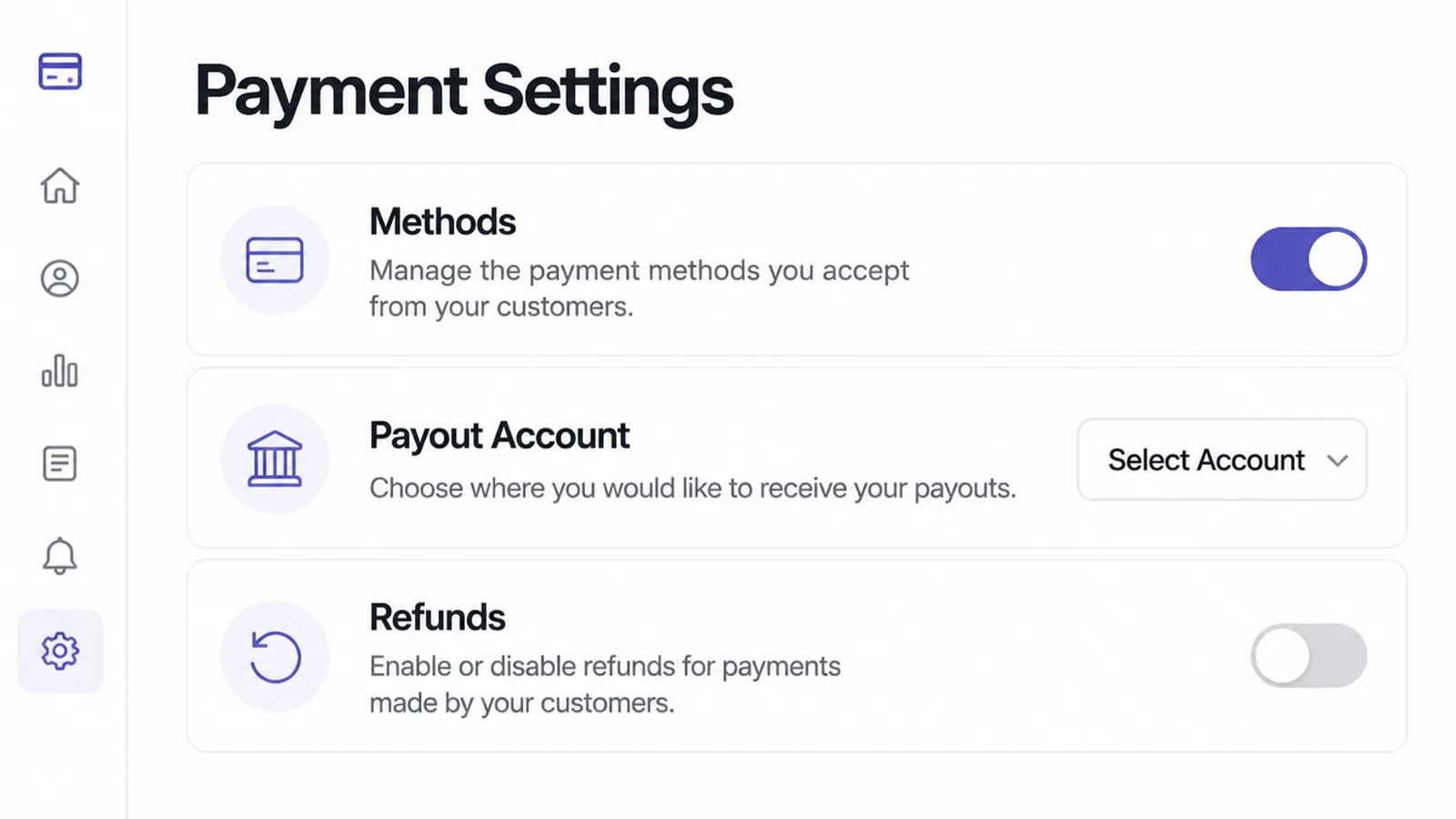
Once you have chosen, the decision lives in three fields, and all three are worth checking before the first real order.
- Methods. Exactly which ones are switched on, confirmed by making a test purchase with each.
- Payout account. The bank account money lands in, and who is notified when it does.
- Refunds. How a refund is issued, and whether the original fee comes back with it.
Ask about the refund fee specifically. It is rarely on a pricing page and it is the one that surprises people in a bad month.
Ask who in your business gets the payout notification too. If it only reaches one person, reconciliation stops whenever they are away.
Keep a note of what you were quoted, with the date. Rates and settlement cycles both change, and a year later nobody remembers what was agreed.
Test a refund before you launch, not after your first one. The flow is different from a sale and it is the one staff have never practised.
And keep the test purchases. A screenshot of each method working on launch day is the fastest way to prove what changed if one stops later.
One more thing worth watching. Bank Negara issued an Interoperable Fund Transfer Framework in June 2026, which governs how these rails connect to each other.
FAQs
Does a payment gateway need Bank Negara approval?
The distinction matters. Bank Negara approves payment system operators under the Financial Services Act, while merchant acquirers are registered rather than approved. Your own business is neither. Ask a provider which category it sits in and under what instrument, then verify it yourself.
How long until the money reaches my bank?
It depends on the provider and the method, not on the country. Curlec documents a standard cycle of two working days, Grab states settlement within five working days for GrabPay, and Stripe puts the first payout in Malaysia at seven calendar days.
Is FPX the same as a payment gateway?
No. FPX is the bank transfer rail, described by PayNet as a real time payment system that uses participating banks' internet banking. A gateway is the service that offers FPX alongside cards and wallets, handles the checkout and pays you out.
Should I just take bank transfers instead?
You can, and plenty of small businesses do. The cost is manual work: somebody opens the bank statement, matches each payment to an order and confirms it. That is fine at low volume, and it becomes the bottleneck as soon as orders grow.
Conclusion
Choosing a payment gateway in Malaysia is not a hunt for the lowest rate. It is matching the methods your buyers use to a payout cycle your cash flow can take.
List your last twenty orders, shortlist on methods, then ask every provider the settlement question in writing.
If you would rather have it set up and tested properly, see how we build online stores, or get in touch and we will tell you which methods your orders actually need.