Key takeaways
- Start with a real question. Write about things your customers already ask, then check people actually search for them.
- Answer first, always. Give the payoff in the first paragraph. Do not make readers scroll to find it.
- Write for people, not the algorithm. Google says it rewards helpful, people-first content, not content made to game rankings.
- SEO basics are simple. A clear title, a meta description, headings, internal links, and image alt text cover most of it.
- Edit like you mean it. Your first draft is a lump of clay. Cutting is where the post gets good.
- Be patient. No one can promise a number one spot. Quality and time do the work.
1. The quick version
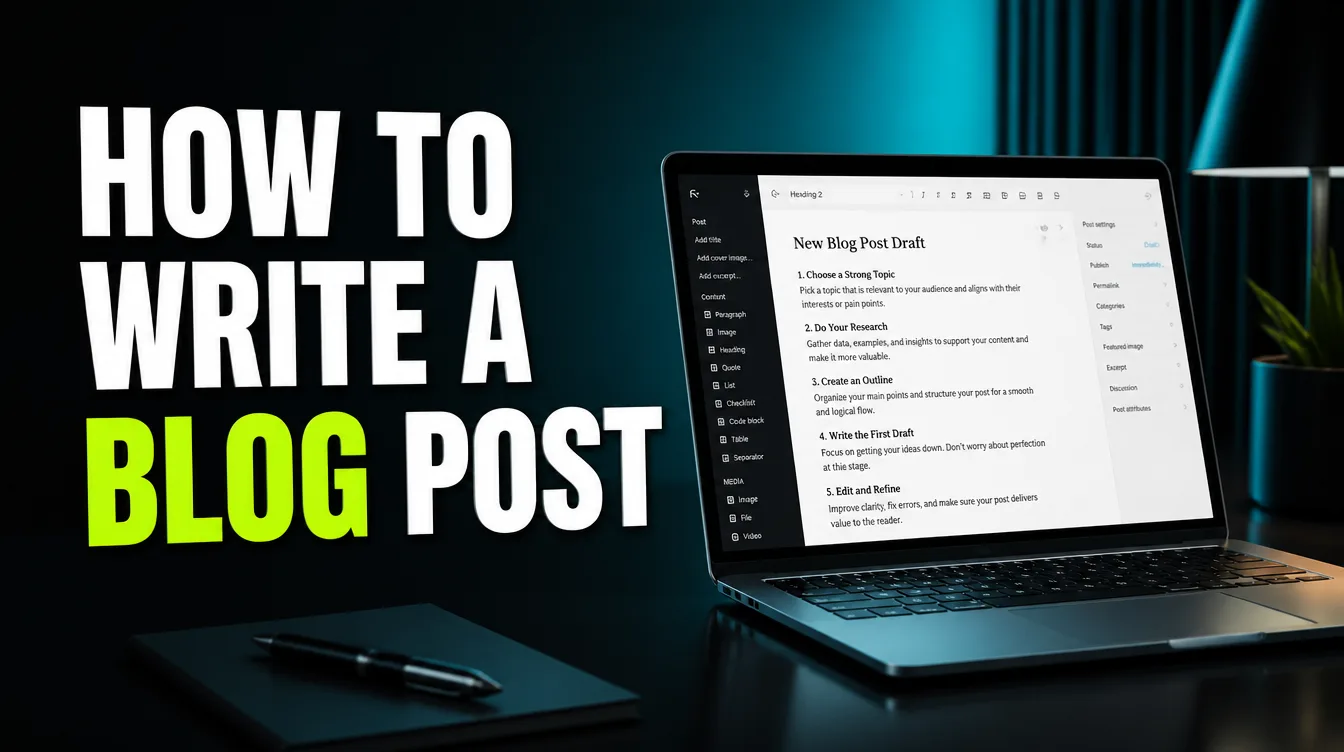
Short on time? Here is the whole process in one list. The rest of this guide unpacks each step.
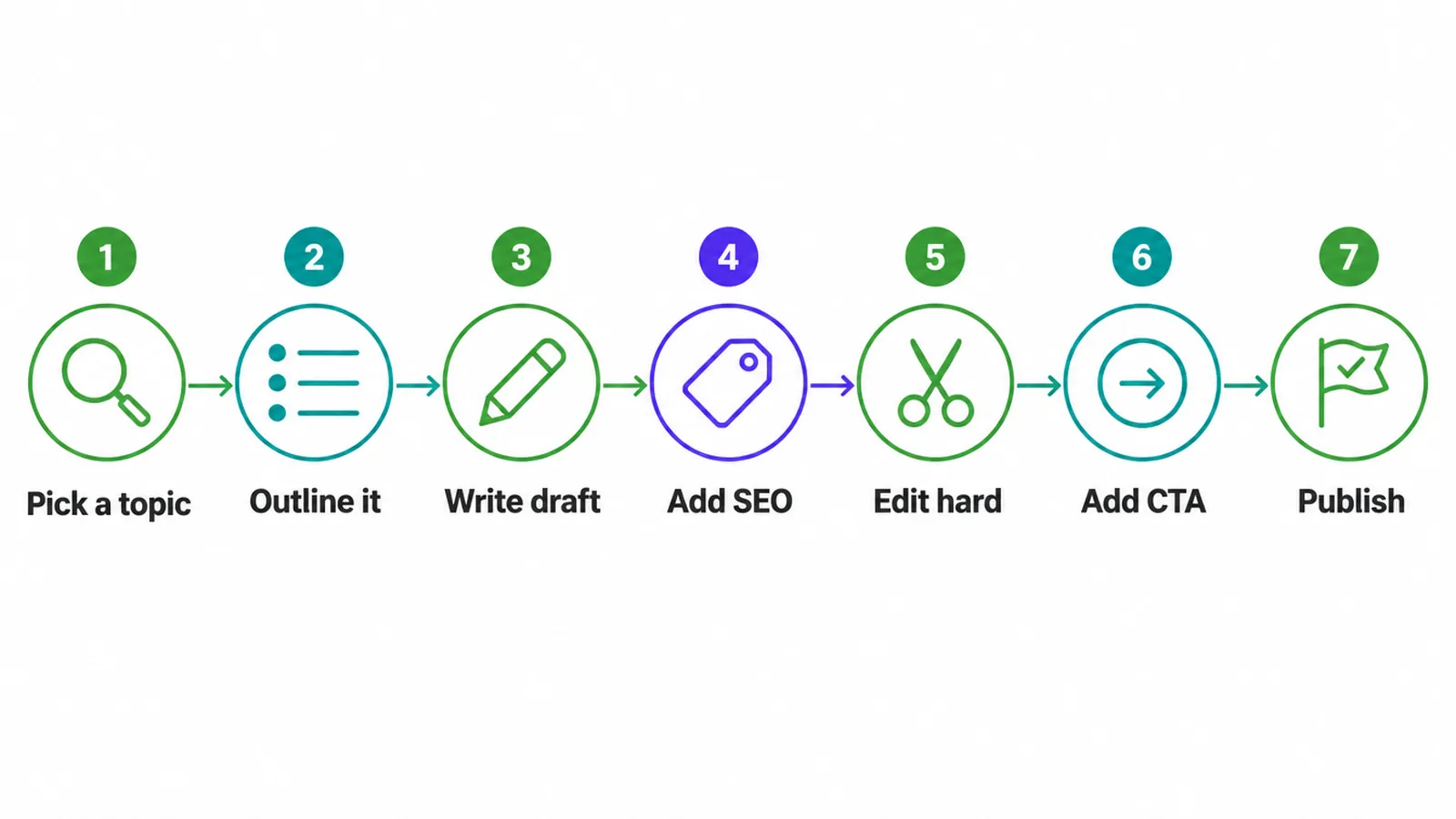
- Pick a topic real people search for.
- Outline it answer-first, with the payoff at the top.
- Write a rough draft plainly, in short sentences.
- Apply the on-page SEO basics.
- Edit ruthlessly and cut the filler.
- Add one clear call to action.
- Run the pre-publish checklist, then publish.
2. Step 1: Pick a topic people actually search for
Do not guess what to write. Start from the questions your customers already ask you. The email you keep answering. The thing people ask on every sales call. Those questions are the raw material of your content, and each one is a blog post waiting to happen, because if one person asks, hundreds more are typing it into Google.
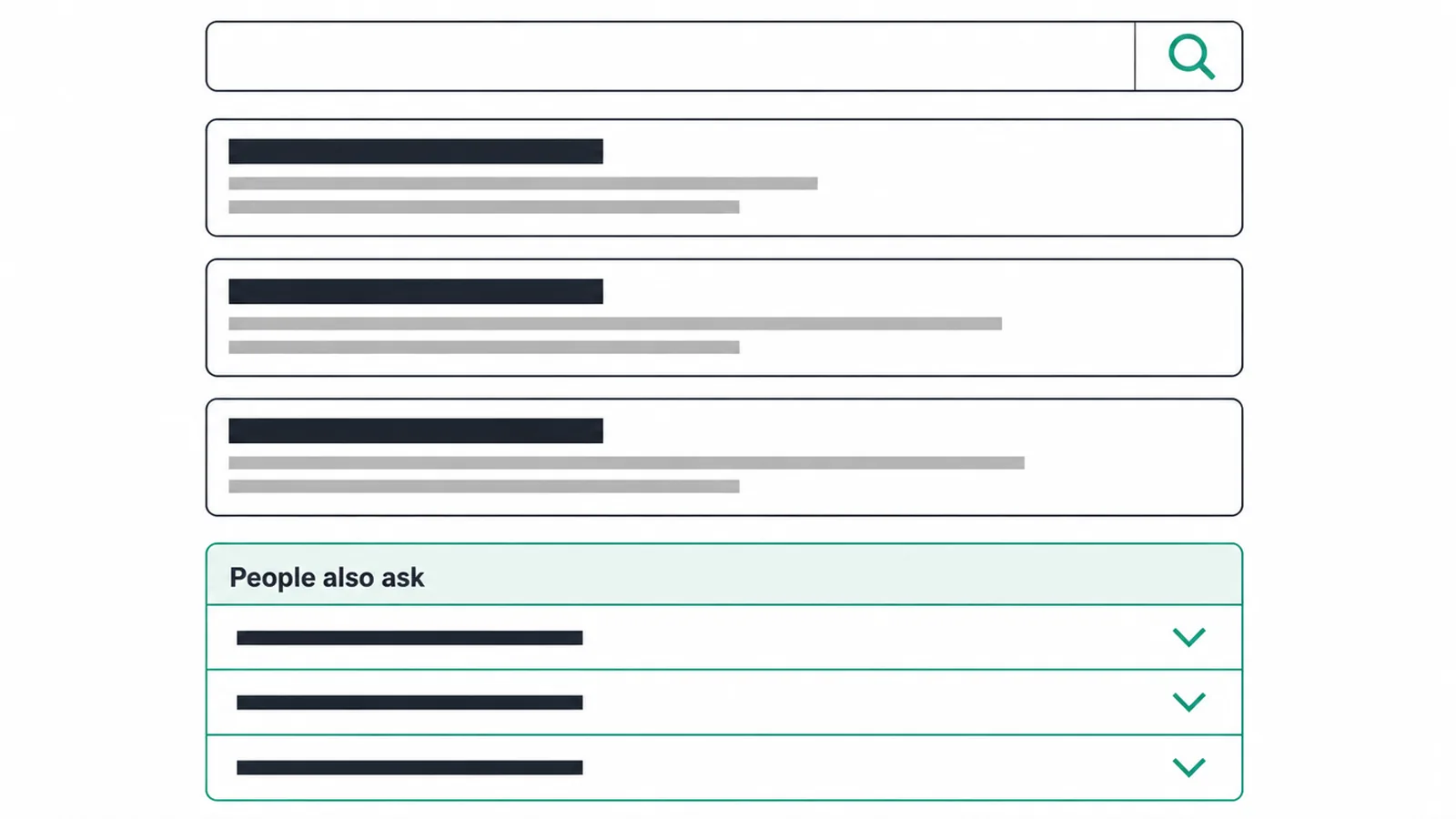
Then sanity-check the demand. A topic you love is useless if nobody searches for it. Type your idea into Google and see what comes up. Look at the "People also ask" box and the searches at the bottom of the page. Those are real questions from real people. If you want to go deeper on finding topics with proven demand, our guide on how to do keyword research shows you how to check search volume and spot easy wins.
One more filter: pick topics you can answer better than what is already ranking. Read the top three results. If they are thin, vague, or out of date, you have an opening. If they are excellent, either find a fresh angle or pick a different question. You do not have to win every topic. You just have to win the ones where you can genuinely help more.
3. Step 2: Outline it answer-first
Never write straight into a blank page. Outline first. An outline is the skeleton of your post, and it saves you from rambling.
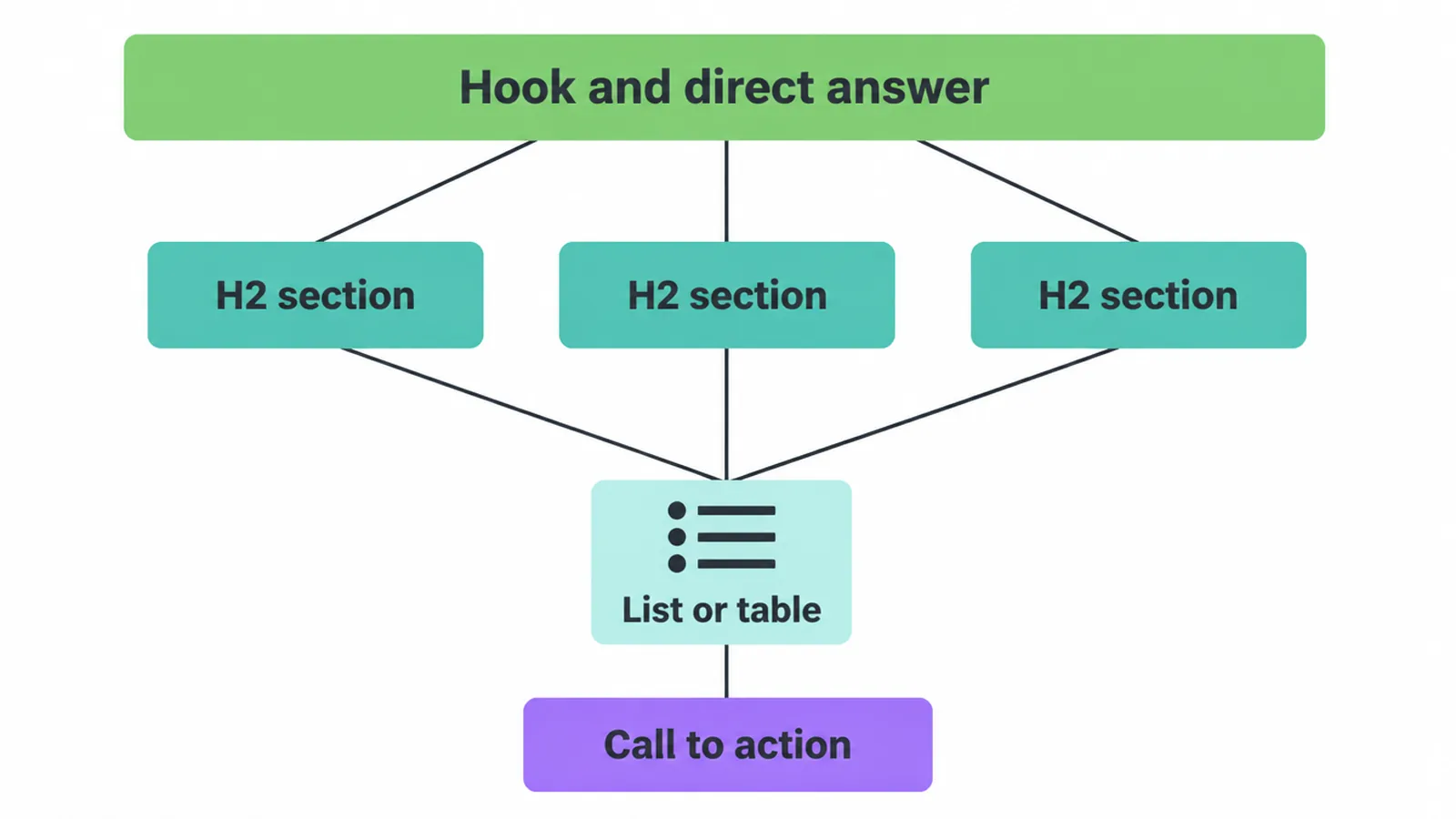
Use the answer-first shape, sometimes called the inverted pyramid. Put the most important thing at the top. A searcher who typed a question wants the answer, not a warm-up. Give it to them fast, then use the rest of the post to explain, prove, and add detail.
Here is a simple skeleton you can reuse for almost any post:
- Hook plus direct answer. One short intro that names the problem and answers the question straight away.
- H2 sections. Each heading covers one point, in a logical order, so a reader can follow the path.
- A list or table. Wherever it makes something easier to scan.
- Call to action. One clear next step at the end.
So how do you structure a blog post in practice? A hook plus a direct answer up top, then H2 sections that each cover one point in a logical order, short paragraphs, a table or list where it helps, and a call to action at the end. Fill your outline with a rough sentence under each heading. Now you are never staring at nothing. You are just filling in blanks.
4. Step 3: Write the draft plainly
Now write, and give yourself permission to write badly. The first draft only has to exist. You will fix it later. Trying to write perfect sentences on the first pass is the fastest way to freeze up.
Write like you talk. Short sentences. One idea per paragraph. Everyday words instead of business jargon. Speak straight to the reader as "you". Break things up with headings and lists so the post is easy to skim, because most people skim before they read.
Pay special attention to your opening. So how do you write an intro that hooks readers? Name the reader's problem in the first line, then give them the answer straight away. Do not warm up for three paragraphs, because searchers leave if they do not see the payoff fast.
If you use AI to help you draft, treat it as a rough assistant, not the author. It can speed up an outline or a first pass, but it does not know your business and it makes things up. Our guide on using AI for content creation covers how to draft with it without losing your own voice. Whatever you do, never ship an unedited AI draft. Add your real experience and check every fact.
5. Step 4: Apply the SEO basics
SEO sounds scary, but the basics for a blog post are a short checklist. Do these and you have covered most of the on-page work. First and last, write for people. Google says it rewards helpful, reliable information made to benefit people, not content made to manipulate rankings. Keep that as your north star and the rest is tidy-up.
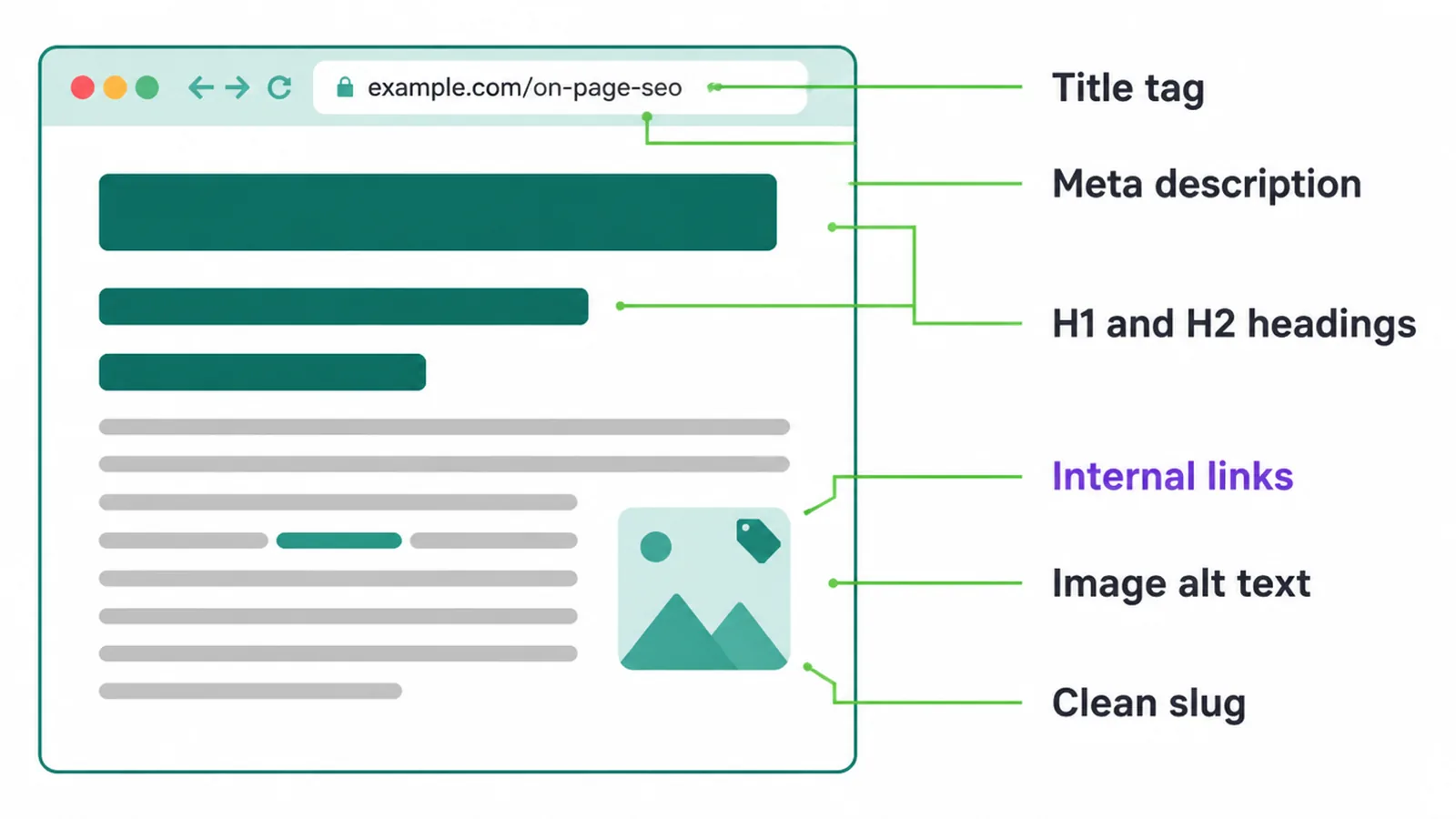
- Title tag. A clear, honest title with your main topic in it. Keep it short enough to show fully in search results.
- Meta description. One or two sentences that tell a searcher what they will get. Aim for around 155 characters.
- One H1, then H2s. Your post title is the H1. Section headings are H2s. Do not skip levels.
- Internal links. Link to a few of your own related pages so readers and Google can find them.
- Image alt text. Describe each image in plain words. It helps accessibility and search.
- A clean slug. A short, readable URL with your topic in it, not a string of numbers.
People always ask how many times to use their keyword. Use it naturally: in the title, the first paragraph, one or two headings, and wherever it genuinely fits. Do not stuff it, and write for the reader first. There is no magic density number. If you catch yourself forcing the phrase in, take it out.
That is the foundation. If you want the deeper craft, like matching search intent, structuring for featured snippets, and stronger on-page tuning, read our guide on SEO content writing. And if the whole thing feels like too much, our SEO service can handle the technical side while you focus on the business.
6. Step 5: Edit ruthlessly
The magic is in the edit, not the draft. Walk away for an hour if you can, then come back with fresh eyes and cut hard. Delete filler words. Delete sentences that repeat the last one. If a paragraph does not help the reader, it goes.
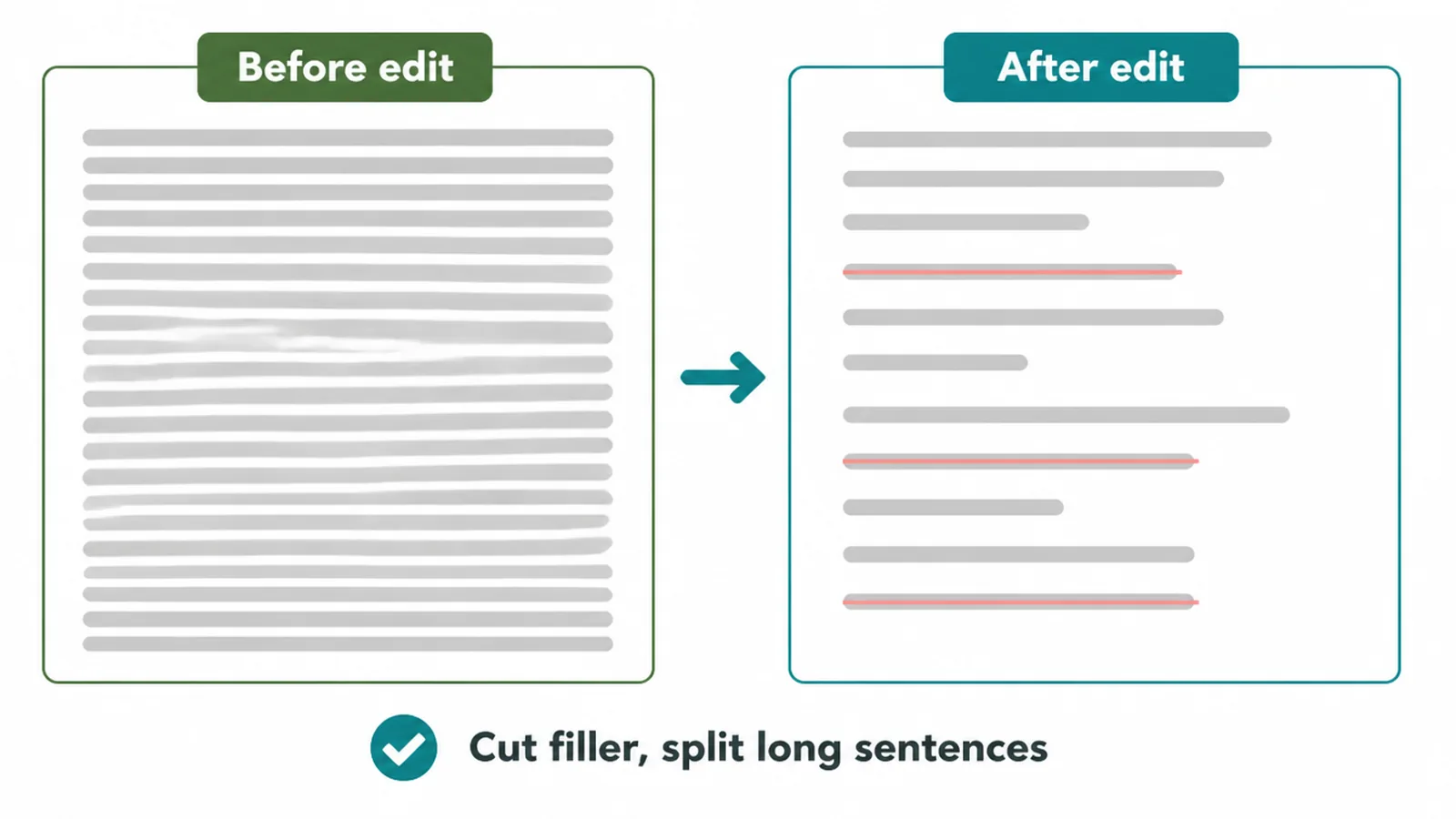
Read the whole thing out loud. Your ear catches what your eye misses. If you stumble over a sentence, it is too long or too clunky. Split it or rewrite it. If you run out of breath, add a full stop.
Then run a quality gut-check. Google publishes a set of questions you can use as your own editing checklist. Ask yourself honestly: does this post give original information or analysis? Is it substantial and complete? Would a reader bookmark it or recommend it to a friend? Do they leave feeling they learned enough to be done? If the answer is no, keep working.
Finally, add a byline. Google wants it to be obvious who wrote the post and why they know the topic. A short author line with a name and a sentence of background builds trust with readers and with search.
7. Step 6: Add one call to action
A blog post that helps someone should point them to a next step. Pick one. Just one. Too many choices and people pick nothing.
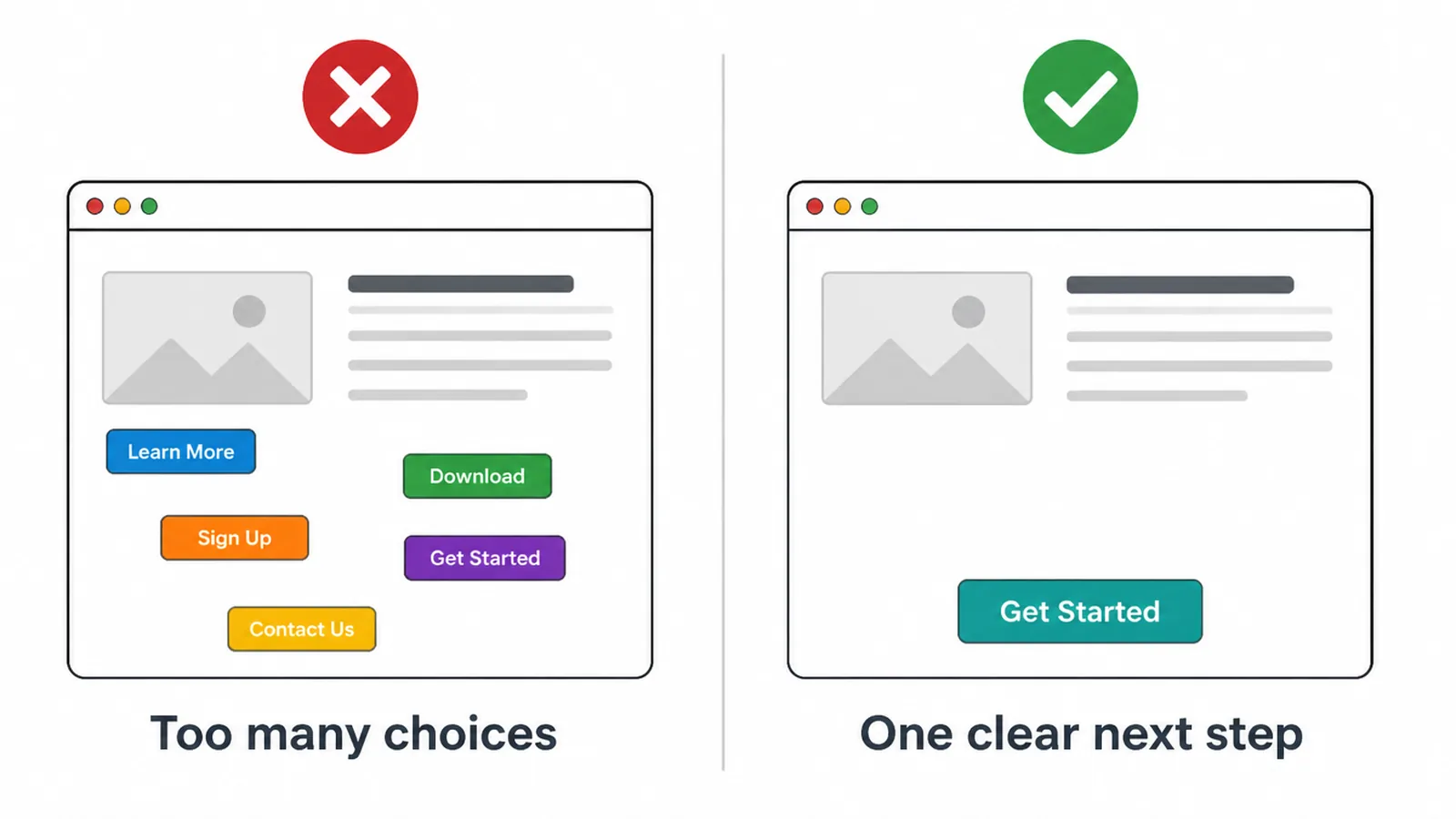
Match the call to action to the post. A how-to guide might end with "want us to do this for you?". A comparison might end with "not sure which fits? Talk to us". Keep it soft and helpful, not pushy. For example, if you would rather have someone build and run your content for you, that is exactly what our team does, so you could get in touch and tell us what you are stuck on. One clear invitation at the end beats five links scattered through the post.
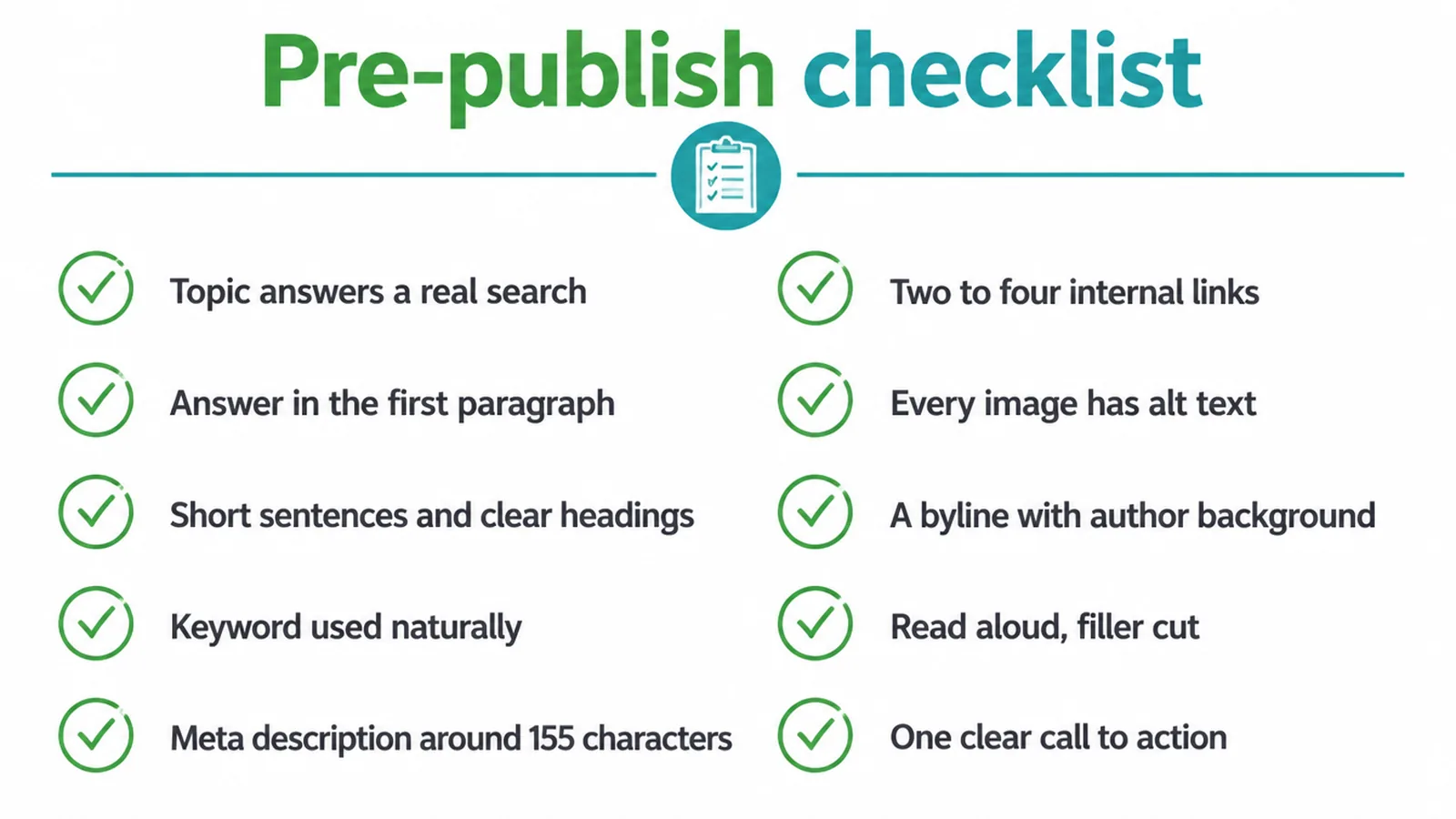
8. Pre-publish checklist
Before you hit publish, run down this list. It takes a few minutes and catches the things that quietly hurt a post.
| # | Check | Why it matters |
|---|---|---|
| 1 | Topic answers a real search | No searches, no readers, no matter how good the writing. |
| 2 | The answer is in the first paragraph | Searchers want the payoff fast, or they leave. |
| 3 | Short sentences and clear headings | Most people skim, so make the post easy to scan. |
| 4 | Keyword used naturally, not stuffed | Forced phrases read badly and can look like spam. |
| 5 | Meta description around 155 characters | It is your ad in the search results, so make it fit and tempt the click. |
| 6 | Two to four internal links added | Helps readers go deeper and helps Google map your site. |
| 7 | Every image has plain alt text | Better accessibility and another signal for search. |
| 8 | A byline with author background | Google wants to know who wrote it and why they know it. |
| 9 | Read aloud, filler cut | Reading out loud catches clunky lines your eye skips. |
| 10 | One clear call to action | Give the reader a single next step, not a dead end. |
9. How long until it ranks?
Here is the honest answer most guides skip: probably not fast, and there are no guarantees. One good post rarely jumps to the top of Google overnight. Ranking follows real quality plus time, as Google crawls your page, weighs it against everyone else, and watches how readers respond.
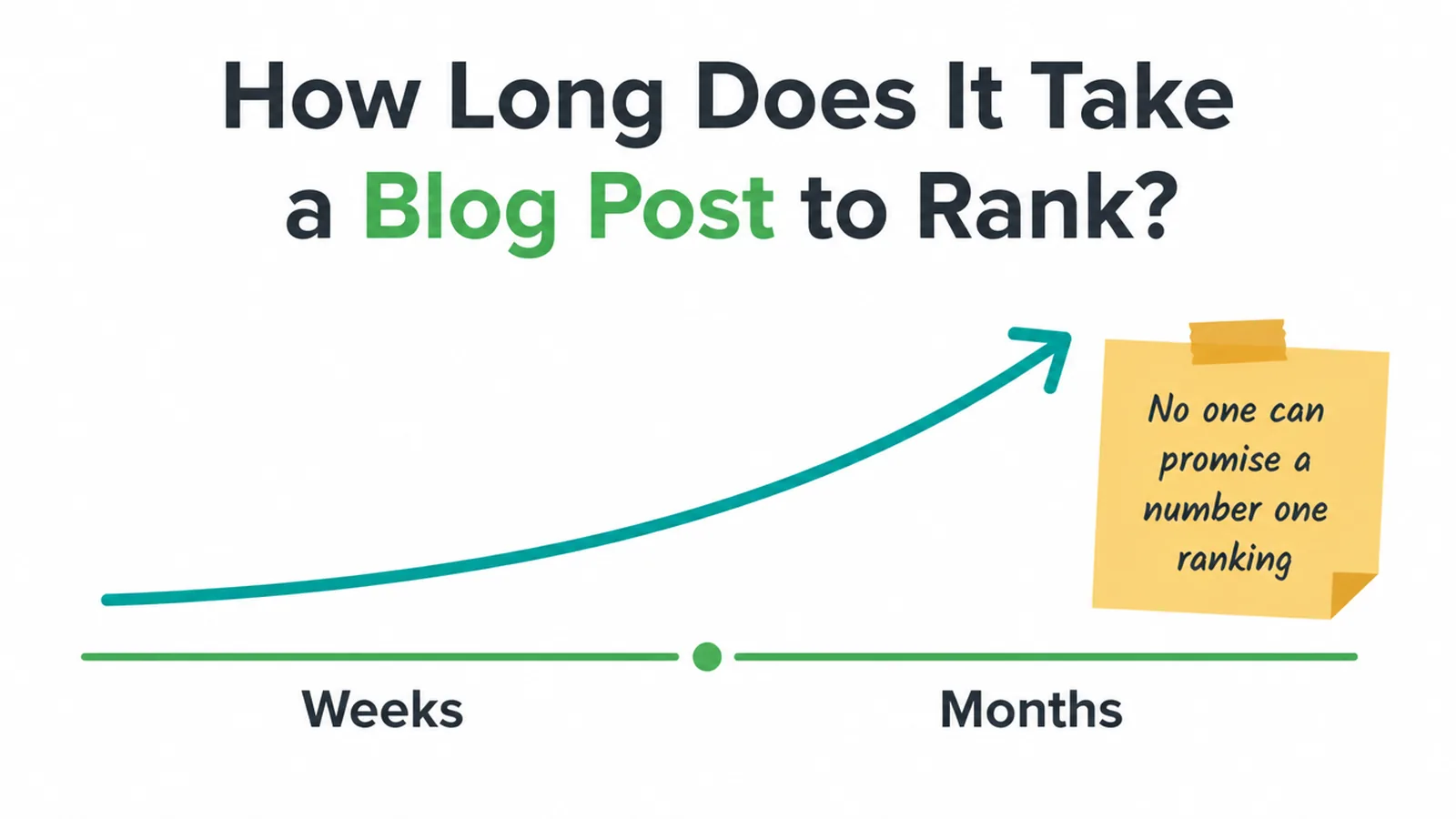
To make a post rank, answer the search intent fully, cover the on-page basics, link it to related pages, and give it time. No one can honestly promise a number one ranking, and quality plus patience is what works. Anyone who guarantees you the top spot is selling something.
This is also why one post is not a content marketing strategy. The businesses that win with content publish steadily and build a library that covers their topic from every angle. A simple plan keeps you consistent, so our guide on building a content calendar shows you how to keep the posts coming without burning out. One post is a start. A habit is what ranks.
Frequently asked questions
1. How do I write a blog post?
Pick a topic people search, outline answer-first, draft it plainly in short sentences with headings, add the SEO basics like title, meta, internal links and image alt text, edit hard, and end with one clear call to action.
2. How long should a blog post be?
Long enough to fully answer the question and no longer. Ignore magic word counts and match the depth the searcher needs. A simple how-do-I answer might be 800 words, while a full guide might be 2,000 or more.
3. How do I structure a blog post?
Hook plus a direct answer up top, then H2 sections that each cover one point in a logical order, short paragraphs, a table or list where it helps, and a call to action at the end.
4. How do I pick a blog topic?
Start from real questions your customers ask you, then check that people actually search those questions. Pick topics you can answer better than what is already ranking.
5. How do I make a blog post rank?
Answer the search intent fully, cover the on-page basics, link it to related pages, and give it time. No one can honestly promise a number one ranking, and quality plus patience is what works.
6. Should I use AI to write blog posts?
AI can help you draft and outline, but Google rewards helpful, people-first content and asks you to disclose automation. Never publish an unedited AI draft, and add your real experience and check every fact.
7. How many times should I use my keyword?
Use it naturally: in the title, the first paragraph, one or two headings, and wherever it genuinely fits. Do not stuff it, and write for the reader first.
8. How do I write an intro that hooks readers?
Name the reader's problem in the first line, then give them the answer straight away. Do not warm up for three paragraphs, because searchers leave if they do not see the payoff fast.

About the author
Gregory Yeoh is the founder of Seed Light, a web design and digital marketing agency. He writes and edits blog content for small businesses every week, so this is the same process we use ourselves: plain writing, the question answered first, and no chasing a ranking with tricks. If you want a hand planning or writing your content, tell us what you are working on.