
Key takeaways
Short on time? Here is the whole method in five lines before we break it down.
- Lead with the benefit, back it with the feature. State the fact, then say what it does for the buyer.
- Answer the buyer's real questions. Size, fit, materials, care, what is in the box, and who it is for.
- Make it scannable. Short intro, bullets for facts, white space, and the key point first (Shopify).
- Be specific, sensory, and honest. Concrete details build trust, empty adjectives do not (Nielsen Norman Group).
- Write your own words, not the manufacturer's, so your page can actually appear and rank.
A good product description tells the buyer what the product is, who it is for, and why it helps them, in plain words they can skim.
Lead with the benefit, back it with specific facts, keep it honest, and write it in your own words. Do that and the same page sells better and ranks better.
Below is the step-by-step method: what a description is for, benefits over features, answering real questions, making it scannable, being specific and honest, avoiding duplicate copy, and ending with a clear next step.
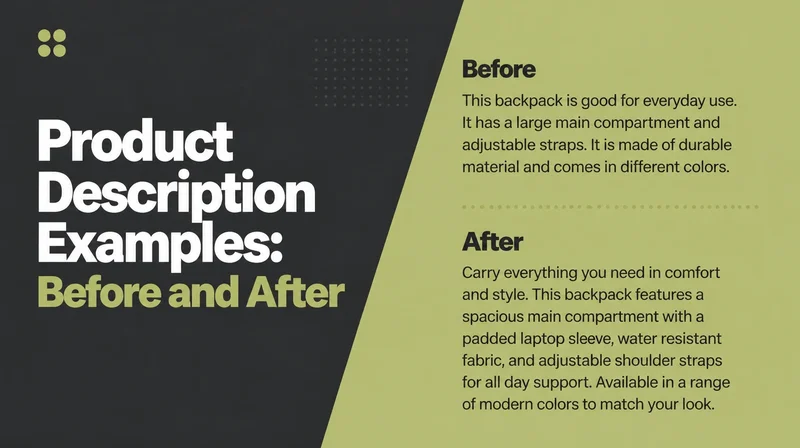
If you learn better from worked samples, our companion post of product description examples shows the before-and-after versions of every rule you are about to read.
2. What a product description is really for
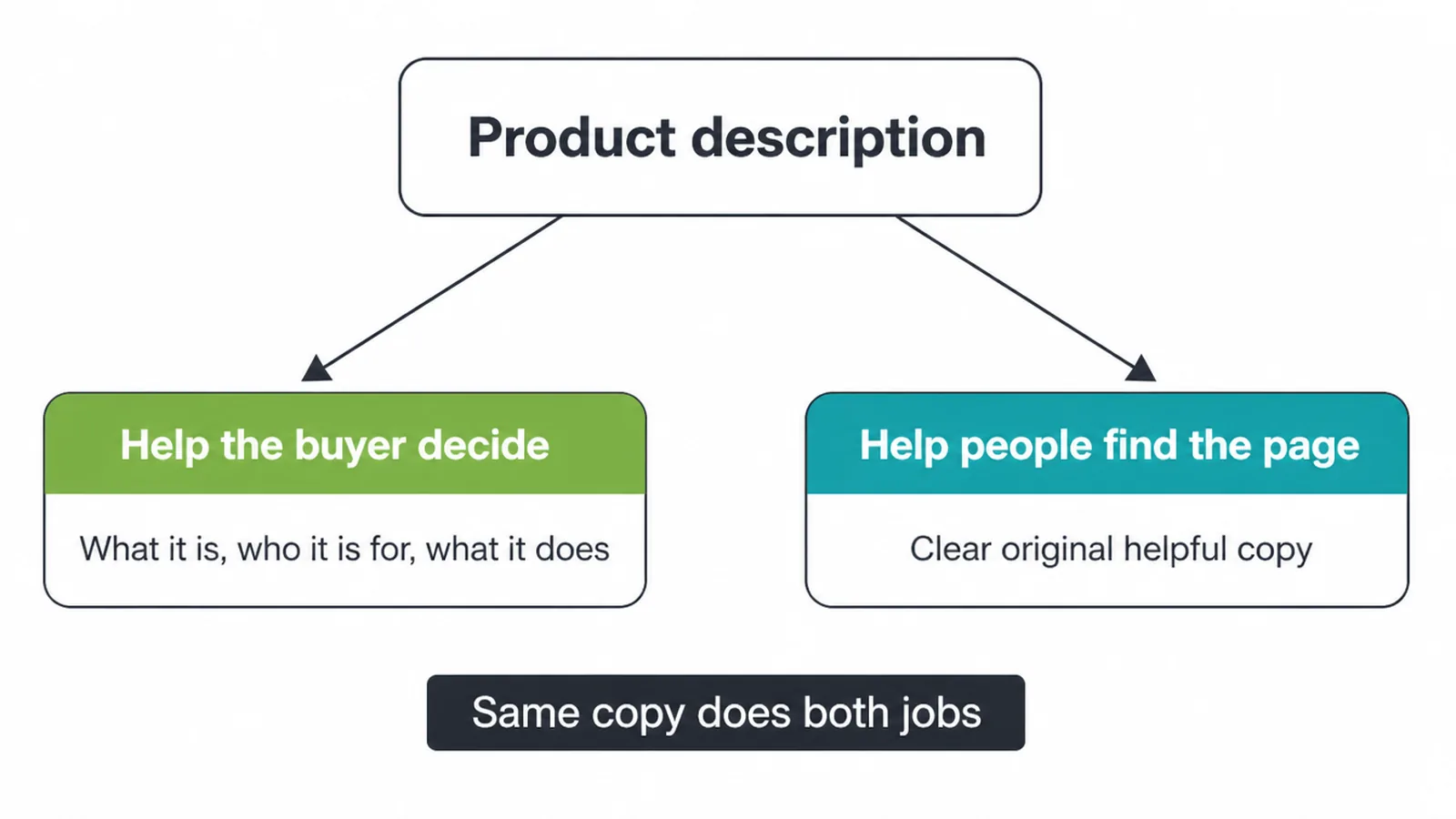
A product description has two jobs. First, it helps the right person decide to buy. Second, it helps shoppers and search engines find and understand the page. Most owners write for neither, and they end up with copy that reads nicely but sells nothing.
What the shopper actually wants
Start with what the shopper actually wants. Nielsen Norman Group puts it plainly: users are not looking for marketing-heavy text, but for a solid description of the product, how it can be used, what it looks like, and what it does (Nielsen Norman Group). In other words, less hype, more substance.
When the information is thin or unclear, the sale is at risk. In the same research, roughly a fifth of task failures were linked to incomplete or unclear product information. That is a lot of lost buyers who simply could not find out what they needed to know.
Being found in search
The second job is being found. That is the search side, and it leans on the same thing: clear, original, helpful copy.
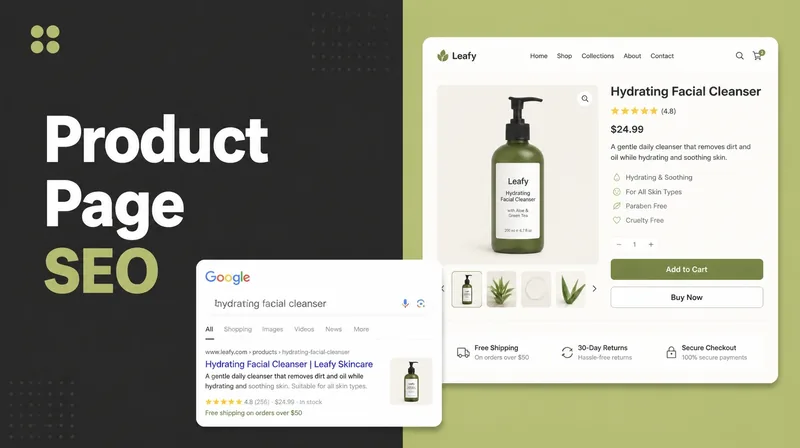
We cover it in full in our guide to product page SEO. For now, hold this thought: the copy that helps a human decide is usually the same copy that helps you rank.
3. Lead with benefits, backed by features
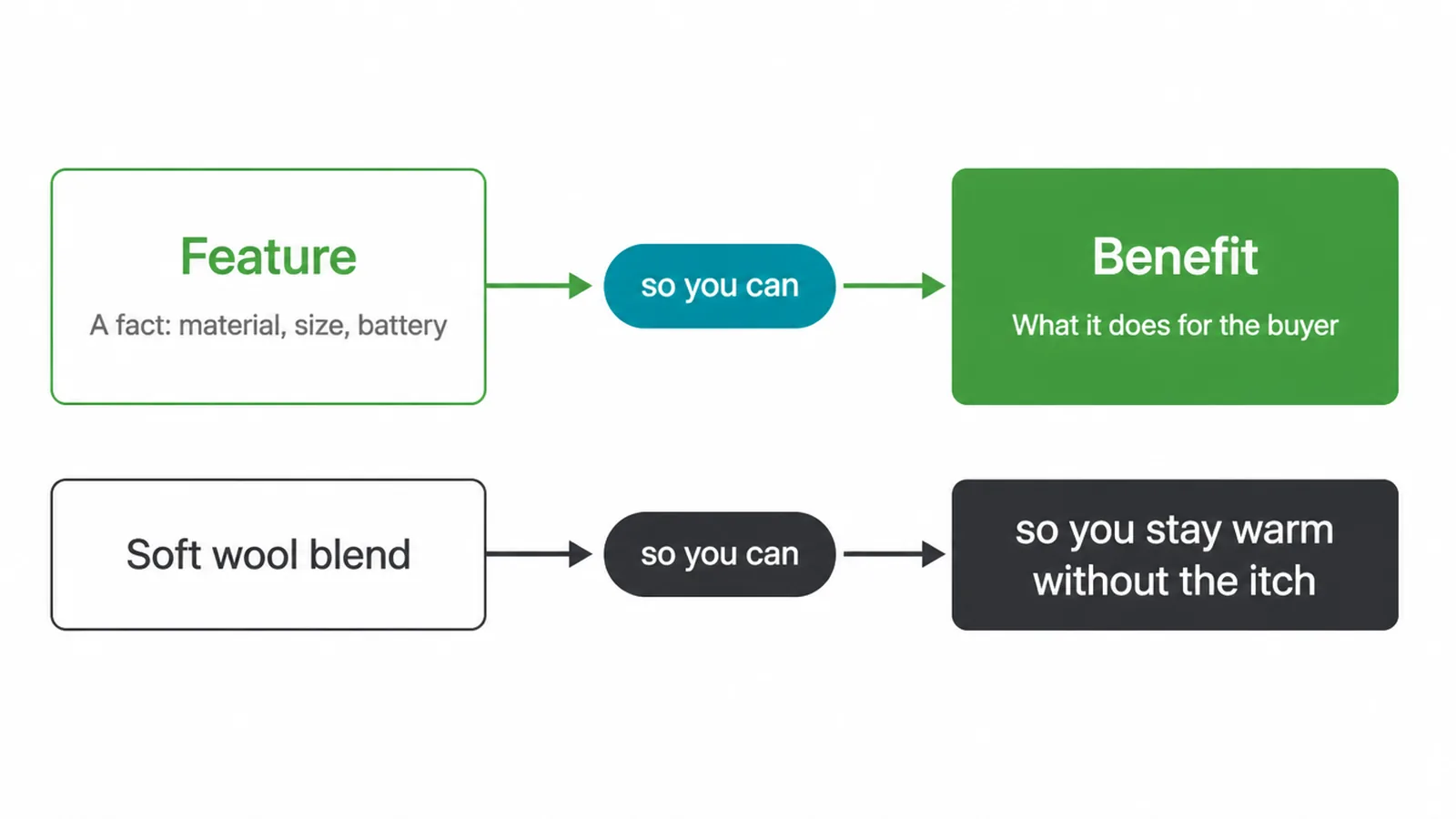
This is the rule that changes the most. A feature is a fact about the product, like the material, the size, or the battery life.
A benefit is what that fact does for the buyer, like keeping them warm, fitting a small kitchen, or lasting a full workday. Buyers care about the benefit. The feature is your proof.
Shopify gives the same advice: highlight your product's benefits so that your customers know how it could help them, and you might want to organise your features and benefits in a bulleted list (Shopify). So go past the specs. Connect each one to a payoff.
State the feature, then add so you can
The simple formula is: state the feature, then add "so you can" or "which means". A wool blend becomes "a soft wool blend, so you stay warm without the itch".
A folding frame becomes "folds flat, which means it tucks behind a door". Same facts, but now the buyer sees themselves using it. Keep the feature in the line. The benefit sells, and the feature makes it believable.
4. Answer the questions a buyer actually has
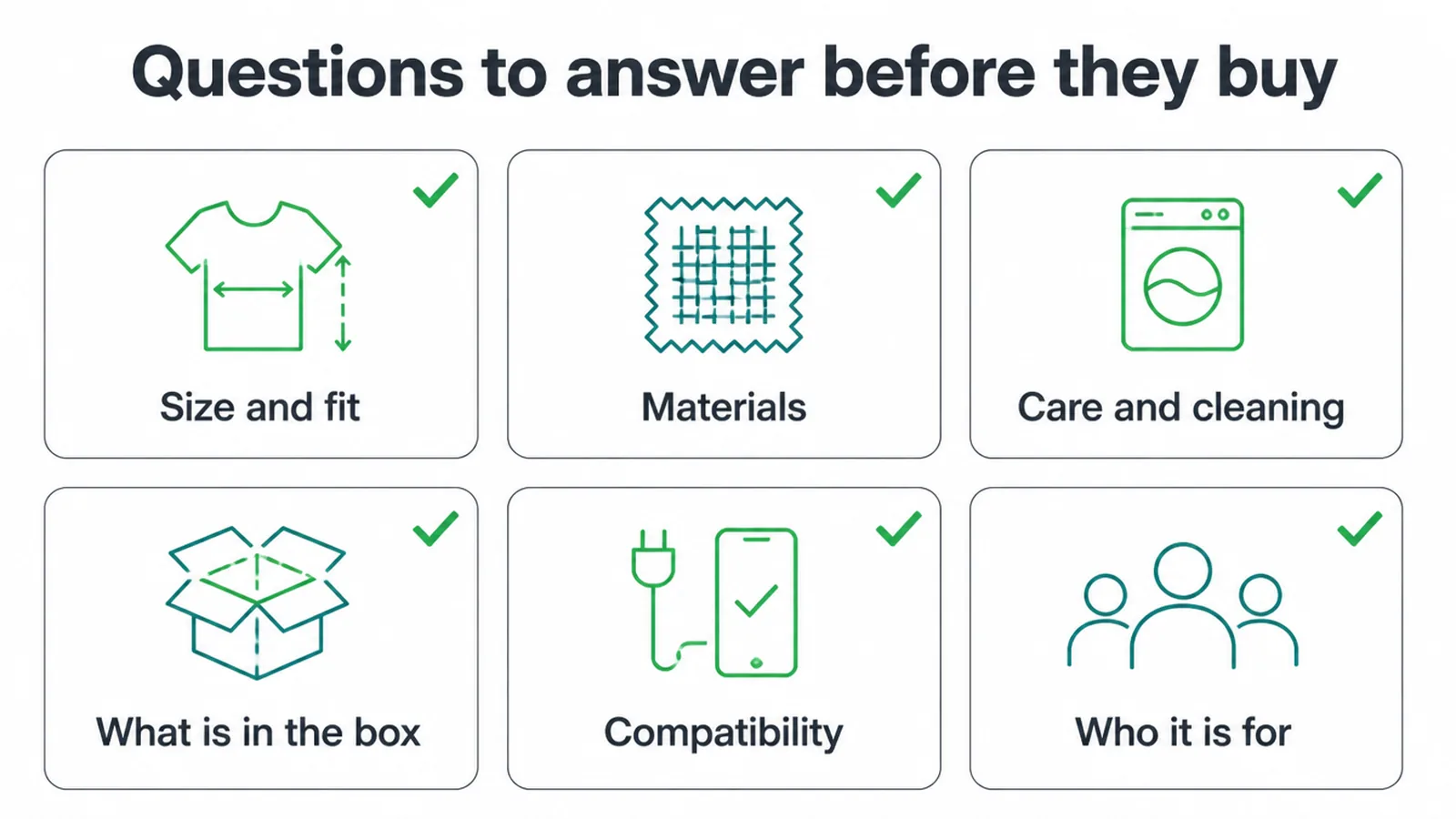
Every shopper has a short list of questions before they buy, and if you do not answer them, they leave. Your description should quietly tick each one off. The usual list is:
- size and fit
- materials
- care and cleaning
- what is in the box
- compatibility with things they own
- who the product is for
Nielsen Norman Group found shoppers want concrete details, and named examples like the accents on clothes, the dimensions of furniture, the care of clothing, the size of toys, and the proper storage of edible products (Nielsen Norman Group).
The same research sets three core requirements for product content: answer the user's questions, get to the point without being wordy, and let people compare products. Hit those three and you are most of the way there.
Read your reviews and customer messages
How do you know which questions to answer? Read your own reviews and customer messages. The questions people ask before they buy, and the complaints they make after, are a free list of exactly what your description is missing. Add the answers, and you cut the doubt that sends buyers off to search elsewhere.
5. Make it scannable
Nobody reads a product page word for word. They skim. So the way your copy is laid out matters as much as what it says.
Nielsen Norman Group found people read more at the beginning of a description than the end, and more at the start of a line than the end of a line (Nielsen Norman Group). Translation: put the important point first, in the paragraph and in the sentence.
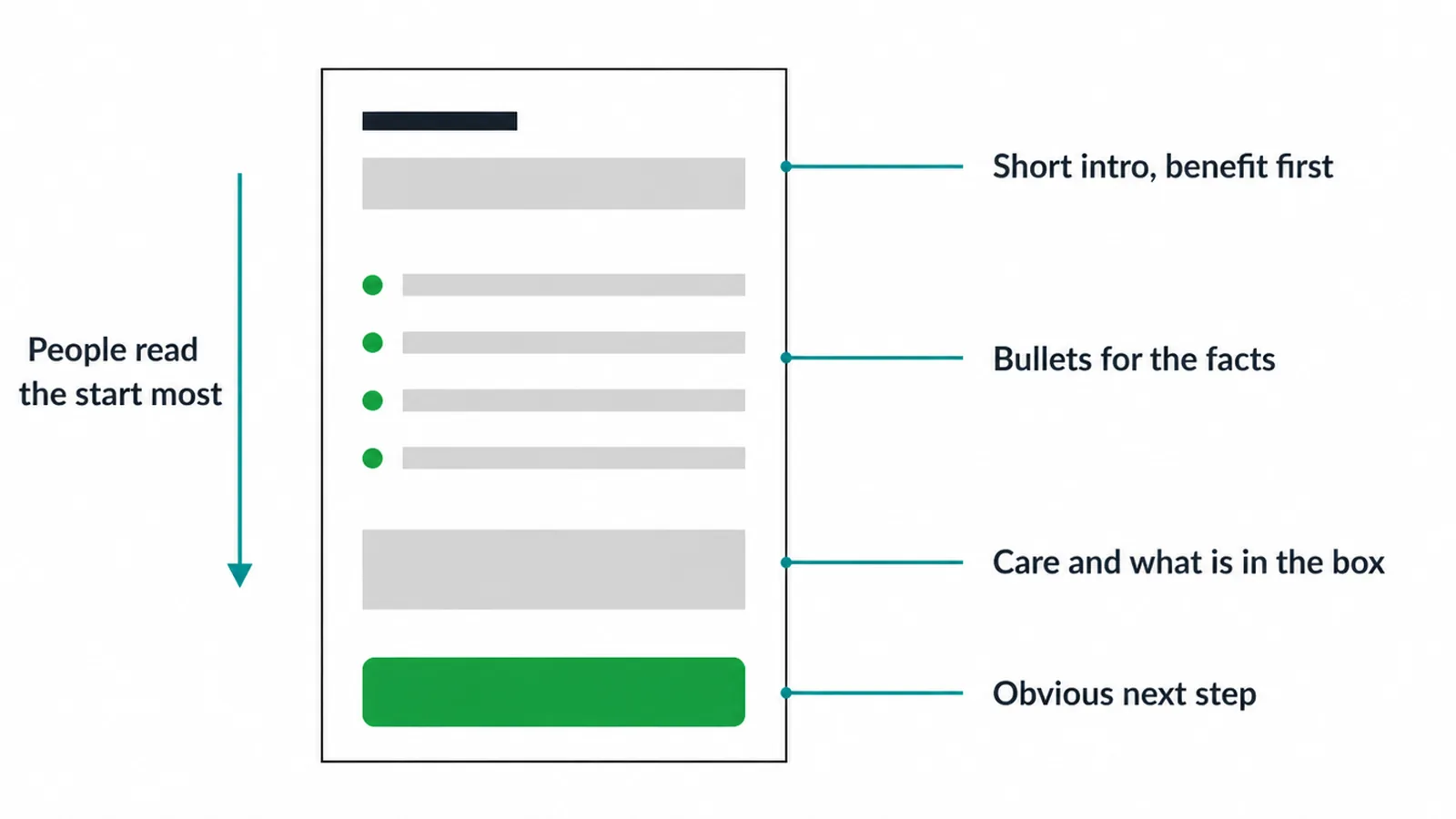
Shopify says the same about format: entice the visitor with headlines, use bullet points for lists, include plenty of white space, and increase the font size to promote readability (Shopify).
A good shape is a short intro that leads with the benefit, then a bullet list for the facts, then a line on care or what is in the box. Easy to skim, easy to buy.
Here is the pattern in a do and don't table you can keep beside you while you write.
| Do | Don't |
|---|---|
| Lead with the benefit, then the feature | Open with a spec dump nobody reads |
| Use short bullets for facts | Write one long grey paragraph |
| Put the key point in the first line | Bury the important detail at the end |
| Give exact details (size, material, care) | Say "excellent quality" and nothing real |
| Write your own words | Paste the manufacturer's description |
| Use true sensory words | Pile on empty adjectives |
| Answer the buyer's real questions | Guess or leave gaps that send them to search |
| Make the next step obvious | Hide the size guide or add-to-cart |
6. Be specific and sensory (but true)
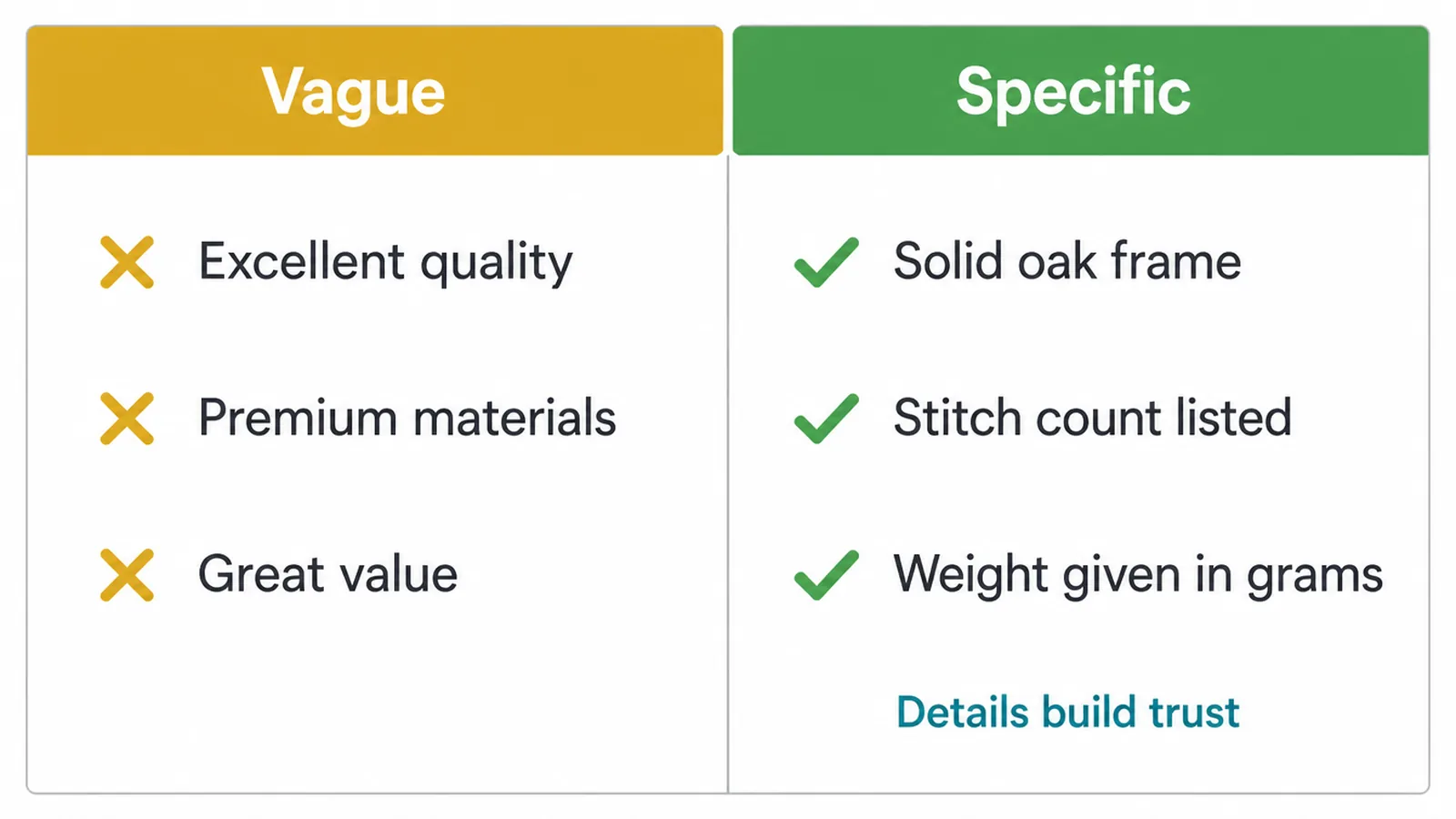
Specific beats vague every time. Shopify puts it bluntly: be specific, because product details add credibility and help to sell your product, and writing something vague like "excellent product quality" does not tell your customer anything substantial (Shopify).
So swap "high quality" for the actual detail. A stitch count, a weight, a wood type, a real number. The specific version does the convincing that the empty adjective never could.
Sensory words that are true
Sensory words help too, when they are honest. Shopify notes that adjectives describing a sensory interaction with the product help customers experience it as they read, with food examples like velvety, smooth, crisp, and bright.
A shopper who can almost taste, feel, or hear the product is a shopper who is picturing owning it. That is a small nudge toward the buy.
One warning. Sensory does not mean stuffing every line with adjectives. Two true, vivid words beat ten vague ones. If a word is not accurate, cut it. Empty hype is worse than plain description, because buyers have learned to skip straight past it.
7. Stay honest
Honesty is not the boring option. It is the one that keeps customers. Remember the shopper wants a solid, accurate picture of what the product is and does, not marketing hype (Nielsen Norman Group).
When your copy matches what turns up at the door, people trust you and keep the item. When it oversells, they feel tricked and send it back.
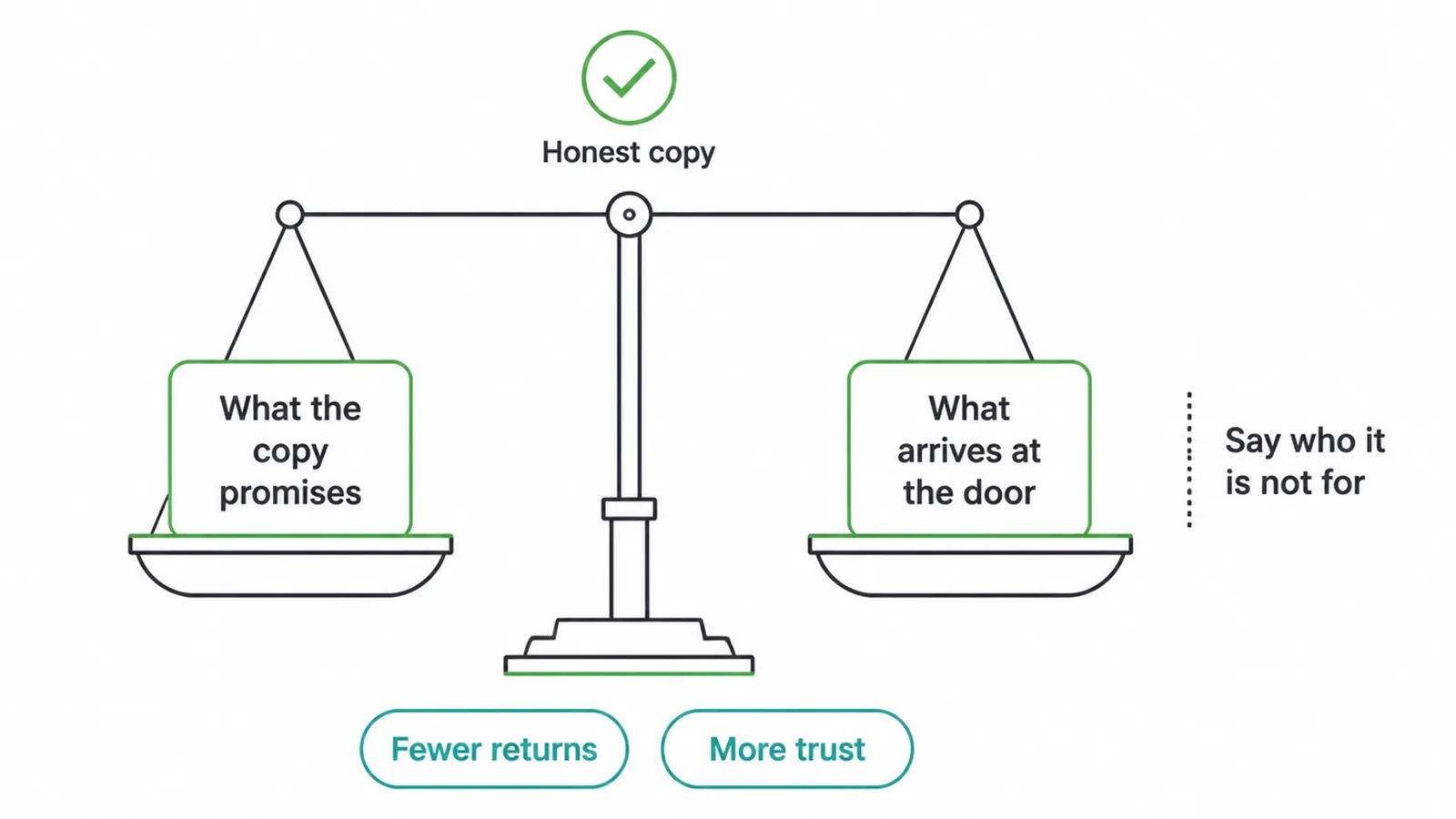
Accurate copy sets the right expectations, and that is what cuts returns and builds repeat buyers. It also, quietly, lifts your conversion rate, because trust and clarity are what move people to act. We dig into that in our guide on how to increase your website conversion rate.
Say who the product is not for
Sometimes the most honest move is saying who the product is not for. A jacket that is great for mild days but not for winter.
A tool built for light home use, not a job site. Naming the limit does not scare off the right buyer. It reassures them, and it filters out the wrong ones before they buy and complain.
8. Do not copy the manufacturer's blurb
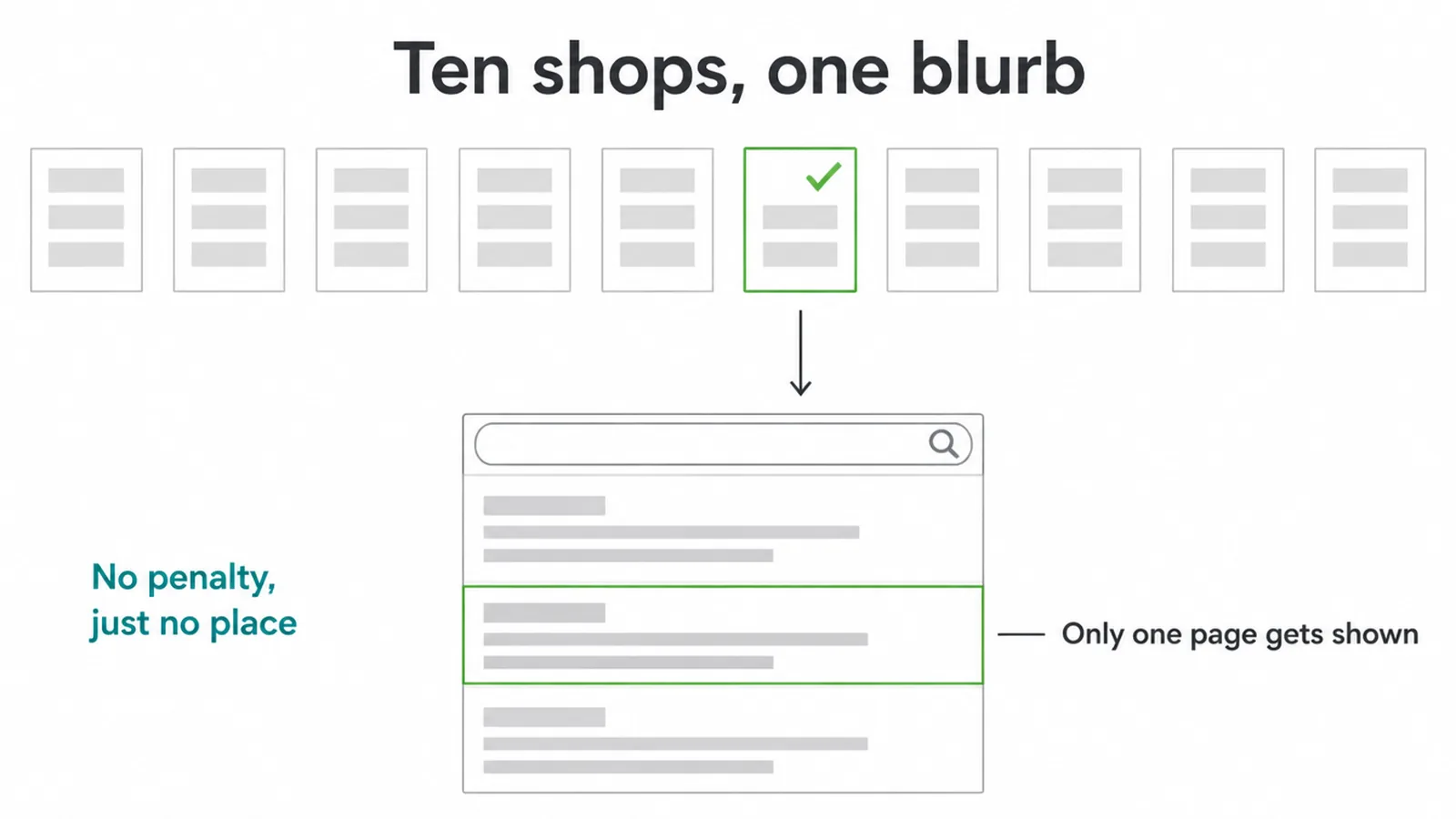
It is tempting to paste the maker's description and move on. Here is why that quietly hurts you. Google's John Mueller has explained there is no penalty for using the same description as the manufacturer when the rest of your site is different.
But Google tries not to show the same text twice, so it may pick just one page to display, and that page could be a competitor's instead of yours (Search Engine Journal).
It is about your page appearing, not a penalty
So it is not about a penalty. It is about your page actually appearing. If ten shops all run the identical blurb, most of them stay invisible for that product. The shop that wrote its own words is the one with a fighting chance to be shown and clicked.
Original copy also just sells better, because it can speak to your buyer in your voice. Two wins from one bit of writing. For the full search side of this, see our guide to product page SEO.
9. Write like you are talking to one buyer
The best descriptions sound like a helpful person, not a brochure. Shopify suggests you ask and answer questions as if you are having a conversation with your ideal customer, rather than writing generically to no one in particular (Shopify).
So picture one real buyer. What would they ask? What would reassure them? Write to that person.
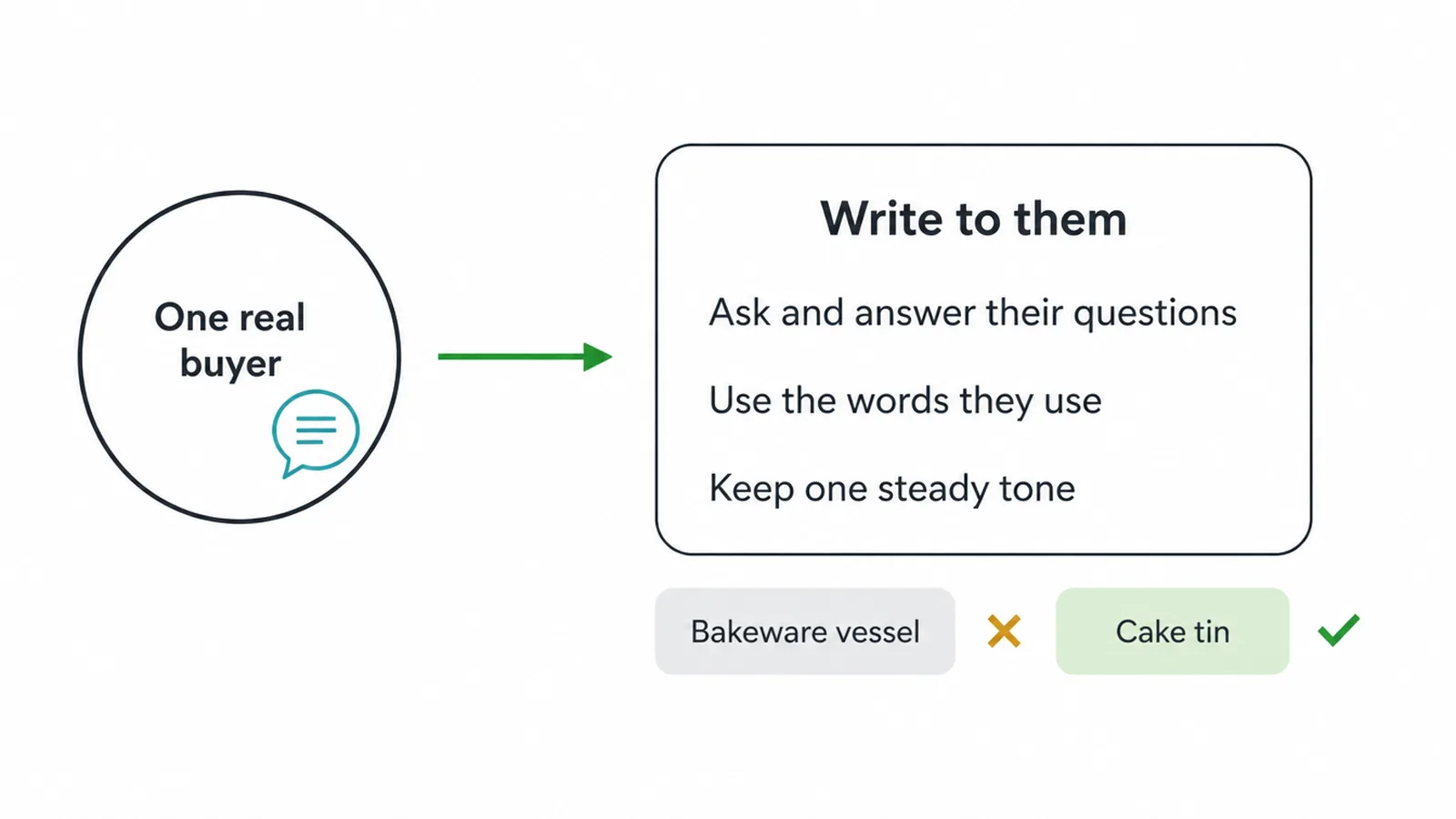
Use the words your buyers use
Match the words to who they are. A description for a busy parent reads differently from one for a hobbyist chef, even for a similar product. Use the words your buyers use, not internal jargon. If they call it a "cake tin", do not write "bakeware vessel".
Keep the voice steady across your whole store too. When every description follows the same shape and tone, shoppers can compare products quickly, which is one of the three things Nielsen Norman Group says product content must let people do. Consistency helps people choose.
10. End with a clear next step
A description that convinces someone and then leaves them wondering what to do has wasted its own work. Every product page should make the next action obvious. Add to cart.
Choose a size. See the size guide. Whatever the step is, it should be right there and easy to spot, not buried below the fold or hidden in small text.
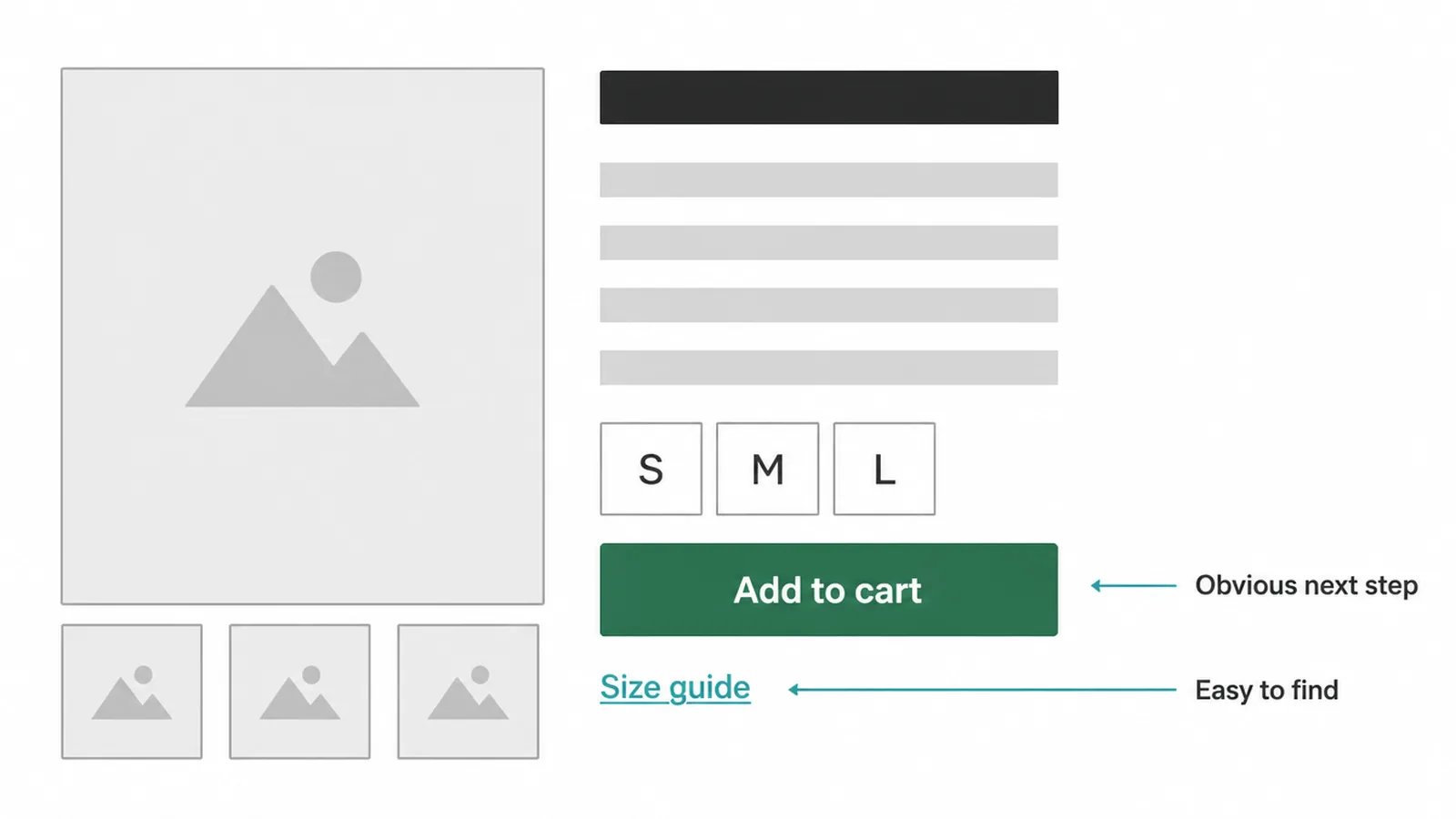
The copy and the buy button work as a team. Great words with a weak, hidden button still lose the sale. A clear layout where the description flows straight into an obvious action is what turns a reader into a customer.
If your store is fighting you on that, our e-commerce website design work builds pages where the copy and the checkout pull in the same direction.
11. A quick checklist before you publish
Run each description past this list before it goes live. If you can tick every box, you have a description that sells and stands a real chance of ranking.
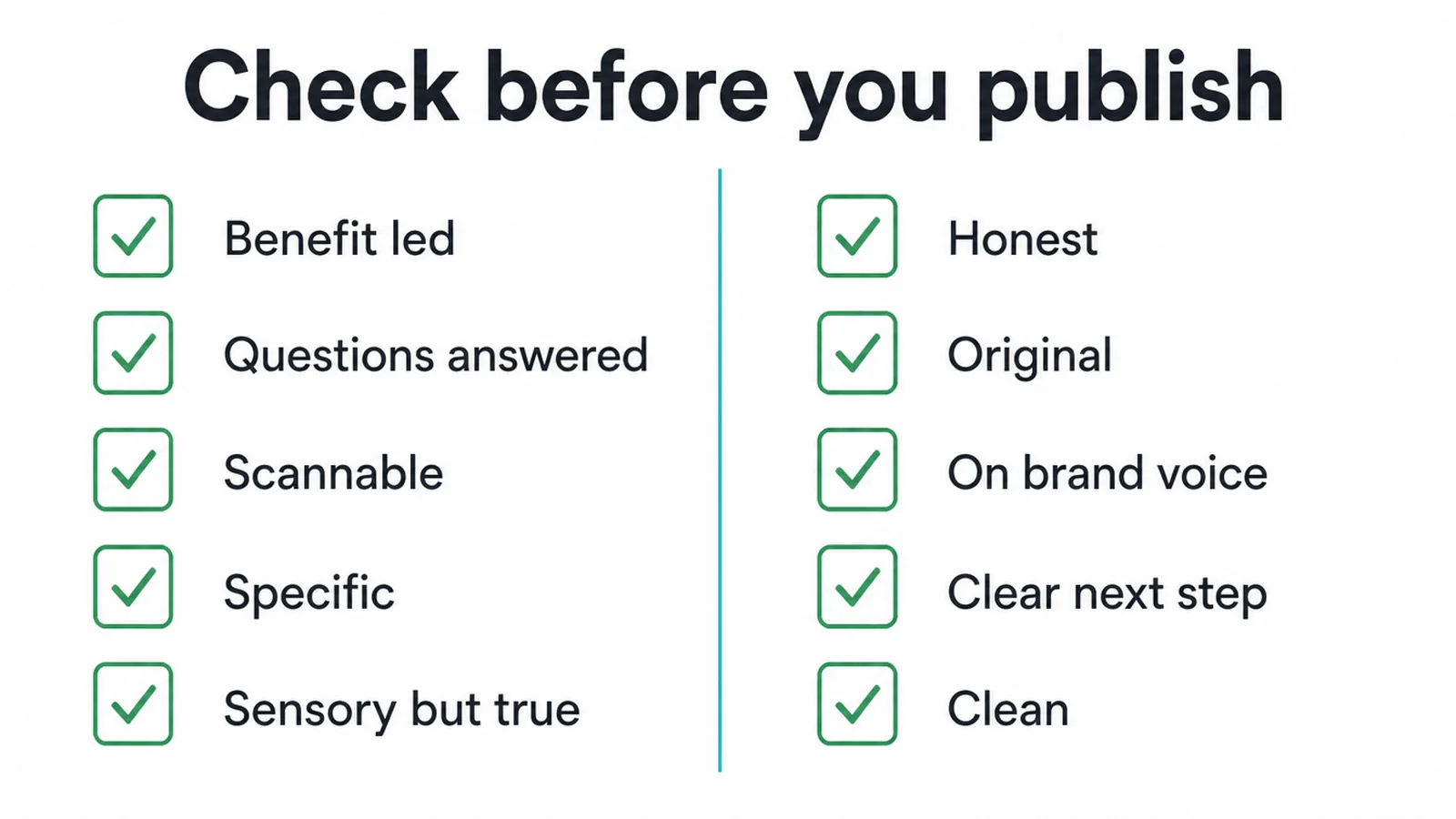
- Benefit-led: the first line says what the buyer gets.
- Questions answered: size, materials, care, what is in the box, who it is for.
- Scannable: short intro, bullets for facts, white space, key point first.
- Specific: real details, no "excellent quality" filler.
- Sensory but true: a couple of honest, vivid words, not a pile of adjectives.
- Honest: it matches the product, limits and all.
- Original: your words, not the manufacturer's blurb.
- On-brand voice: written to one real buyer, in words they use.
- Clear next step: add-to-cart and size guide are obvious.
- Clean: reads well on mobile, no typos.
Frequently asked questions
1. How long should a product description be?
Long enough to answer the buyer's real questions and no longer. A simple, familiar item may need only a few short lines and a bullet list. A complex or costly item needs more detail on size, materials, use, and care. Lead with the most important point, because people read the start far more than the end.
2. Should I write about features or benefits?
Both, but connect them. A feature is a fact, like the material or size. A benefit is what that fact does for the buyer, like keeping them warm or saving them time. Shopify advises highlighting benefits so customers know how the product helps them. State the feature, then say why it matters.
3. Can I just use the manufacturer's description?
You can, and Google will not penalise you for it. But Google tries not to show the same text twice, so it may choose to display a competitor's page instead of yours. Writing your own words gives your page a better chance to appear in search and helps it stand out.
4. How do I make a product description good for SEO?
Write unique copy that answers what buyers search for, and use the words they actually use in the heading and first lines. Add clear details like size, material, and use. Do not stuff keywords. Helpful, specific, original copy is what both shoppers and search engines reward.
5. What should a product description include?
What the product is, who it is for, what it does, and the details buyers ask about, such as dimensions, materials, care, and what is in the box. Nielsen Norman Group found shoppers want concrete details like the size of furniture or the care of clothing.
6. How do I make descriptions easy to read?
Break the text up. Use a short intro, then bullet points for the facts, plenty of white space and clear headings. Put the key point first and keep sentences short so the details are easy to scan.
7. Are sensory and specific words worth it?
Yes, when they are true. Specific words add credibility, and sensory words help a shopper picture using the product before they buy. Shopify gives food examples like velvety, smooth, and crisp. Avoid vague filler like excellent quality, which tells the buyer nothing.
8. Should product descriptions be honest about limits?
Yes. Buyers want a solid, accurate picture of what the product is and does, not marketing hype. Honest copy sets the right expectations, which means fewer returns and more trust. Say who the product is not for if that helps the right buyer decide.