
Key takeaways
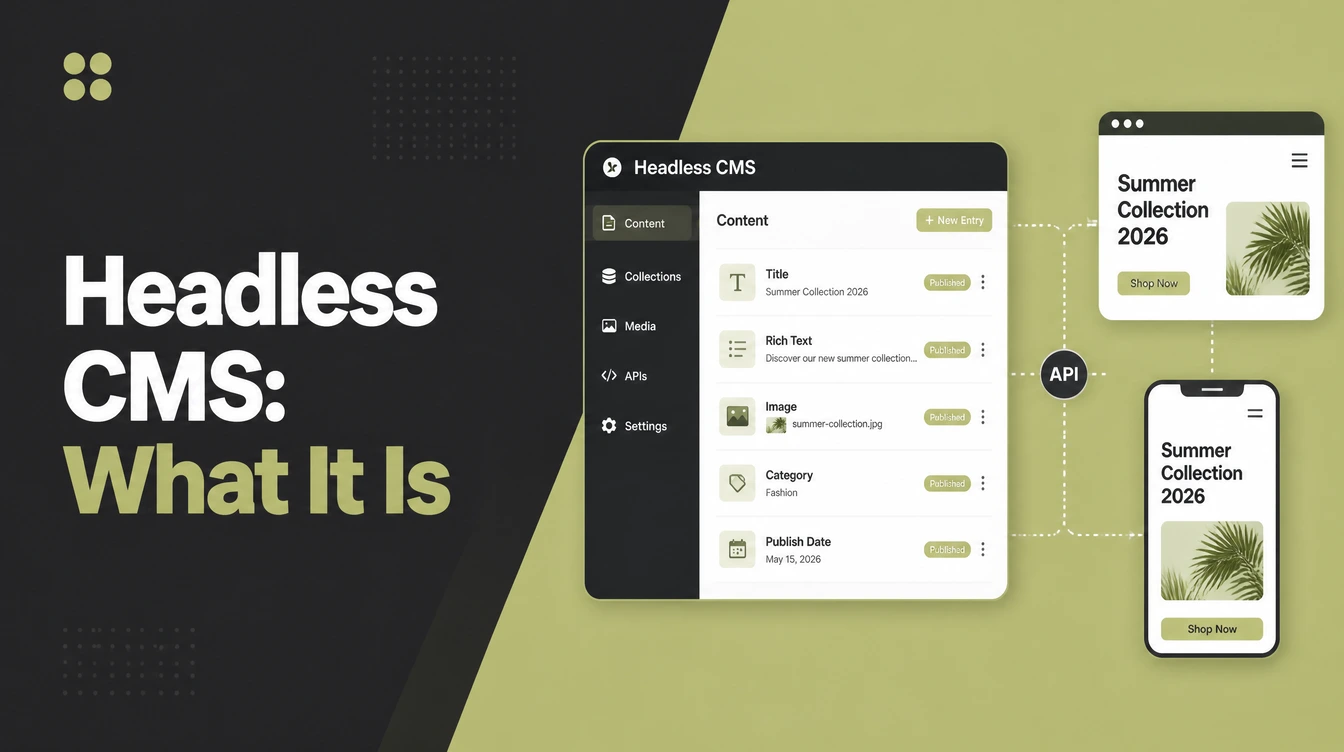
- Headless means split. A headless CMS separates your content (the body) from your public site (the head), connected by an API.
- Most of the web is still traditional. About 51% of sites in the Web Almanac desktop dataset ran on a CMS in June 2024, and the bulk of that is the traditional, all-in-one kind.
- Speed is the real prize. A tiny mobile speed gain of 0.1s was linked to an 8.4% lift in retail conversions by Google and Deloitte.
- Security has a plugin angle. 96% of 2024 WordPress vulnerabilities were in plugins, and a headless front end often loads fewer of them.
- Most small businesses do not need one. If you have one site you edit yourself, traditional is simpler. Headless fits multi-channel, developer-backed setups where speed and scale matter.
1. What is a headless CMS?
A headless CMS is a content system where the place you manage content (the "body") is separated from the place visitors see it (the "head"), connected by an API. You write your text and upload your images in a dashboard.
A developer builds the public website, app, or screen that pulls that content in and shows it. The two halves are decoupled. That split is the whole idea behind a headless CMS.
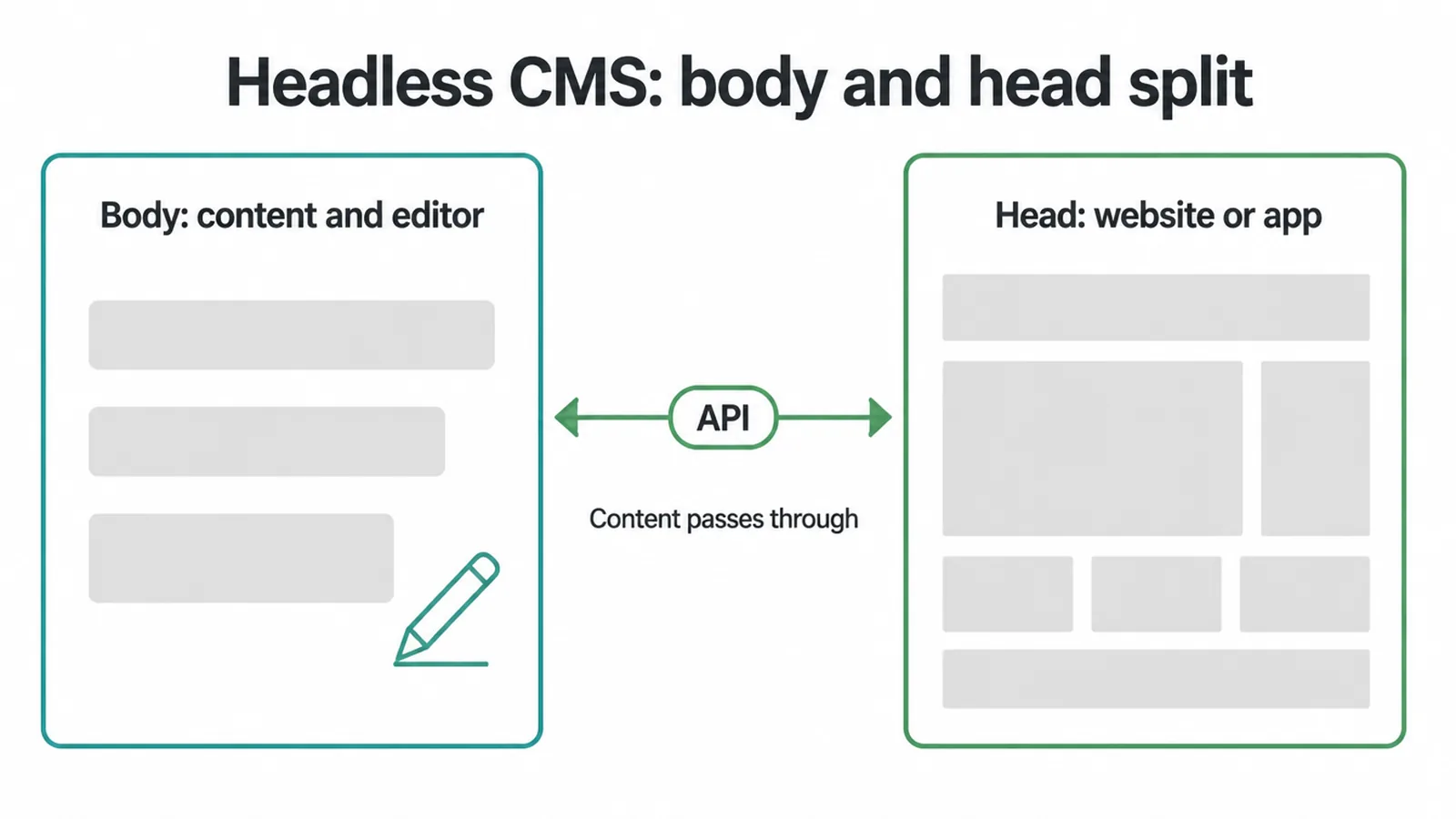
Picture a restaurant. The kitchen prepares the food. The dining room serves it. A traditional setup is one building that does both.
Headless is a kitchen that can send food to a dining room, a food truck, and a delivery app all at once. The kitchen does not care where the food ends up. It just makes the content and hands it over.
If the basics of a content system are new to you, start with our plain-English guide to what a content management system is. This post assumes you know that part and goes one level deeper into the architecture.
2. Headless vs traditional CMS
A traditional CMS bundles everything together. WordPress is the classic example. It stores your content, gives you the editor, and builds the public pages, all in one place. That is why it is so popular.
WordPress powers about 41.5% of all websites and holds a 59.3% CMS market share, according to W3Techs. Most of the web you visit runs on a traditional, all-in-one system.
A headless CMS strips out the public-page part. It keeps your content and your editor, then hands the content to any front end through an API.
A developer decides how the site looks and how fast it loads. The trade is freedom for simplicity. You gain control over the front end, and you take on the job of building it.
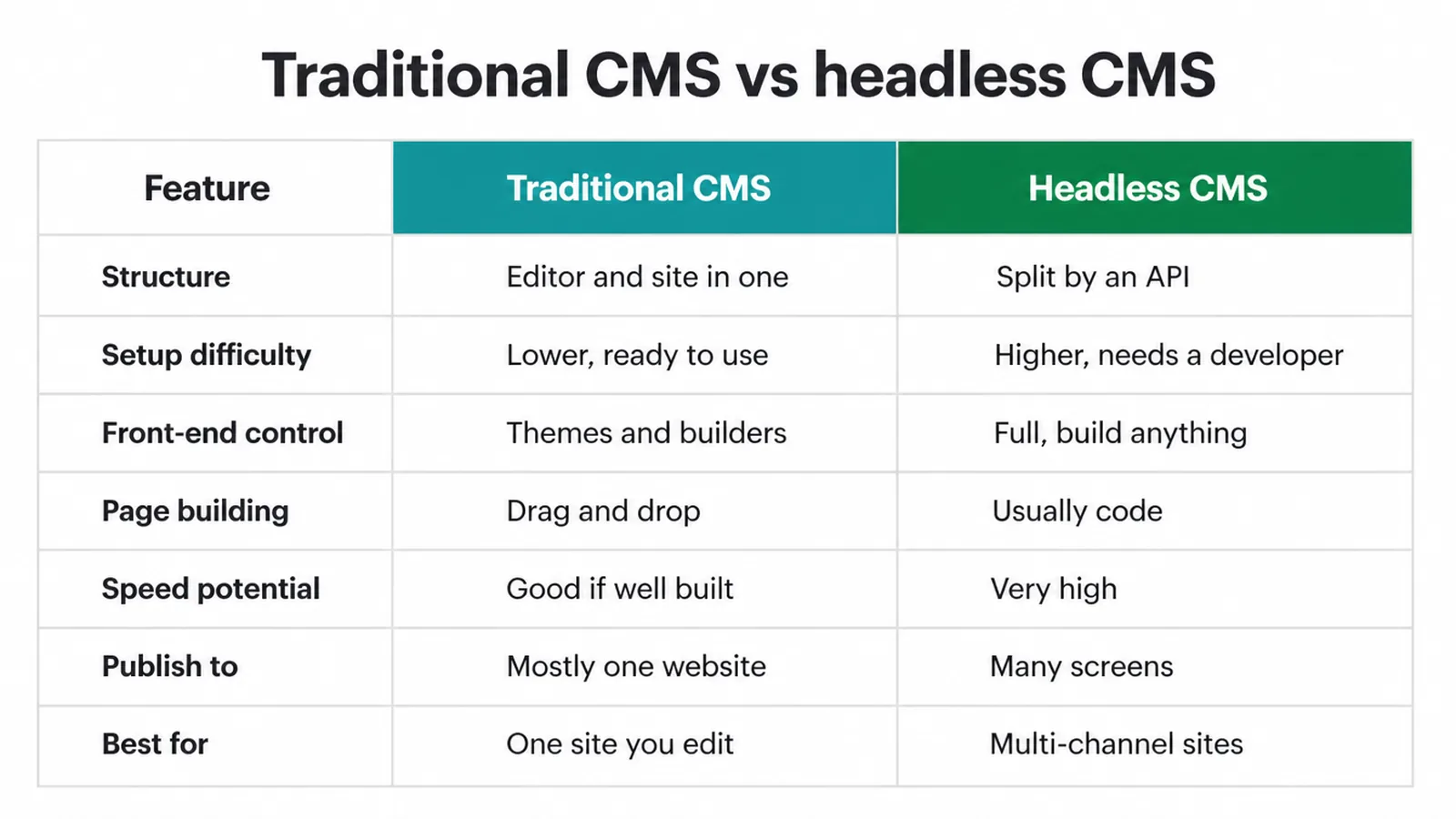
| Feature | Traditional CMS | Headless CMS |
|---|---|---|
| Structure | Editor and public site in one | Content and front end split by an API |
| Setup difficulty | Lower, ready to use | Higher, needs a developer |
| Front-end control | Limited to themes and builders | Full, build anything |
| Page building | Drag-and-drop available | Usually code, no simple builder |
| Speed potential | Good if well built | Very high, often static and fast |
| Publish to many places | Mostly one website | Website, app, kiosk, many screens |
| Best for | One site you edit yourself | Multi-channel, developer-backed sites |
There is a close cousin worth knowing: the static website. A headless CMS often feeds a static front end, where pages are pre-built into fast files and served as-is. That pairing is a big reason headless sites can feel quick.
3. The upsides of going headless
The first upside is speed. A headless front end can be tuned hard and often served as static files, so it loads fast. Speed pays.
A 0.1s mobile speed improvement was linked to an 8.4% lift in retail conversions and a 10% lift in travel in Google and Deloitte research. If you want to understand the page-speed metrics that matter, our guide to Core Web Vitals breaks them down.
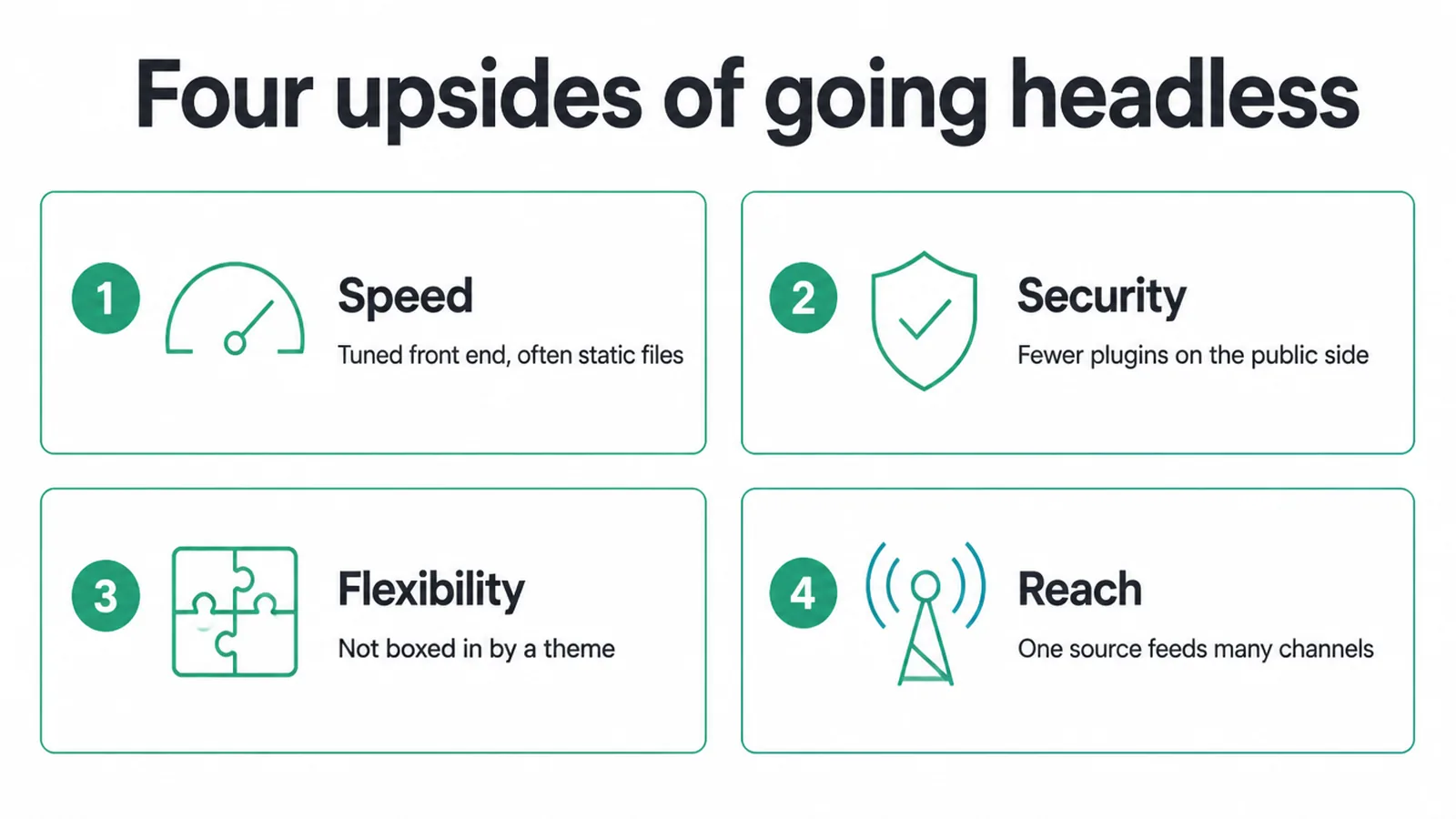
The second is security. Much of the WordPress risk lives in add-ons. 96% of 2024 WordPress vulnerabilities were in plugins, with only 4% in themes, per Patchstack.
Worse, 33% of those vulnerabilities were not fixed in time for public disclosure. A headless front end usually loads fewer plugins on the public side, which can shrink that exposure.
The third is flexibility. Because the front end is yours to build, you are not boxed in by a theme.
You can craft an experience that fits your brand exactly, and a developer can optimise every detail. If that level of control appeals to you, that is the realm of custom web design and development.
The fourth is reach across channels. One content source can feed a website, a mobile app, and an in-store screen at the same time. If you publish the same content to many places, that single source of truth saves real time and prevents mismatched information.
4. The downsides to weigh
Headless is not free of trade-offs. The biggest is cost. Someone has to build and maintain the front end, and that someone is usually a developer. With a traditional CMS, a theme and a page builder get you most of the way for far less effort.
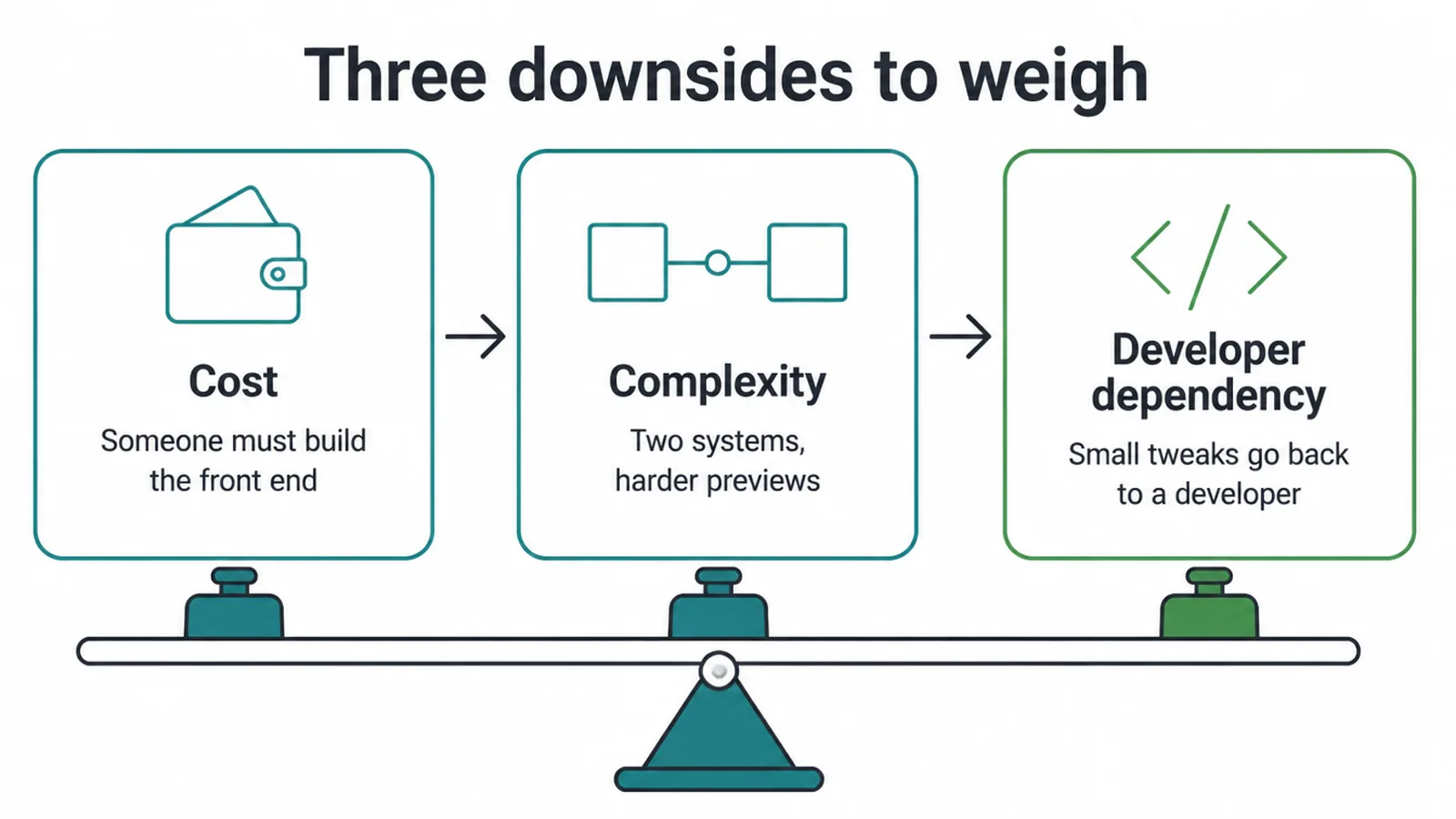
The second downside is complexity. Two systems mean two things to set up, connect, and keep running. Previewing changes before they go live can be clumsier, because the editor and the public site are not the same place. There is no drag-and-drop builder to move blocks around on a whim.
The third is the developer dependency itself. With a traditional setup, many owners can make small layout changes alone. With headless, front-end tweaks often go back to a developer. That is fine if you have one. It is friction if you do not. Be honest about who will maintain the site a year from now.
5. Is a headless CMS better for SEO?
It can be, but it is not automatic. The upside is real. A fast, clean front end helps both rankings and the visitors who land on it, and speed is part of how Google judges a page. Our guide on how to rank higher on Google covers why that matters.
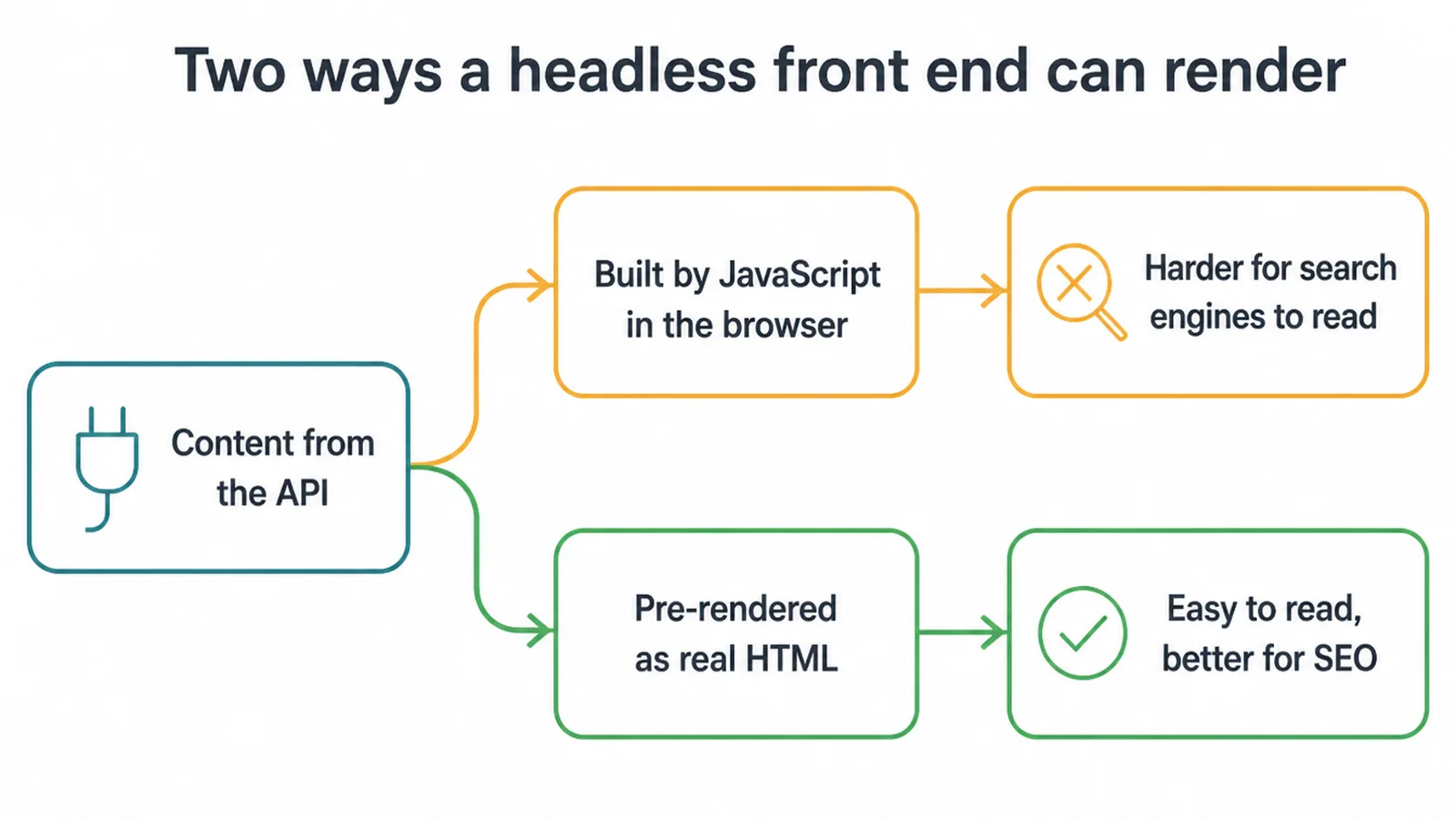
The catch is rendering. Some headless front ends build content with JavaScript in the browser. If a search engine or AI tool cannot read that content easily, your pages can underperform no matter how modern the stack is.
The fix is to serve real HTML, often by pre-rendering or static generation. A good build does this by default. A careless one does not.
So headless is a tool, not a guarantee. The fundamentals still decide your results. If you want the rankings to follow, pair the architecture with a real plan from a team that does SEO properly.
6. Can WordPress be headless?
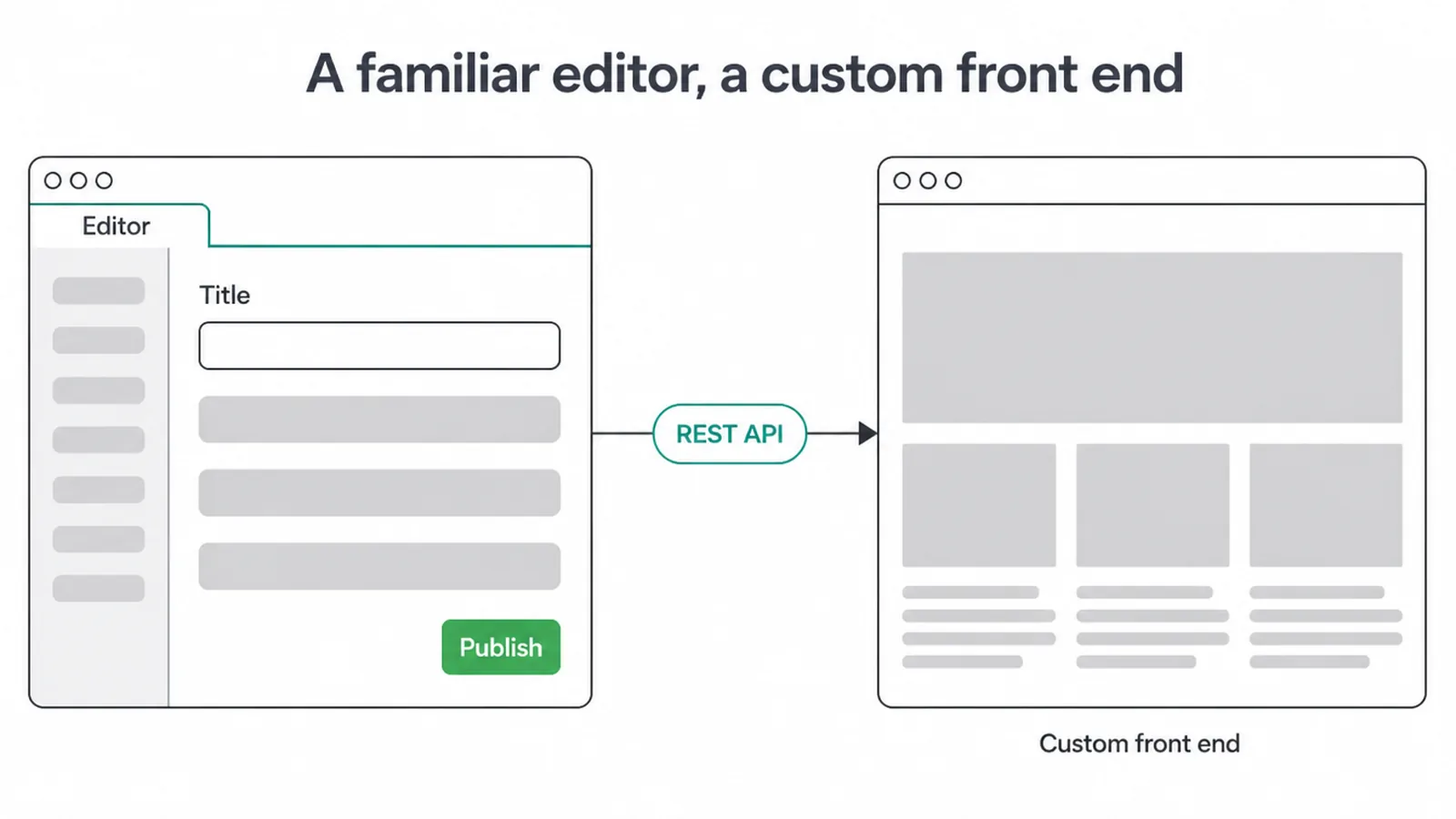
Yes. WordPress can run headless by using its REST API as the body where you manage content, while a separate custom front end displays it.
You keep the familiar editor your team already knows, and a developer builds the public site on top of it. This very site runs that way, so we speak from the editor's chair, not a sales deck.
There are also purpose-built headless tools, sometimes called headless-first platforms. Common names include Sanity, Contentful, Strapi, and Storyblok. They start life with no front end at all, so the API is the whole product. WordPress, by contrast, was traditional first and can be coaxed into headless mode.
If you are still choosing your platform from scratch, our comparisons can help you weigh options, like Wix vs WordPress and WordPress vs Webflow. Pick the body before you worry about the head.
7. Do you actually need one?
Probably not, and that is an honest answer. If you have one website that you edit yourself, a traditional CMS is simpler, cheaper, and faster to live with. The split-system overhead buys you nothing when you only have one place to publish. Most small businesses are in exactly this spot.
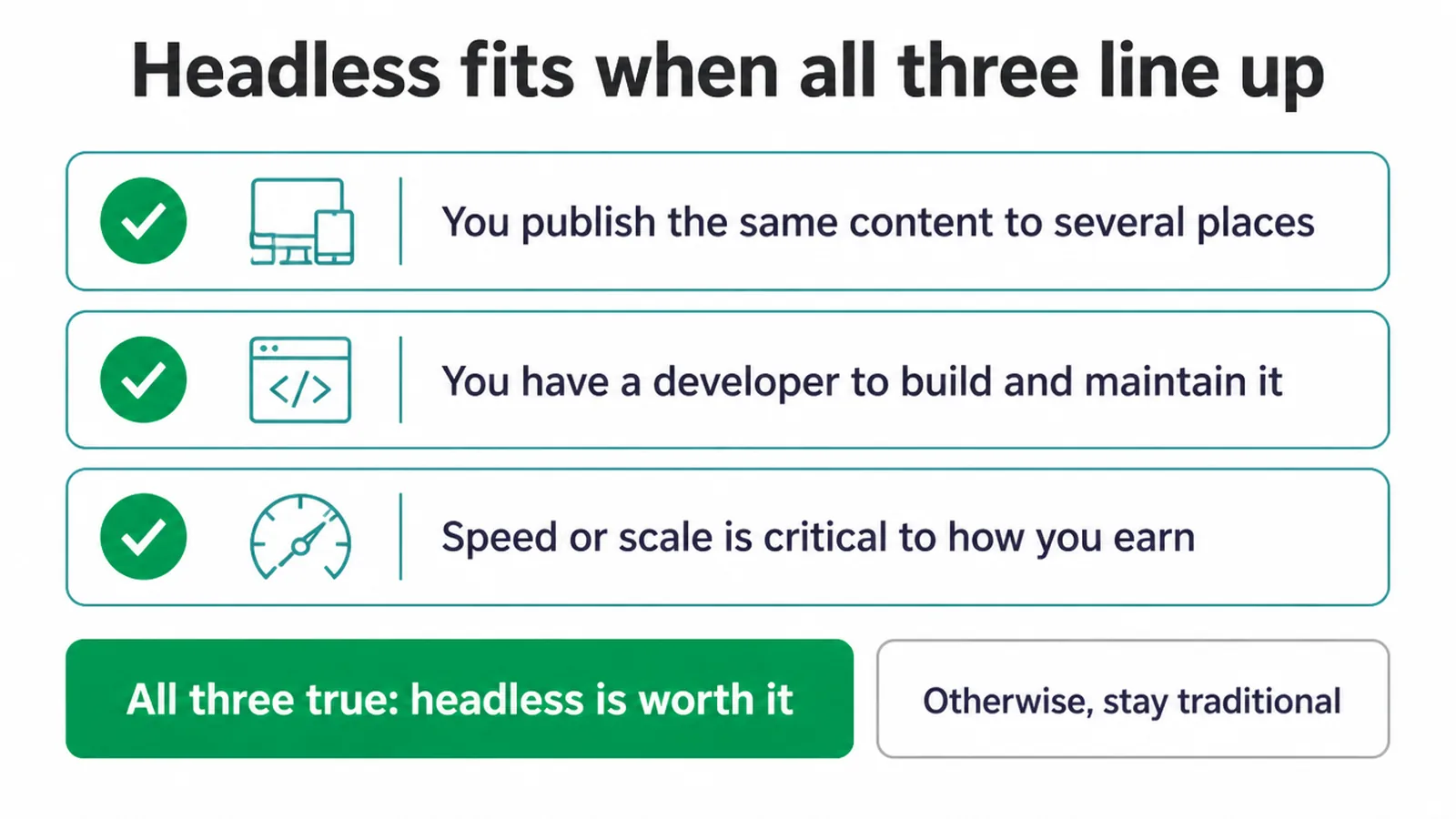
You might want headless when three things line up. You publish the same content to several places, like a site plus an app plus in-store screens.
You have a developer, in-house or on retainer, who can build and maintain the front end. And speed or scale is genuinely critical to how you make money. When all three are true, the trade-offs start to pay off.
If you are still building the basics, our pillar guide to a small business website is the better place to start. Get a solid site live first. Worry about architecture later, and only if you have a real reason.
When you want a second opinion on which path fits your business, talk to us. We build both, so we have no reason to push you toward the fancier option.
Frequently asked questions
1. What is a headless CMS in simple terms?
A headless CMS is a content system where the place you write and manage content (the body) is separated from the place visitors see it (the head). The two talk through an API. You edit text and images in a dashboard, and a developer builds the front end that pulls that content in and displays it.
2. What is the difference between a headless CMS and a traditional CMS?
A traditional CMS like WordPress bundles the editing tools and the public website together in one system. A headless CMS keeps only the content and editing tools, then hands the content to any front end through an API. Traditional is simpler and self-contained. Headless is more flexible but needs a developer to build and connect the front end.
3. Do small businesses need a headless CMS?
Most small businesses do not need one. If you have a single website you edit yourself, a traditional CMS is simpler and cheaper. A headless setup makes sense when you publish the same content to several places, you have a developer, and speed or scale really matters to your business.
4. Can WordPress be headless?
Yes. WordPress can run headless by using its REST API as the body where you manage content, while a separate custom front end displays it. This site runs that way. You keep the familiar WordPress editor but a developer builds the public site on top of it.
5. Is a headless CMS better for SEO?
It can be, but it is not automatic. A headless front end can be very fast with clean code, which helps. The risk is rendering content with JavaScript that search engines or AI tools struggle to read. If the front end is built well and serves real HTML, headless can be excellent for SEO.
6. Is a headless CMS faster than a traditional one?
It can be, because the front end is built separately and can be highly optimised, often served as fast static files. Speed matters for results. A small mobile speed gain has been linked to higher conversions. But a well-built traditional site can also be fast, so headless is not the only path to speed.
7. What are the downsides of a headless CMS?
The main downsides are cost and complexity. You usually need a developer to build and maintain the front end, there is no simple drag-and-drop page builder, and previewing changes can be harder. For a single small site you edit yourself, that overhead is rarely worth it.
8. Is a headless CMS more secure than WordPress?
It can reduce some risk. Much of the WordPress security risk comes from plugins, and a headless front end usually loads fewer of them on the public side. Splitting the editing tools from the public site also shrinks the public attack surface. No setup is risk-free, so good updates and hosting still matter.