Key takeaways
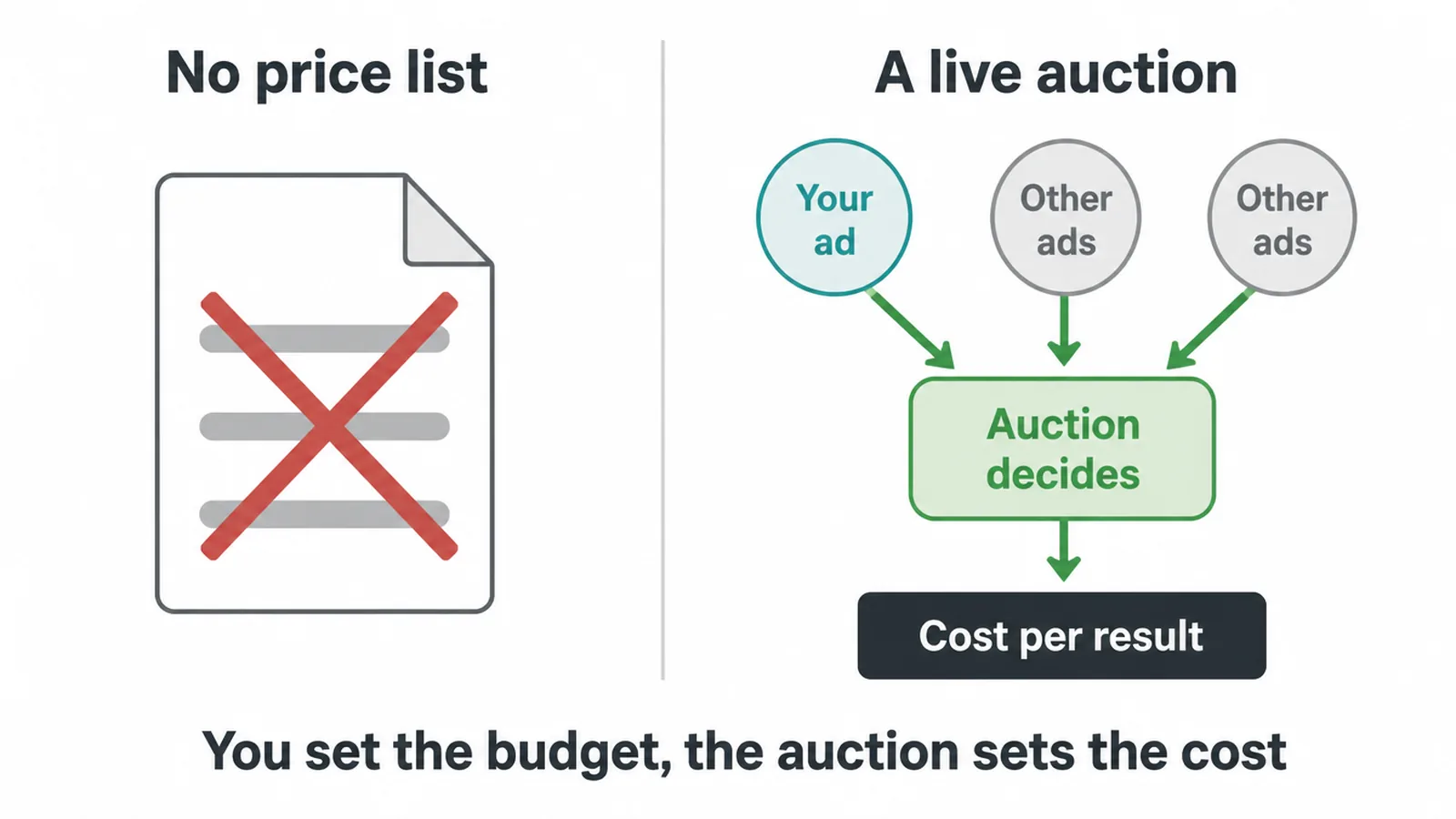
- There is no fixed price. You set the budget, and an auction decides what each result costs.
- The highest bidder does not win. Meta's auction rewards the ad that pairs a fair bid with a relevant, high-quality ad and the right objective.
- You usually pay less than you bid. Your actual cost is based on the competition for that person, not the full amount you were willing to pay.
- A few factors move your cost. Audience size, competition, ad relevance, your objective, and the season all push cost per result up or down.
- Start small and watch cost per result. Give the system enough to learn from, cut the ads that lose, and put more behind the ones that work.
1. Why there is no single price for Facebook ads
How much it costs to run Facebook ads is not a price you look up. It is a budget you set. Facebook does not sell ad space at a flat rate. Every time your ad could show, it enters an auction that pairs your ad with the people most likely to care, so you get the most results for your money. That means your cost is decided in the moment, not printed on a menu.
So when you see a blog promising "the average Facebook ad costs X per click," treat it with suspicion. Those numbers are averages of wildly different businesses, audiences, and goals. They tell you nothing about what your ad will cost.
The useful answer is the structure underneath the number: what you set, how the auction decides, and what you can change. If you have not built an ad yet, our guide on how to create a Facebook ad walks through the setup first. When you want a team to plan and run it for you, that is what our Facebook marketing service is for.
2. The budget you set is your ceiling
The first thing that decides your cost is simple: you set it. Before an ad runs, you choose a budget, and Facebook can never spend more than that. There is a small minimum daily budget to get started, but most businesses spend well above it, so the minimum is rarely the thing you need to worry about. Your real decision is which kind of budget to use.
Daily budget vs lifetime budget
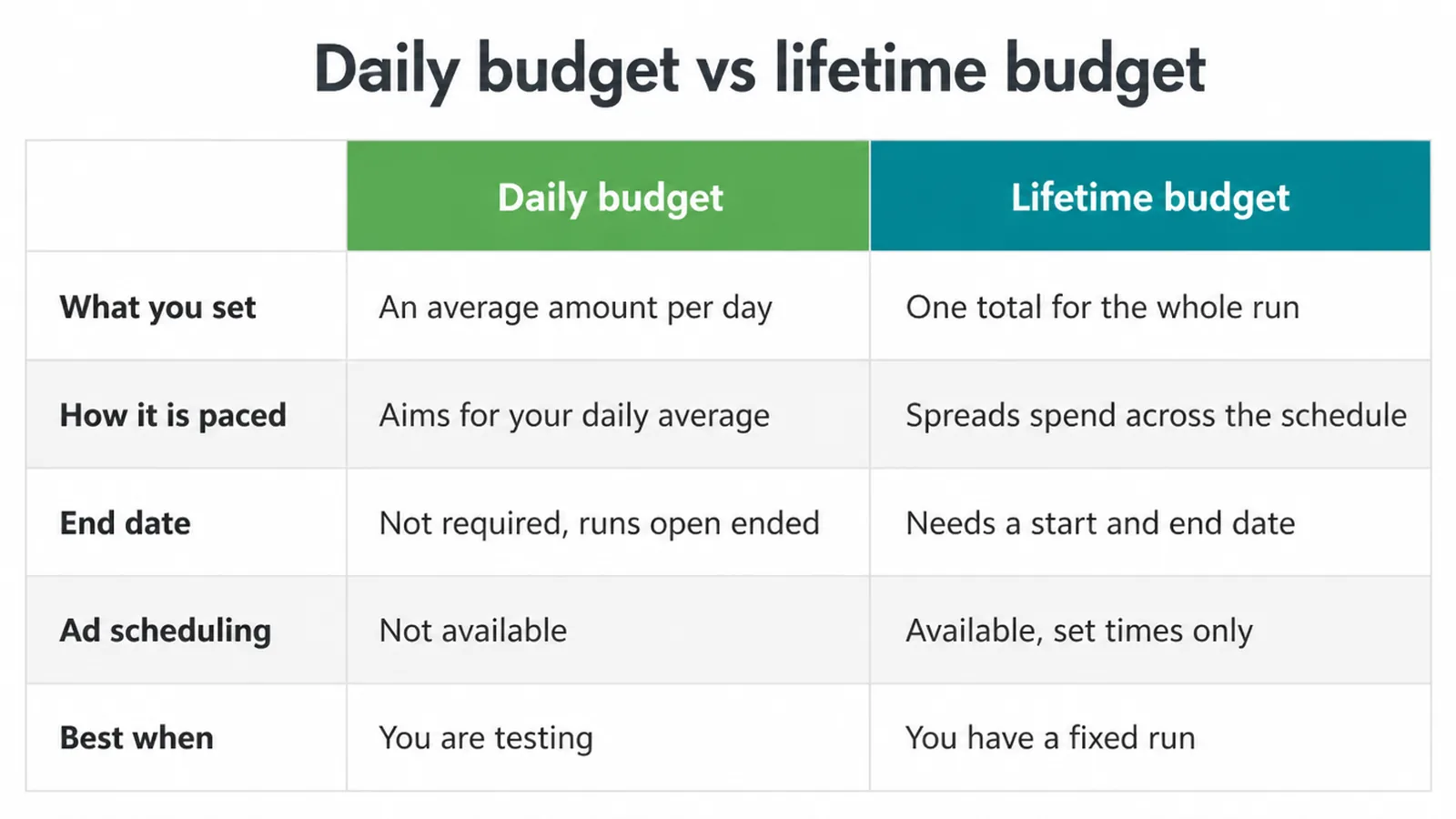
You have two options. A daily budget is the average you will spend per day. It can flex a little on any given day, but it averages out over the week, and it runs with no fixed end date. A lifetime budget is one total for the whole run, and Meta paces the spend across your schedule. A lifetime budget also unlocks ad scheduling, so you can choose to show ads only at certain times or days.
| Daily budget | Lifetime budget | |
|---|---|---|
| What you set | An average amount per day | One total for the whole run |
| How Meta paces it | Aims for your daily average, flexing slightly day to day | Spreads spend across the full schedule |
| End date | Not required, runs open-ended | Needs a start and end date |
| Ad scheduling | Not available | Available, so you can run ads only at set times |
| Best when | You are testing and want to keep it running | You have a fixed run, like a sale or an event |
3. How the Facebook ad auction decides your cost
The second thing that decides your cost is the auction. This is the part most people get wrong. They assume the advertiser who bids the most wins the space. That is not how it works. Meta's ad auction weighs the right objective, good targeting, an adequate budget, enough time to run, and creative that people actually respond to. A big bid alone does not win.
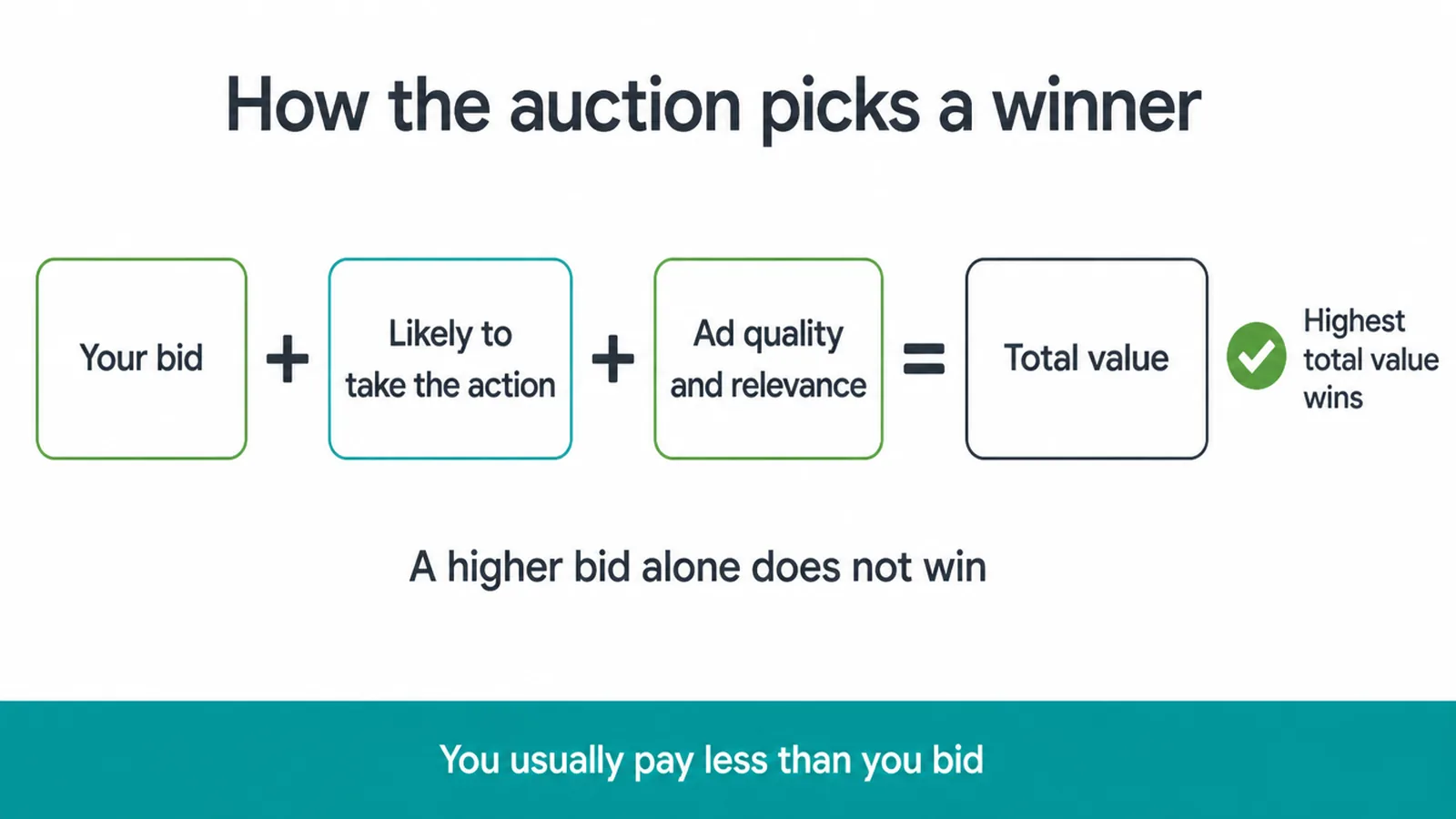
Under the hood, the auction adds up a total value for each ad. That total is your bid, plus Meta's estimate of how likely the person is to take the action you want, plus your ad's quality and relevance. So a cleaner, more relevant ad can beat a higher bid. Meta looks for low-quality signals like clickbait, sensationalised wording, or engagement bait, and ads that avoid those tend to win more cheaply.
Here is the part that helps you sleep at night: you usually pay less than the amount you bid. Your actual cost is based on the next-best competition for that person, not the full amount you were willing to pay. And because delivery is optimised around the objective you pick, your cost is always tied to a goal, whether that is clicks, views, or sales.
If you want your ads to line up with where a buyer is in their journey, our post on marketing funnel stages explains how to match the message to the moment.
4. What pushes Facebook ad costs up or down
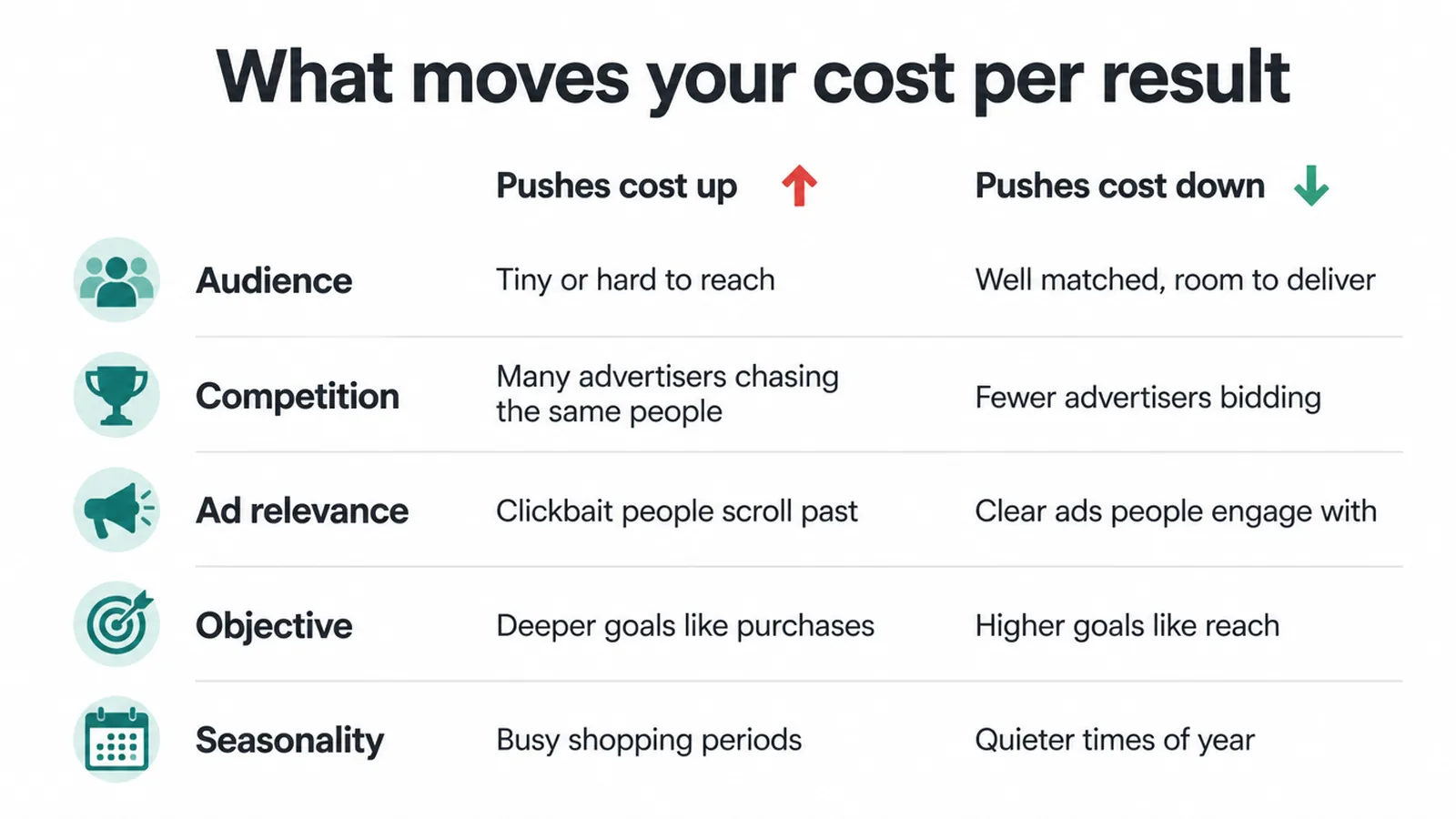
The third thing that decides your cost is a set of factors you can influence. Since cost is set by the auction, anything that changes the auction changes what you pay. None of these are magic buttons, but together they are the difference between an efficient campaign and a wasteful one. Here are the main things that move your cost.
| Driver | Pushes cost UP | Pushes cost DOWN |
|---|---|---|
| Audience | Tiny, hyper-specific, or hard-to-reach audiences | A well-matched audience with room to deliver |
| Competition | Many advertisers chasing the same people | Fewer advertisers bidding for that audience |
| Ad relevance and quality | Clickbait, bait, or ads people scroll past | Relevant, clear ads people actually engage with |
| Objective | Goals deeper down the funnel, like purchases | Goals higher up, like reach or engagement |
| Seasonality | Busy shopping periods when everyone bids more | Quieter times of the year with less demand |
Notice the pattern. Most of the "cost down" column comes from being relevant and picking the right goal, not from bidding cleverly. That is good news, because relevance is something you can control. A better ad, aimed at the right people, for the right objective, is the closest thing to a cheat code Facebook ads have, and it is what our Facebook ads team works on first.
5. How to spend efficiently on Facebook ads
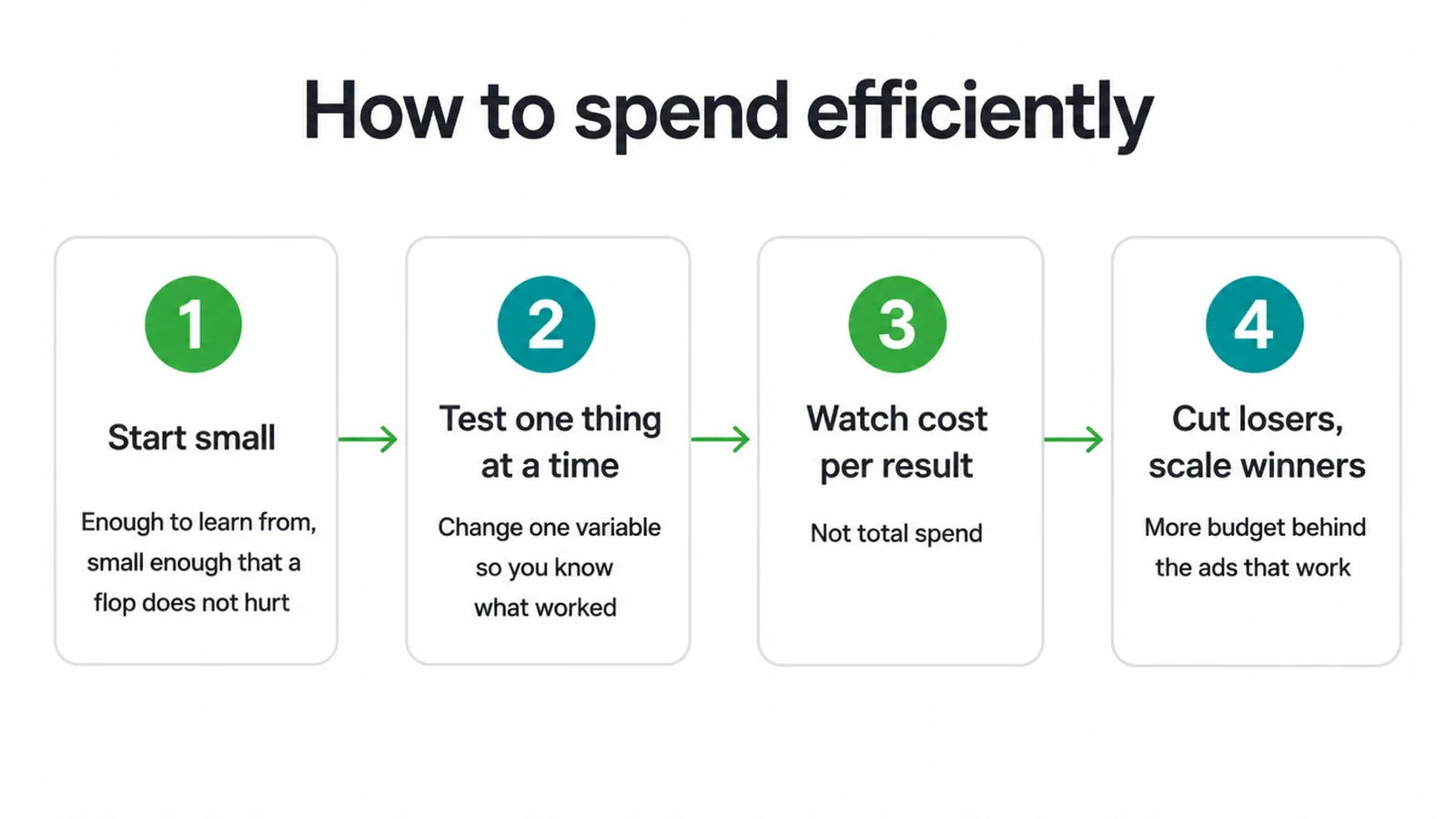
Now for the practical part. You cannot control the auction, but you can control how you spend inside it. Start small. Give the system enough budget to learn who responds, but keep it low enough that a flop does not hurt. A tiny test that fails costs you a little money and teaches you a lot.
Test one thing at a time
Test one thing at a time. If you change the audience, the image, and the wording all at once, you will never know which change worked. Run a clean comparison, let it gather enough data, then keep the winner. And watch your cost per result, not your total spend. Total spend only tells you how much left your account. Cost per result tells you whether the ad is actually working.
Cut the losers and scale the winners
Then cut the losers and scale the winners. Ads that bring results below your target cost deserve more budget. Ads that do not, get switched off.
This is where thinking about return matters more than any per-click figure. The right question is not "how cheap is a click," it is "is this ad worth it." Our guide on what a good ROAS is shows how to judge whether the money coming back beats the money going out.
Frame your budget around what a customer is worth to you, not around a number you read online. If you also run search ads, the same discipline applies, and our post on Google Ads for small business covers it for that platform.
What real numbers look like
For a sense of what real numbers look like, here are two Meta campaigns from our own accounts, published on our results page. One lead campaign brought in 4,500 leads at about $1.23 each. An ecommerce account turned roughly $8.1k of spend into 3,200 purchases, a 13x return. Same platform, very different cost per result. The objective and the offer decide that.
Frequently asked questions
1. How much does it cost to run Facebook ads?
There is no fixed price. You set the budget, and an auction decides what each result costs, so the real answer is the cost structure: your budget, the auction, and a few factors you control.
2. Do Facebook ads have a minimum budget?
Yes, there is a small minimum daily budget, and it can vary depending on the objective and how you are billed. Most businesses spend well above any minimum anyway, so the minimum is rarely the deciding factor.
3. What is a daily budget vs a lifetime budget?
A daily budget is the average you will spend per day, and it can flex slightly but averages over the week. A lifetime budget is a total for the whole run that Meta paces across the schedule, and it also lets you schedule ads to run only at certain times.
4. Why do Facebook ad costs vary so much?
Because cost is set by an auction, not a price list. Your audience size, how many advertisers are competing for the same people, how relevant your ad is, the objective you pick, and the time of year all move your cost per result.
5. What makes Facebook ads cheaper?
More relevant, higher-quality ads that people actually engage with, a well-matched audience, and picking the right objective. Meta rewards relevance, so a better ad often wins the auction for less.
6. How much should a small business spend on Facebook ads?
Enough to give the system data to learn from, but small enough that testing does not hurt if it flops. Start modest, watch your cost per result, and scale the ads that work, judging every result against what a customer is worth to you.
7. Do I pay per click or per view on Facebook ads?
It depends on your objective and how the ad is optimized and billed. Some campaigns are optimized around clicks, others around impressions or conversions, and you control this when you set the campaign up.
8. How do I control my Facebook ad spend?
You control it directly by setting a daily or lifetime budget as your ceiling, choosing your objective, and starting small. Then watch cost per result and cut what loses, because Facebook can never spend more than the budget you set.
6. Want help spending your ad budget well?
Facebook ads reward businesses that set a smart budget, run relevant ads, and read the results honestly. That takes time and testing. If you would rather have a team plan, run, and tune your ads around what a customer is actually worth to you, get in touch with us and tell us about your goals. We will give you a straight answer about what to expect.

About the author
Gregory Yeoh is the founder of Seed Light, a web design and digital marketing agency that plans and runs paid campaigns for small businesses. He spends his days inside ad accounts, and wrote this the way he would explain it to a client: no hype, no made-up numbers, just the cost structure you need to understand before you spend.