Ad Copy Examples: Patterns to Adapt

Every ad is three parts: a headline carrying one clear idea, a description that backs it with detail or proof, and a call to action naming the next step. The landing page then has to keep the ad's promise. Specific beats clever every time. Seed Light writes and tests ad copy in live client accounts.
Key takeaways
- Lead with one benefit, not the category. Say the payoff first, then the details. Benefit-first is the safest default for both search and social.
- Every ad has three parts. A headline that hooks, a description that adds proof or detail, and a call to action that names the next step.
- Match the ad to the page. The promise in your ad should be the first thing the reader sees when they land. Google recommends this too.
- Be specific and honest. A real offer, a real review count, a real limit. Never invent a stat, fake urgency, or promise a result.
- Ship two, let data pick. Write a couple of versions, change one thing at a time, and keep the winner.
1. What every ad is made of
Almost every ad, on Google or social, is built from the same three parts. Learn these and you can write for any platform.
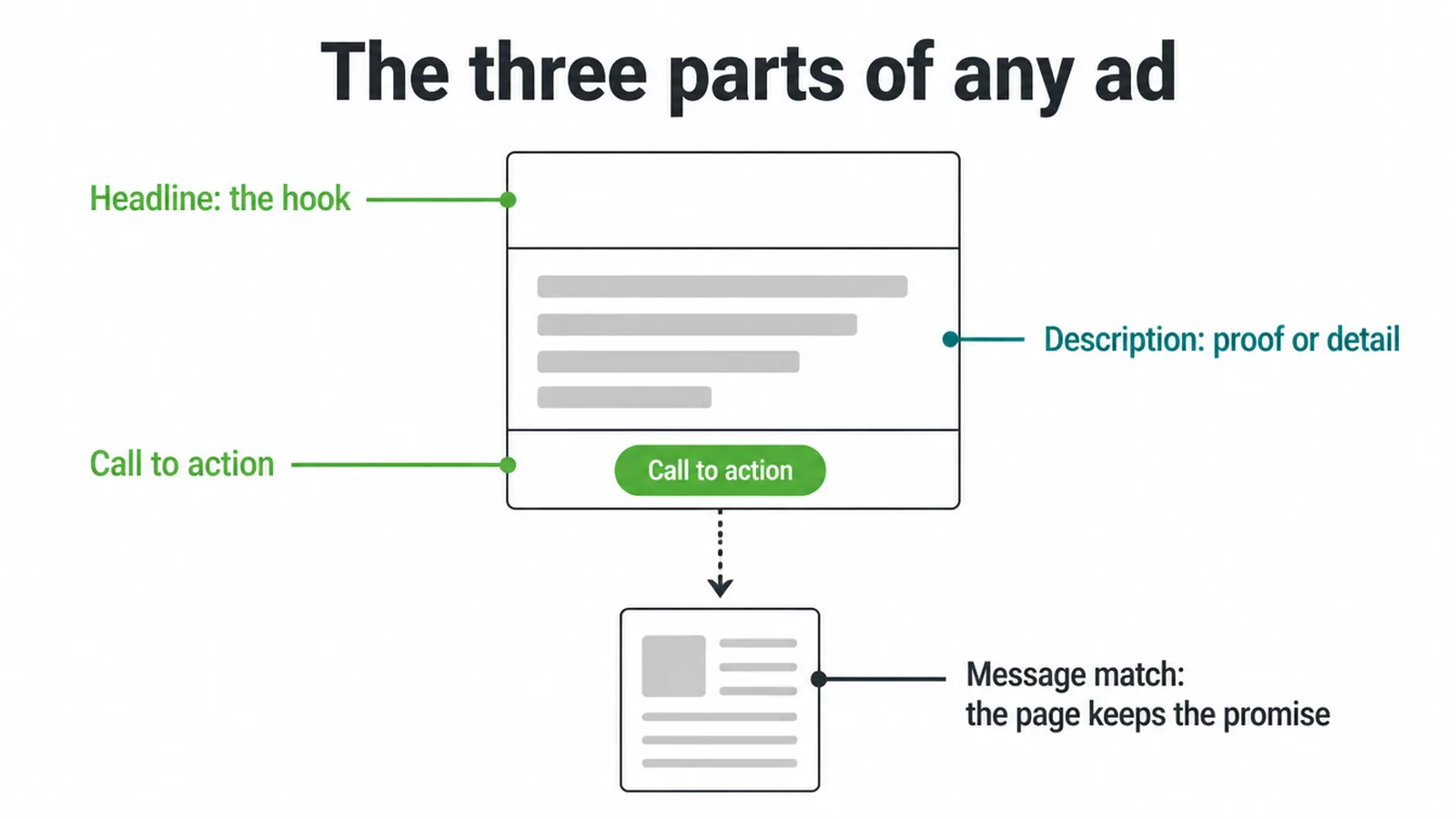
The headline does the heavy lifting. It is the hook. Most people read it and nothing else, so it has to carry one clear idea.
The description (called primary text on social) backs up the headline with detail, proof, or a reason to act. The call to action tells the reader exactly what to do next: book, call, get a quote, read reviews.
There is a fourth thing that ties it all together: message match. The promise in the ad must carry through to the page it sends people to. Break that promise and they leave.
Google's own text ad guidance echoes this. It suggests you highlight what makes you unique, include a keyword the reader is searching for, add a promotion or exclusive, and use action verbs like get a quote, call today, or sign up.
It also says to match your ad message to the landing page and to avoid strange capitalisation and extra spaces. You can read the full Google Ads text ad best practices for the detail.
If you would rather have someone build and run the campaigns for you, that is what our digital marketing team does day to day.
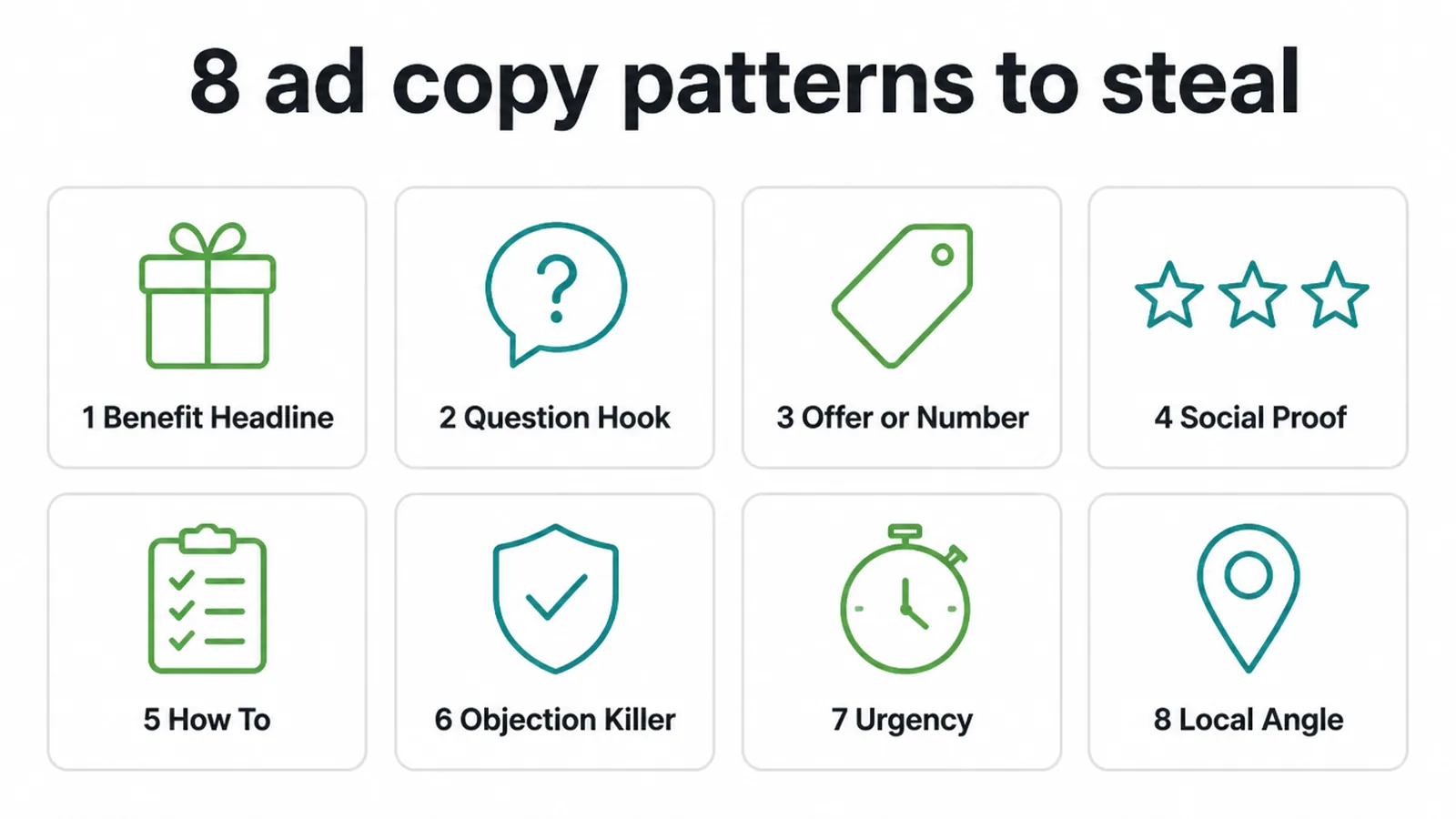
2. The swipe file: 8 ad copy patterns to steal
Here are eight patterns you can adapt today. Each uses a made-up small business so you can see the shape. Swap in your own offer, your own neighbourhood, and your own proof. Placeholders in square brackets are things you fill in.
1. The Benefit Headline (lead with the outcome)
Headline: A Dentist Your Whole Family Will Actually Look Forward To
Description: Gentle care, clear pricing, and same-week appointments in [Neighbourhood]. Book online in under a minute.
CTA: Book Now
Why it works: it names the payoff before the category. Benefit-first is the safest default, and it works on both search and social.
2. The Question Hook (mirror the worry)
Headline: Tired of Cleaning on Your Only Day Off?
Description: FreshNest takes the whole list off your plate. Vetted cleaners, flexible times, satisfaction guaranteed.
CTA: Get a Free Quote
Why it works: a well-aimed question makes them nod before the pitch. It is best for social feeds where people are scrolling.
3. The Offer / Number (a specific reason to click now)
Headline: New Patients: Book Your First Visit This Week
Description: Exam, clean, and X-rays with our new-patient offer. Friendly team, easy parking, evening slots available.
CTA: Claim Offer
Why it works: specificity beats vague enthusiasm. Reference the offer generically, never a dollar amount, so the ad stays accurate as prices change.
4. The Social Proof (let customers sell)
Headline: Rated 5 Stars by 300+ Local Families
Description: See why [Neighbourhood] trusts Brightside Dental for gentle, honest care. New patients welcome.
CTA: Read Reviews
Why it works: proof lowers risk. Only use real, verifiable numbers. Never invent a review count.
5. The How-To / Instructional (promise a small how)
Headline: How to Get a Spotless Home Without Lifting a Finger
Description: Book FreshNest in three steps: pick a time, tell us your priorities, come home to clean.
CTA: See How It Works
Why it works: "how to" signals a helpful, low-pressure read. It pairs well with a step-by-step landing page.
6. The Objection Killer (name and disarm the hesitation)
Headline: No Lock-In Contracts. Cancel Any Time.
Description: FreshNest cleaning that fits your life, not the other way around. Book one clean or a weekly slot.
CTA: Start With One Clean
Why it works: it removes the friction that stops a click. This is strong for high-consideration services people hesitate over.
7. The Urgency / Scarcity (honest, real limits only)
Headline: Only a Few Evening Slots Left This Week
Description: Brightside Dental fills up fast for after-work appointments. Reserve yours before they're gone.
CTA: Reserve My Slot
Why it works: urgency drives action, but it must be true. Fake countdowns erode trust and can breach ad policy.
8. The Local Angle (the small-business superpower)
Headline: Your Trusted [Neighbourhood] Cleaning Team
Description: Local, insured, and easy to reach. FreshNest looks after homes across [City] every week.
CTA: Book a Local Cleaner
Why it works: "local" plus a place name builds trust instantly and matches how people actually search.
3. Headline formulas you can reuse
If you want a shortcut, these are the headline shapes behind the swipe file. Pick the one that fits your goal, then fill in the blanks. The example column shows the pattern in action.
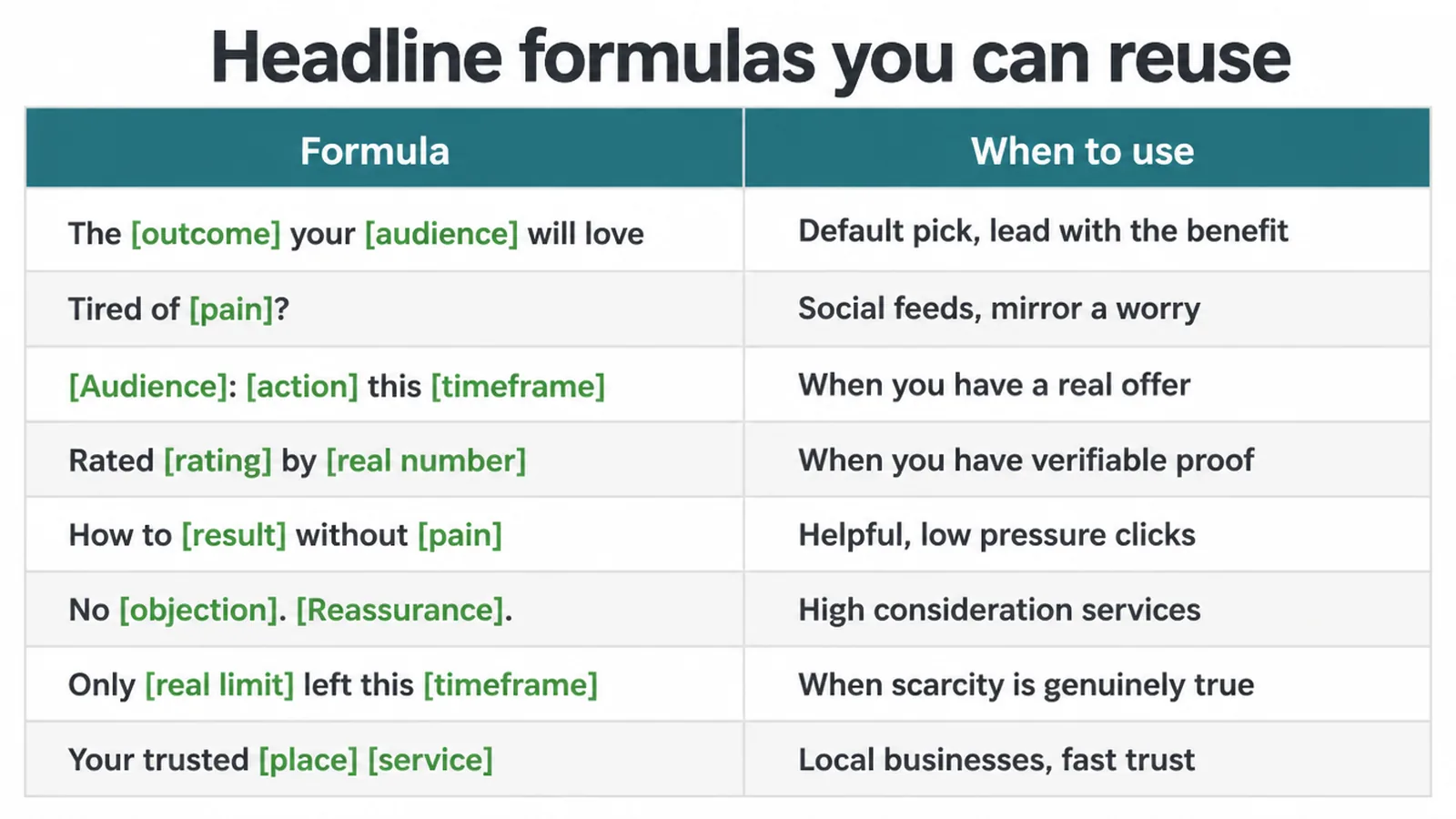
| Formula | When to use | Example |
|---|---|---|
| The [outcome] your [audience] will love | Default pick. Lead with the benefit. | A Dentist Your Whole Family Will Love |
| Tired of [pain]? | Social feeds, to mirror a worry. | Tired of Cleaning on Your Only Day Off? |
| [Audience]: [action] this [timeframe] | When you have a real offer or deadline. | New Patients: Book Your First Visit This Week |
| Rated [rating] by [real number] of [audience] | When you have verifiable proof. | Rated 5 Stars by 300+ Local Families |
| How to [result] without [pain] | Helpful, low-pressure clicks. | How to Get a Spotless Home Without Lifting a Finger |
| No [common objection]. [Reassurance]. | High-consideration services. | No Lock-In Contracts. Cancel Any Time. |
| Only [real limit] left this [timeframe] | When the scarcity is genuinely true. | Only a Few Evening Slots Left This Week |
| Your trusted [place] [service] | Local businesses, to build fast trust. | Your Trusted [Neighbourhood] Cleaning Team |
4. Search ads vs social ads: same rules, different tone
The three parts stay the same, but the tone shifts depending on where the ad shows up.
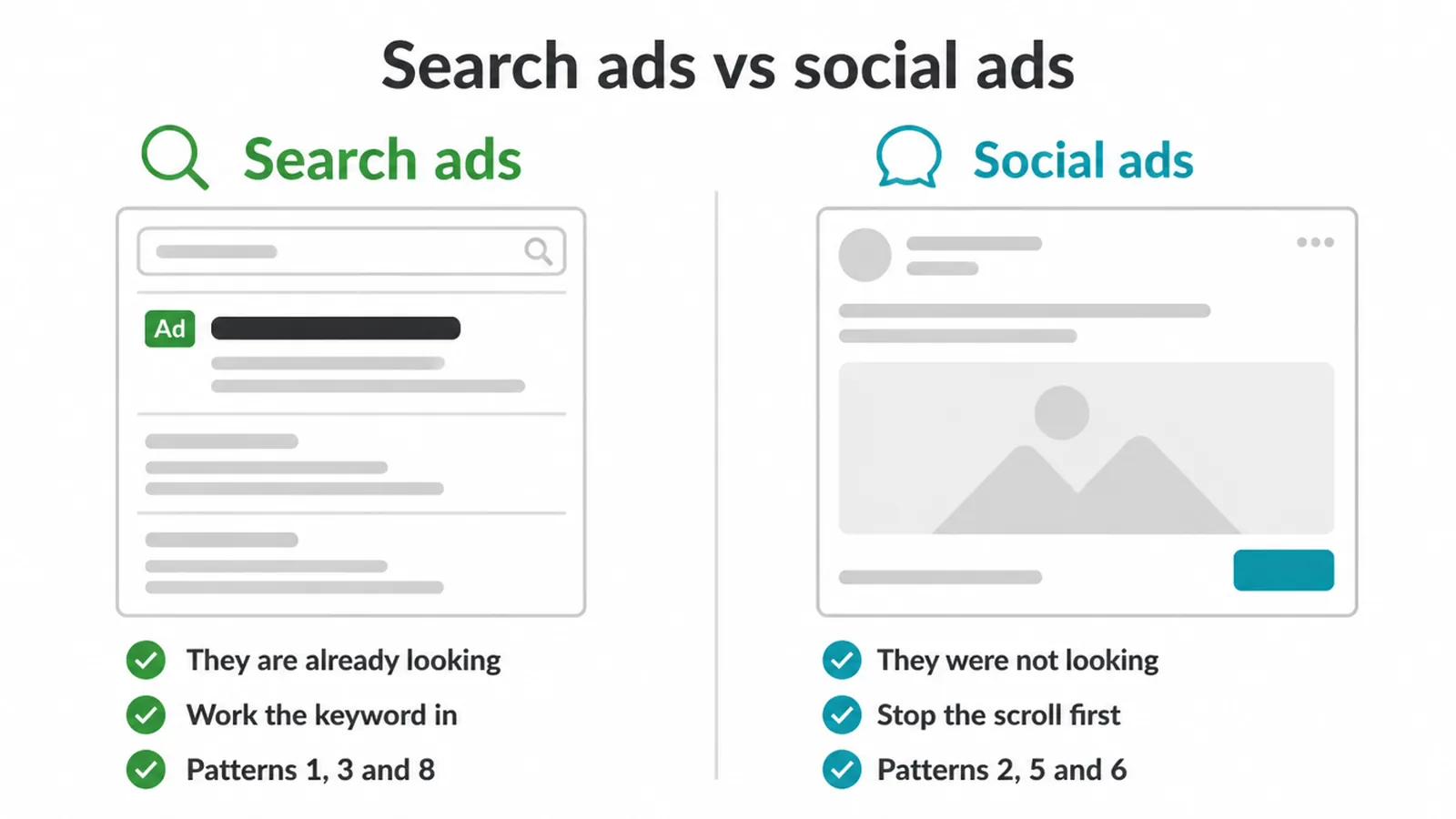
Search ads reach people who are already looking. So lead with the exact thing they searched, work the keyword in naturally, and get to the action fast. There is little room, so every word earns its place. Patterns 1, 3, and 8 fit search well.
Social ads interrupt people who were not looking for you. So the job of the first line is to stop the scroll. A hook, a benefit, or a sharp question earns the read before you pitch.
You have more room in the primary text, but front-load the point. Patterns 2, 5, and 6 shine here, and the same rules apply when you write Facebook and Instagram ads. For the wider setup, see our guide to Google Ads for small businesses.
5. Message match: the page must keep the ad's promise
This is the mistake that quietly wastes the most ad spend. You write a great ad, someone clicks, and the page they land on says something different. They feel a tiny jolt of "wrong place" and they leave.
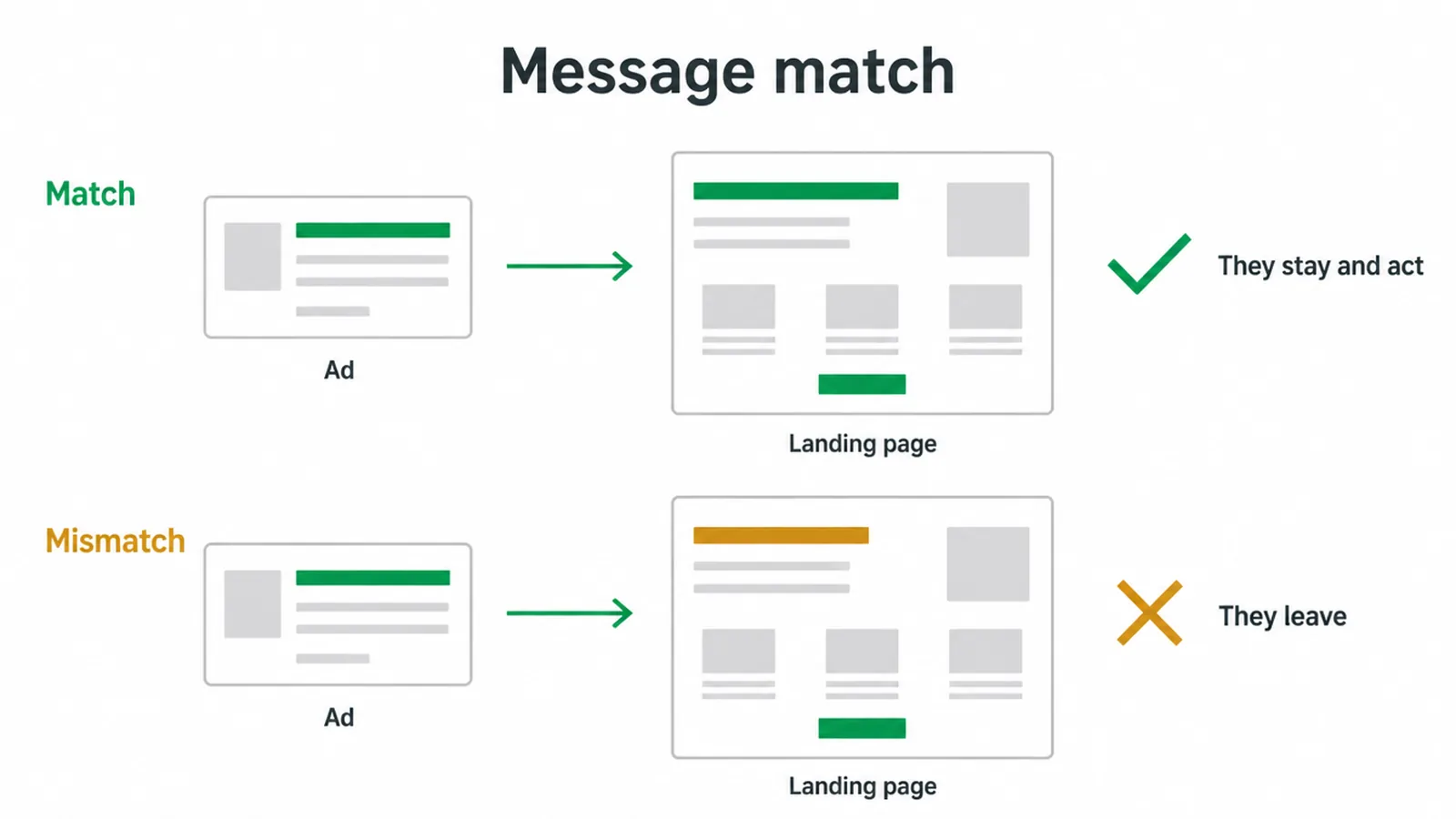
Message match means the promise in your ad is the first thing the reader sees on the page. If the ad says "new-patient offer, book this week", the page headline should say the same, and the booking button should be right there.
Google recommends aligning your ad message with the landing page for exactly this reason. Get the page right with our landing page best practices, or hand the landing page design to us.
6. Writing and testing your copy
You do not have to stare at a blank page. A tool like ChatGPT is a solid drafting partner. Feed it the offer, the audience, and one clear benefit, and ask for a handful of headline options. Then edit hard.
Cut the fluff, fix the voice so it sounds like you, and check every claim is true. Never publish something a tool wrote without reading it closely. If you want prompt ideas, we keep a list of the best ChatGPT prompts.
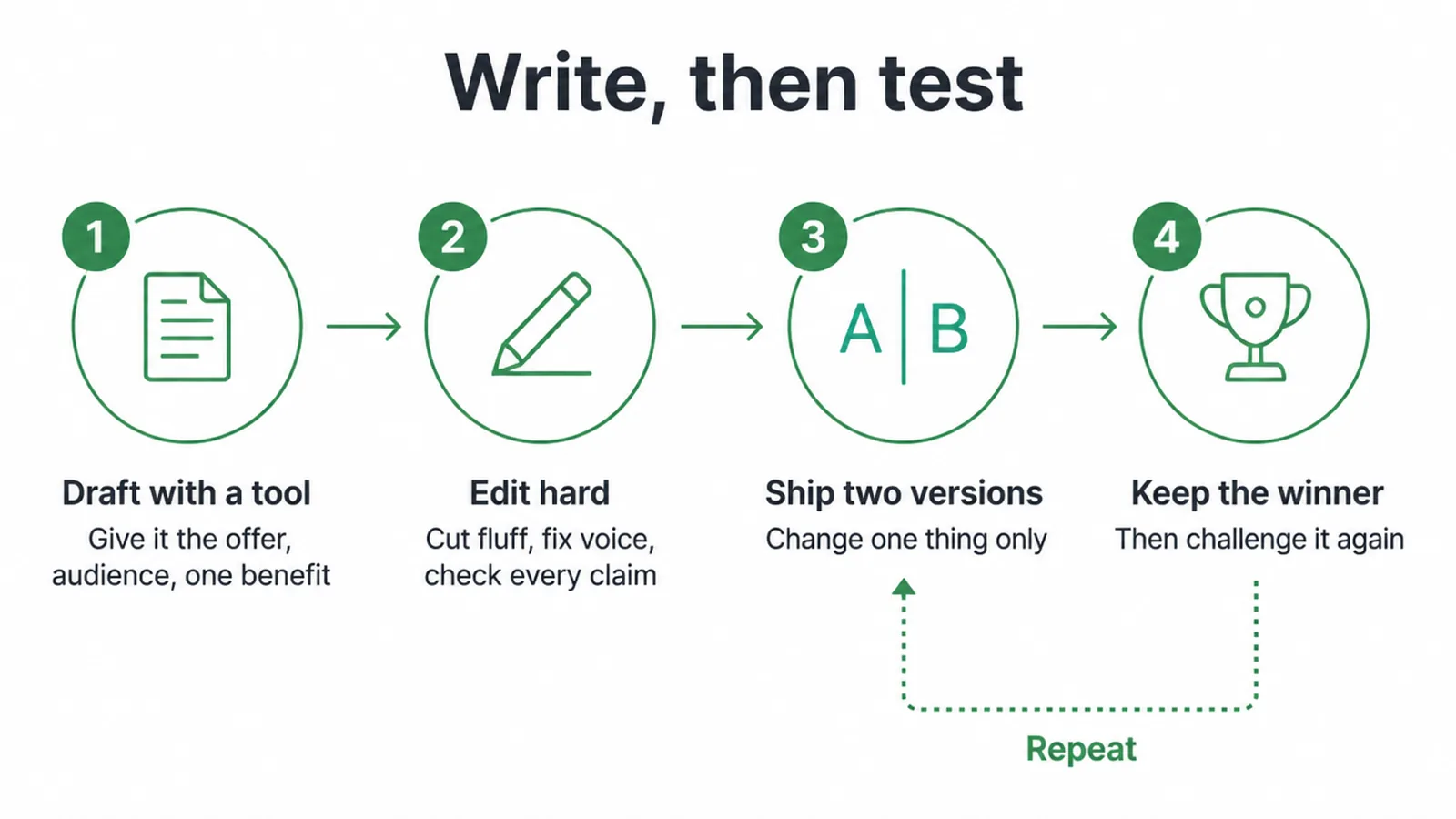
Then test. Write two versions that change one thing, the headline or the CTA or the angle, and run them against each other. Give each enough time and enough impressions to mean something, then keep the winner and challenge it again. Copy is a craft you improve by testing, not a formula you solve once.
7. Ad copy do's and don'ts
Do: lead with one benefit, use action verbs, name a specific and real offer, match the ad to the page, and test one change at a time.
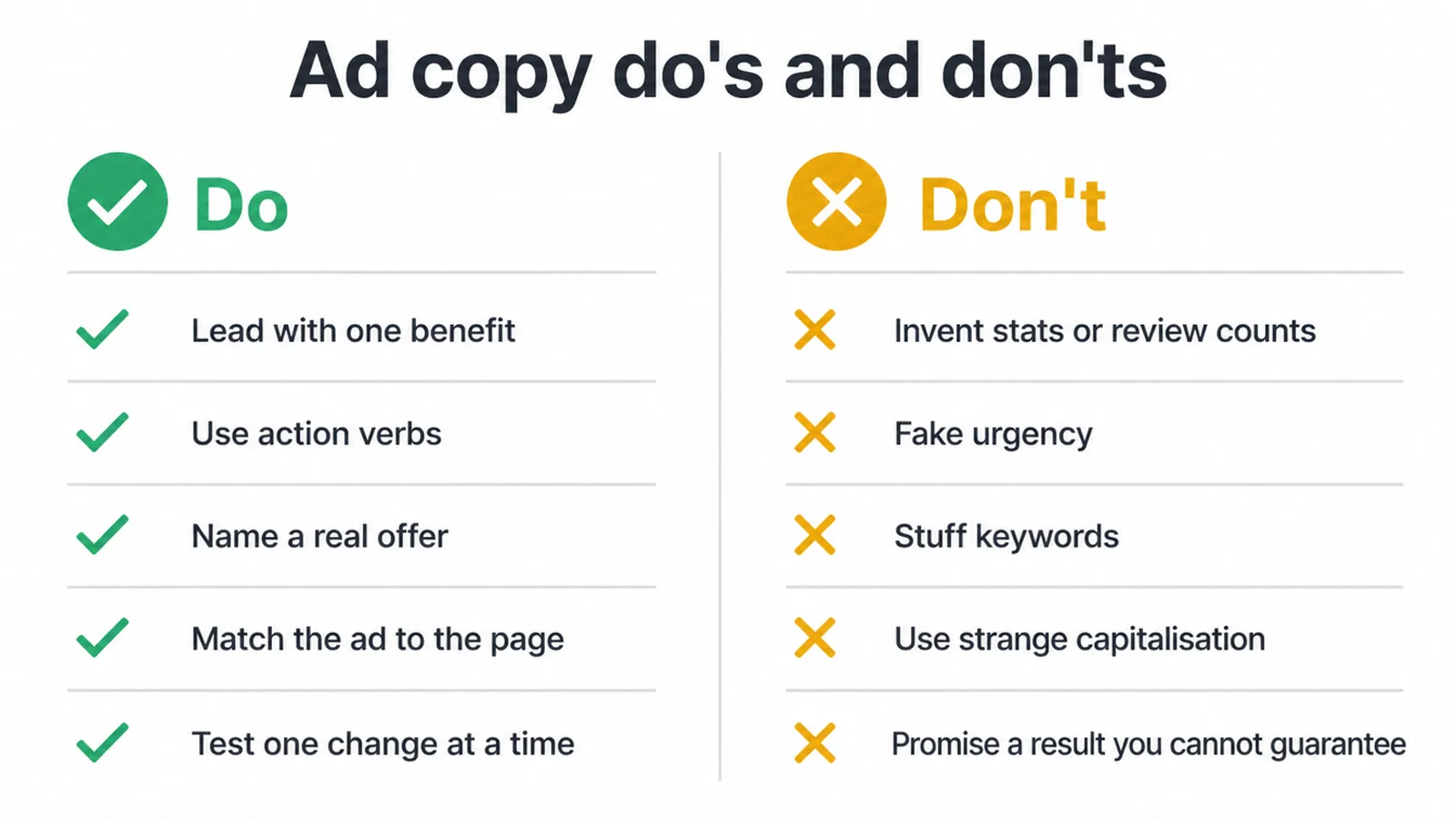
Don't: invent stats or review counts, fake urgency with countdowns that reset, stuff keywords, use sTrAnGe capitalisation, or promise a result you cannot guarantee. Honest copy that tests well beats clever copy that overpromises.
Copy a pattern, adapt it to your business, ship two versions, and let the data pick. If you would rather hand the whole thing off, talk to us and we'll take it from writing to running.
8. Where these ad copy patterns come from
For context on where these patterns come from: we write and run ad copy in live client accounts.
Seed Light has written and run these patterns in live client accounts since 2018. The current lead, sales and ad-return figures are published on our results page.
Frequently asked questions
1. What makes good ad copy?
Clarity plus one clear benefit plus one clear action, matched to what the reader wants and to the landing page. Specific beats clever.
2. What should a Google ad include?
Keyword-relevant headlines, a benefit, a promotion or unique point, and an action CTA. Google recommends matching the ad message to the landing page and using verbs like get a quote or book now.
3. How long should ad copy be?
As long as it needs to be and no longer. Search ads are tight, while social primary text can be longer, but front-load the point in the first line before the See more cut-off.
4. How do I write a good headline?
Pick one job, whether benefit, question, offer or proof, say it plainly, put the most important words first, and avoid strange capitalisation.
5. Should ad copy match the landing page?
Yes. This is message match: the promise in the ad should be the first thing the reader sees on the page, or they bounce.
6. How do I write a call to action?
Use one clear action verb tied to the next step, like Book Now, Get a Free Quote or Claim Offer, and match the CTA to how ready the reader is.
7. Can I use ChatGPT to write ad copy?
Yes, as a drafting partner. Feed it the offer, audience and one benefit, then edit hard for truth and voice, and never publish unchecked claims.
8. How do I test ad copy?
Run two or more variations that change one thing, whether the headline, CTA or angle, give each enough time and impressions, and keep the winner.