Guest Posting for SEO: Earn Better Links Without Spam

Guest posting still works for SEO when you write a genuine article for a relevant site's readers and take one natural link. Google counts optimised anchor text in guest posts as link spam, so the gain comes from the audience and the trust you build. Seed Light earns links this way for small business clients.
Key takeaways
- Google draws a clear line. Its spam policies count "links with optimized anchor text in articles, guest posts, or press releases distributed on other sites" as link spam. Real articles are fine. Link farming is not.
- Links still matter. Google says the vast majority of new pages it finds each day are through links, so a good link from a relevant site has real value.
- Write for the audience first. The value moved from the raw link to the readers and the trust you build by showing up where your customers already are.
- One natural link beats ten stuffed ones. Keyword-rich anchors and the same article copied across sites are the patterns Google ignores or punishes.
- Quality over quantity in outreach. Most cold emails get ignored, so a few personal pitches to the right sites beat mass-blasting.
1. What is guest posting?
Guest posting is writing an article for a website that someone else owns. It sits in your field, reaches readers you do not have yet, and usually lets you add one link back to your own site. The site gets free, useful content.
You get a new audience and a little SEO benefit. For a fuller picture of how links fit your whole strategy, see our guide on how to get backlinks for your website, which this post sits under.
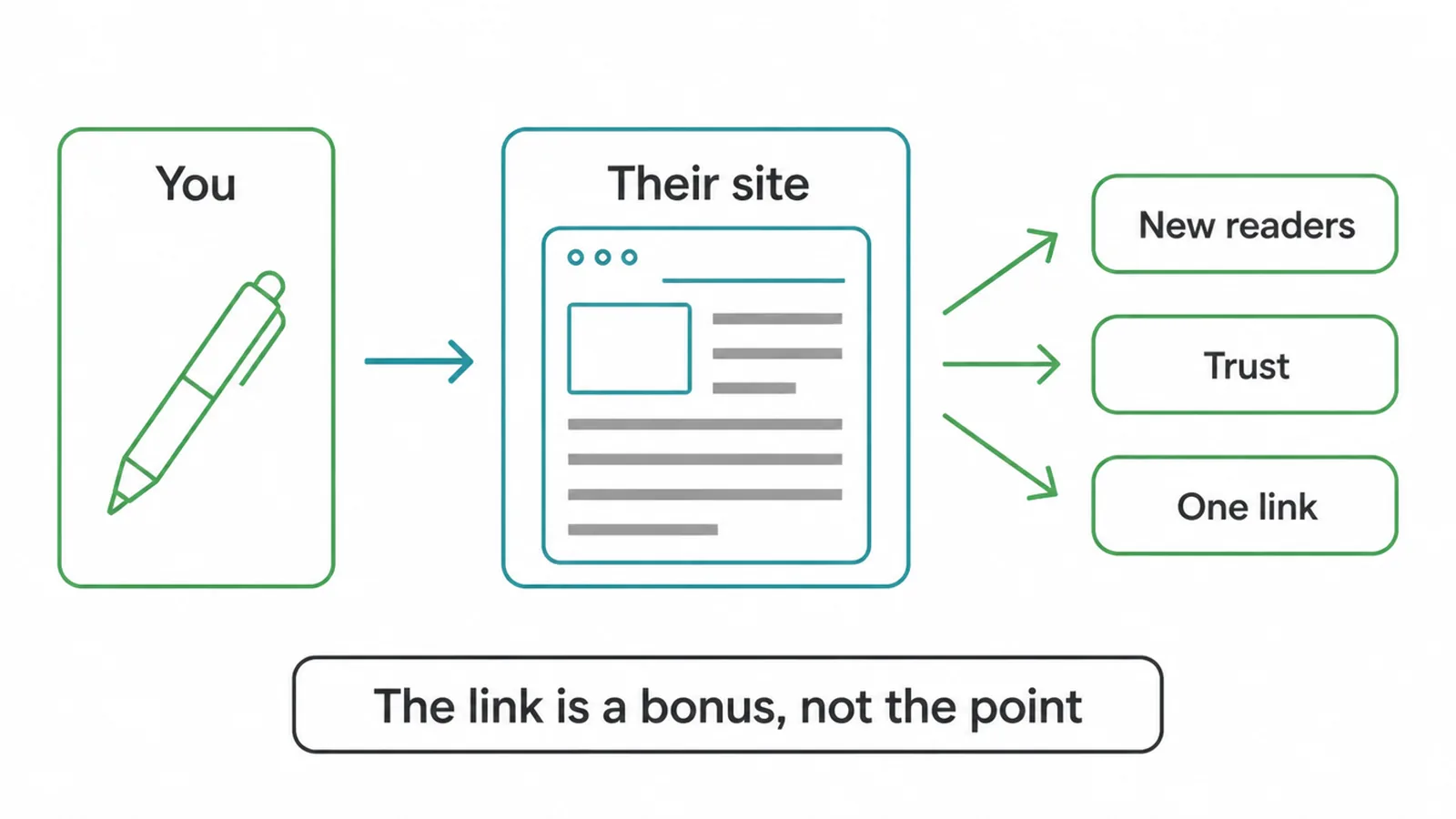
Here is the part people get wrong. The link is a bonus, not the whole job. The real win is reaching people who could become customers, and earning a bit of trust by being helpful.
When you treat guest posting as a link machine, it stops working. When you treat it as a way to teach a new audience, the links take care of themselves.
2. Does guest posting still work for SEO?
Yes, guest posting still works for SEO when you do it for real readers on relevant sites. Links are still how Google gets around.
Google says it primarily finds pages through links from other pages it already crawled, and that the vast majority of new pages it finds each day come through links. So a real link from a site in your field still carries weight.
What changed is where the value sits. Years ago people chased the raw link and ignored the readers. That game is over.
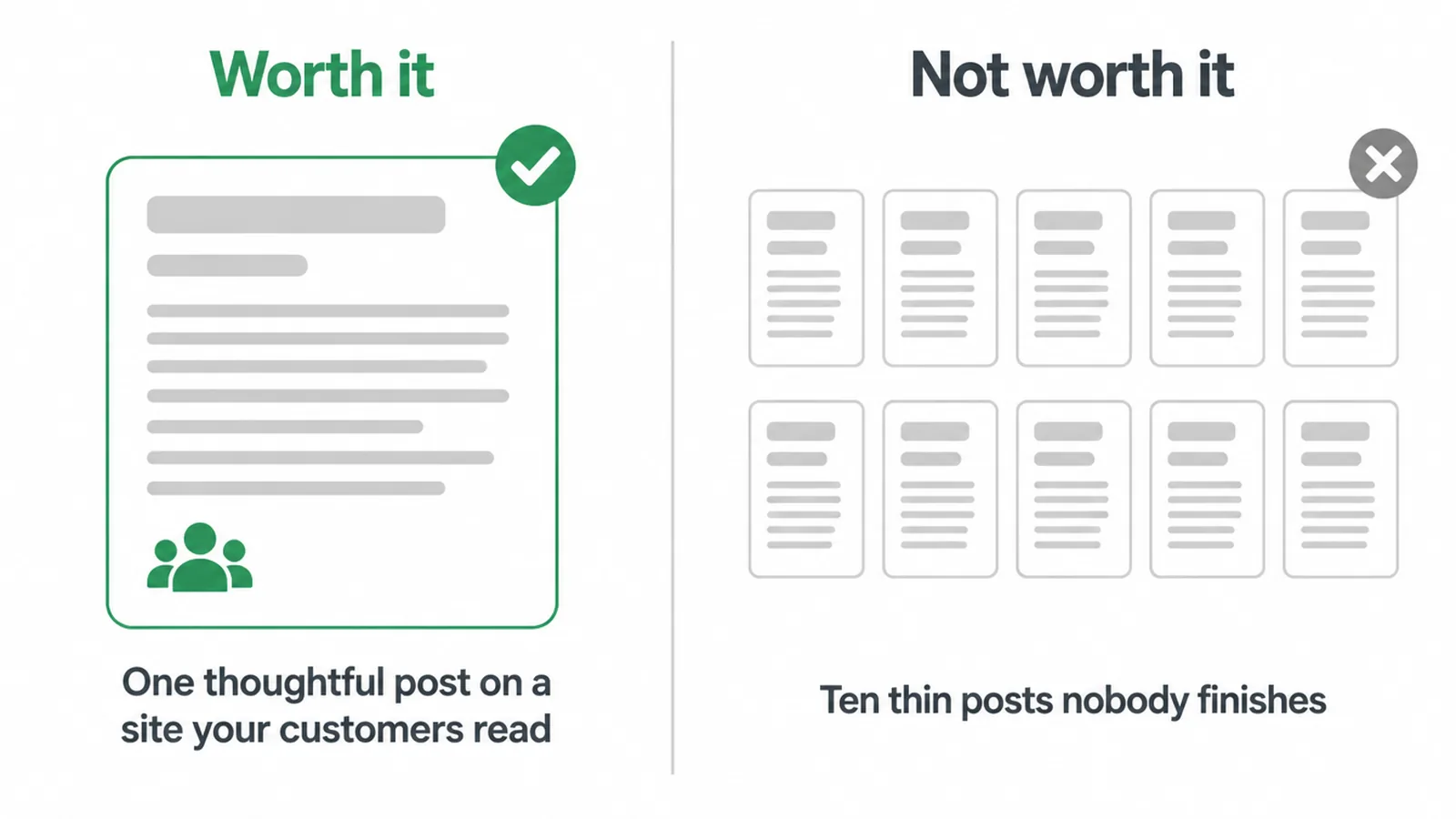
Now the value is the audience you reach and the topical trust you build by writing well in your space. A single thoughtful post on a site your customers actually read does more than ten thin posts nobody finishes.
Bulk placements barely move rankings anymore. If you picture cranking out fifty near-identical articles to drop links across fifty sites, stop. Google has spent years learning to spot that pattern and tune it out. The honest, slower path is the one that still pays.
3. The line Google draws between a guest post and spam
Guest posting becomes spam at a clear line, and Google spells it out. Its spam policies say link spam is "the practice of creating links to or from a site primarily for the purpose of manipulating search rankings." If the main reason for the link is to game Google, it counts as spam.
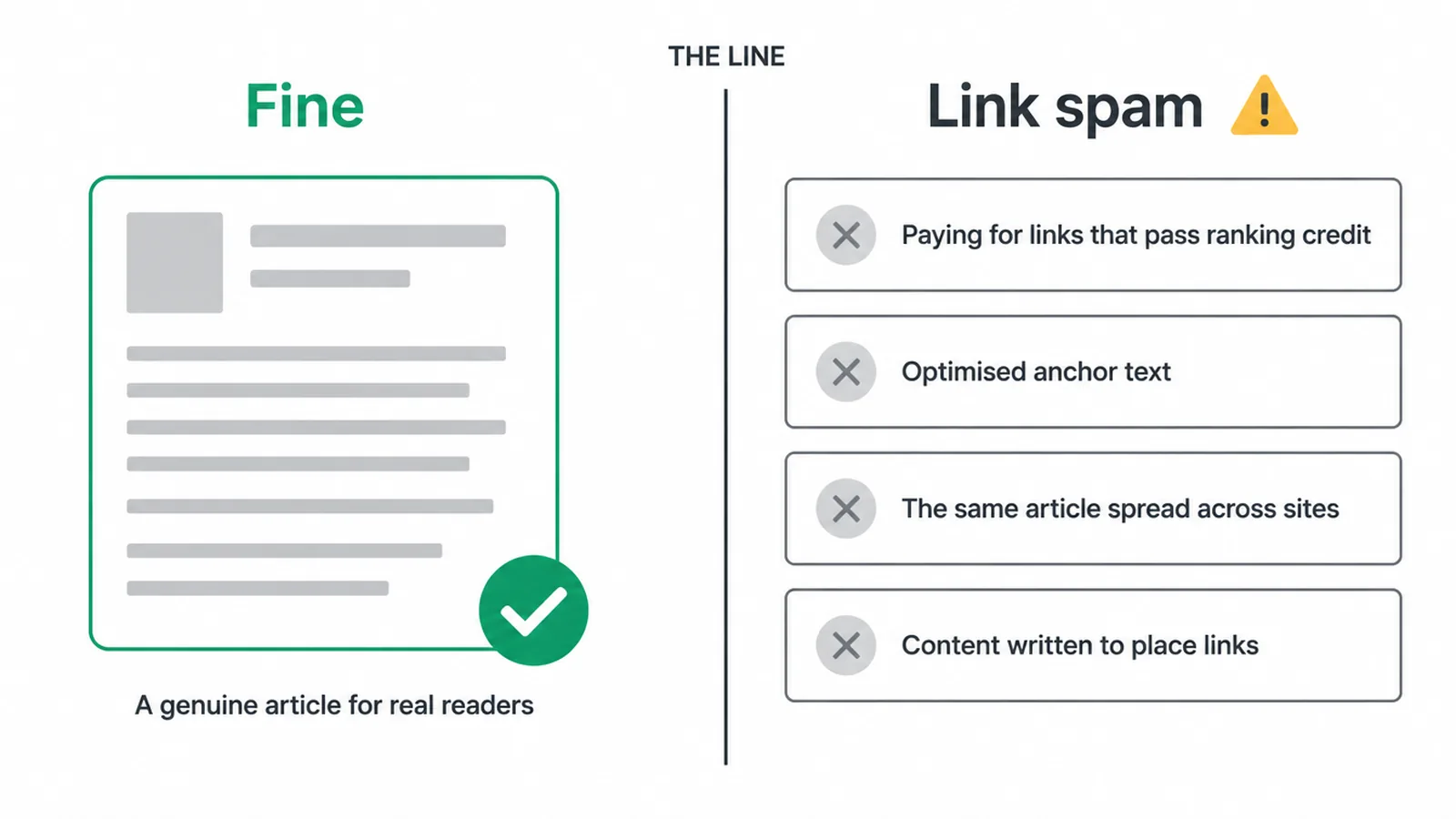
The same policy lists the exact moves that cross the line. It names "advertorials or native advertising where payment is received for articles that include links that pass ranking credit, or links with optimized anchor text in articles, guest posts, or press releases distributed on other sites." Read that twice. Four things break the rules:
- Paying for links that pass ranking credit. Buying a placement just to get a link Google counts.
- Optimised anchor text. Stuffing your money keyword into the link words inside the article.
- The same article spread across sites. One post distributed everywhere just for links.
- Content written to place links, not to help. Articles by people who do not really know or care about your topic.
Back in 2017 Google made a public point about large-scale guest-post campaigns built mainly for links, and that thinking now lives right in the spam policy above. The takeaway is simple. A genuine article you wrote for a real audience is fine. The factory version is not.
4. How to find good sites to guest post on
Finding good sites for guest posting starts with one test: relevance and real readers. Would your own customers read this site? If yes, it is worth a pitch. If the site publishes anything from anyone who pays, walk away. That is a link farm wearing a blog costume, and Google treats it like one.
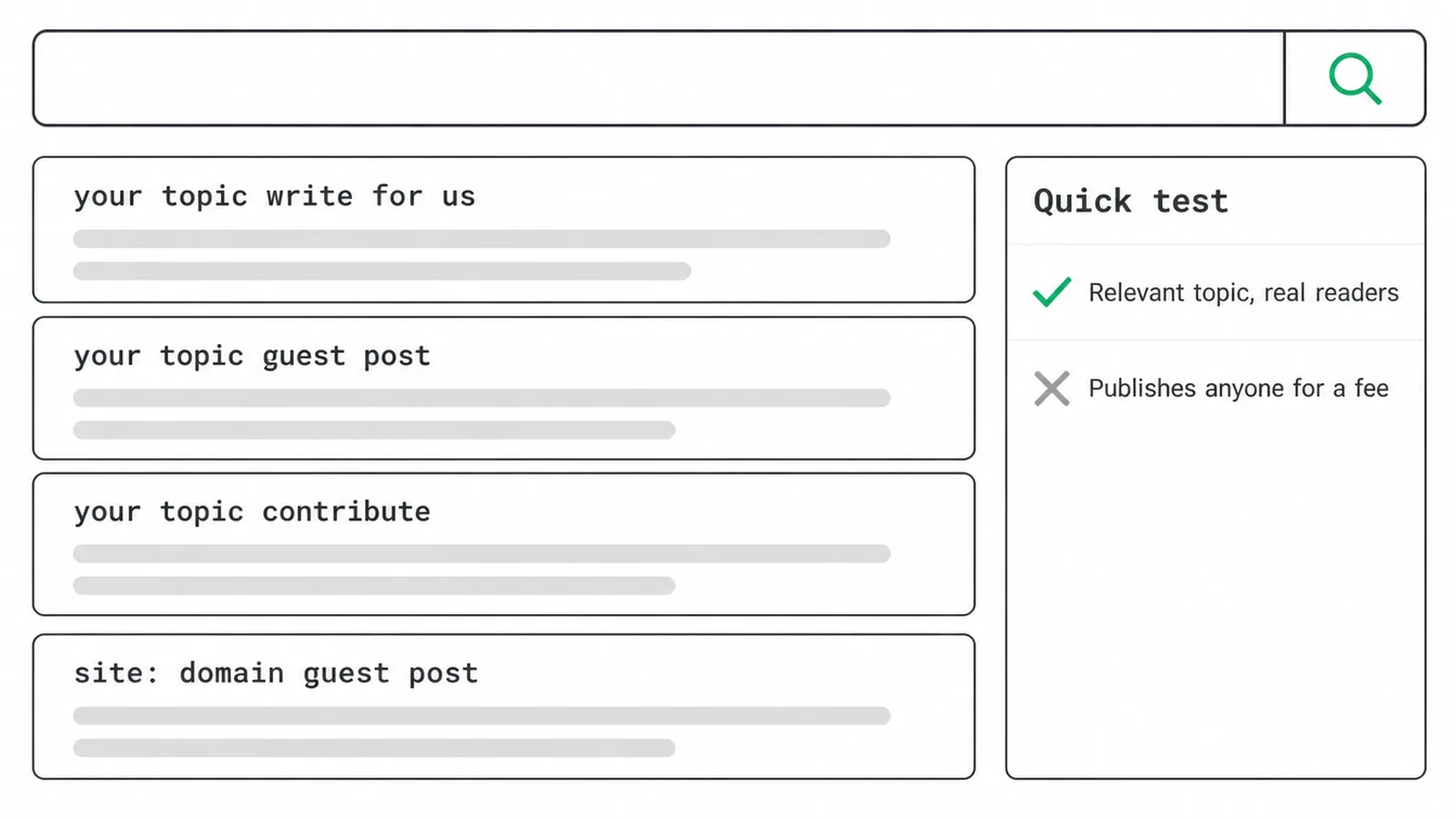
To build your list, start with the blogs and publications you already read in your field. Then use a few simple searches:
your topic + "write for us"your topic + "guest post"your topic + "contribute"site:somedomain.com "guest post"to check if a specific site accepts them
Also look at where respected people in your space have published. Those sites already trust good outside writers.
A handful of research and outreach tools can speed this up, and we cover some in our roundup of the best link building tools. Whatever tool you use, the filter stays the same: relevant topic, real readers, real editing.
5. How to write a guest post pitch that gets a reply
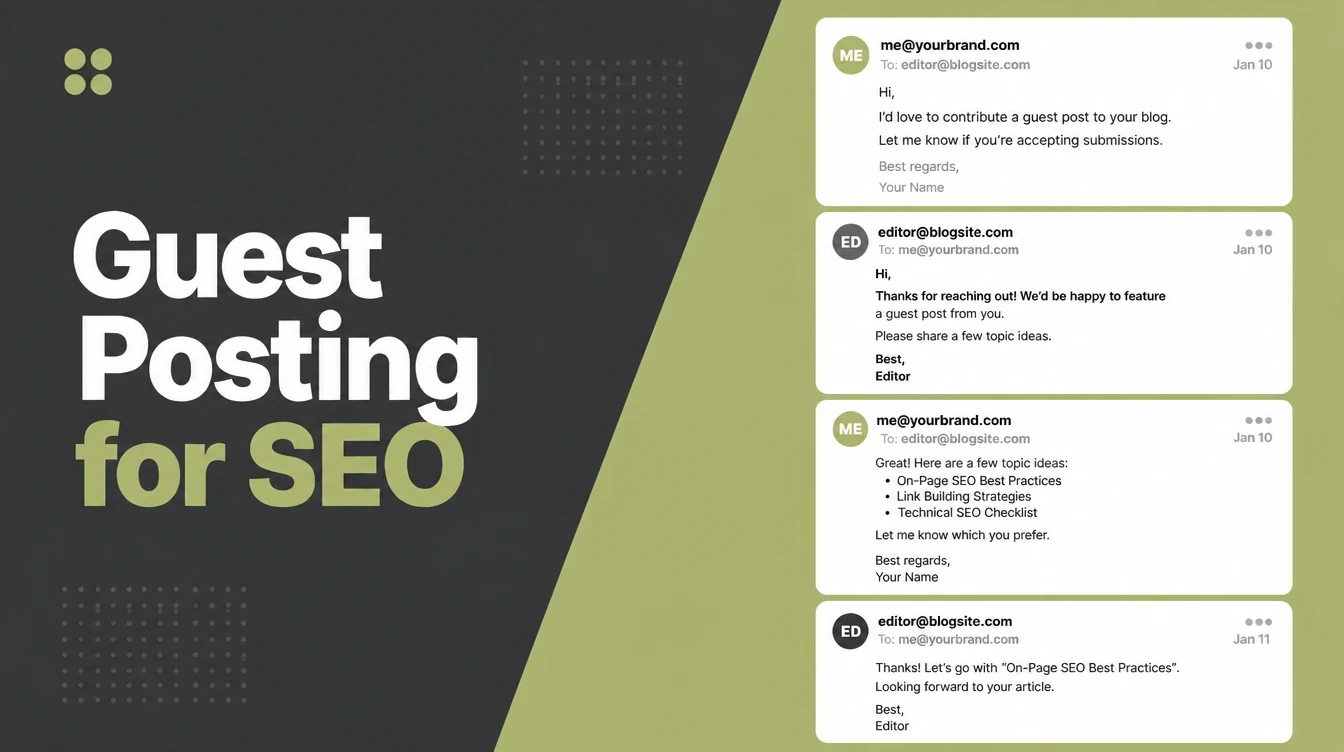
A good guest post pitch is short, personal, and aimed at one site at a time. Be realistic about the odds first.
Across more than 53 million messages, the average cold email reply rate is about 3.7%, with only the strongest campaigns getting past 10%. So most pitches get ignored. That is normal. The fix is not to send more, it is to send better.
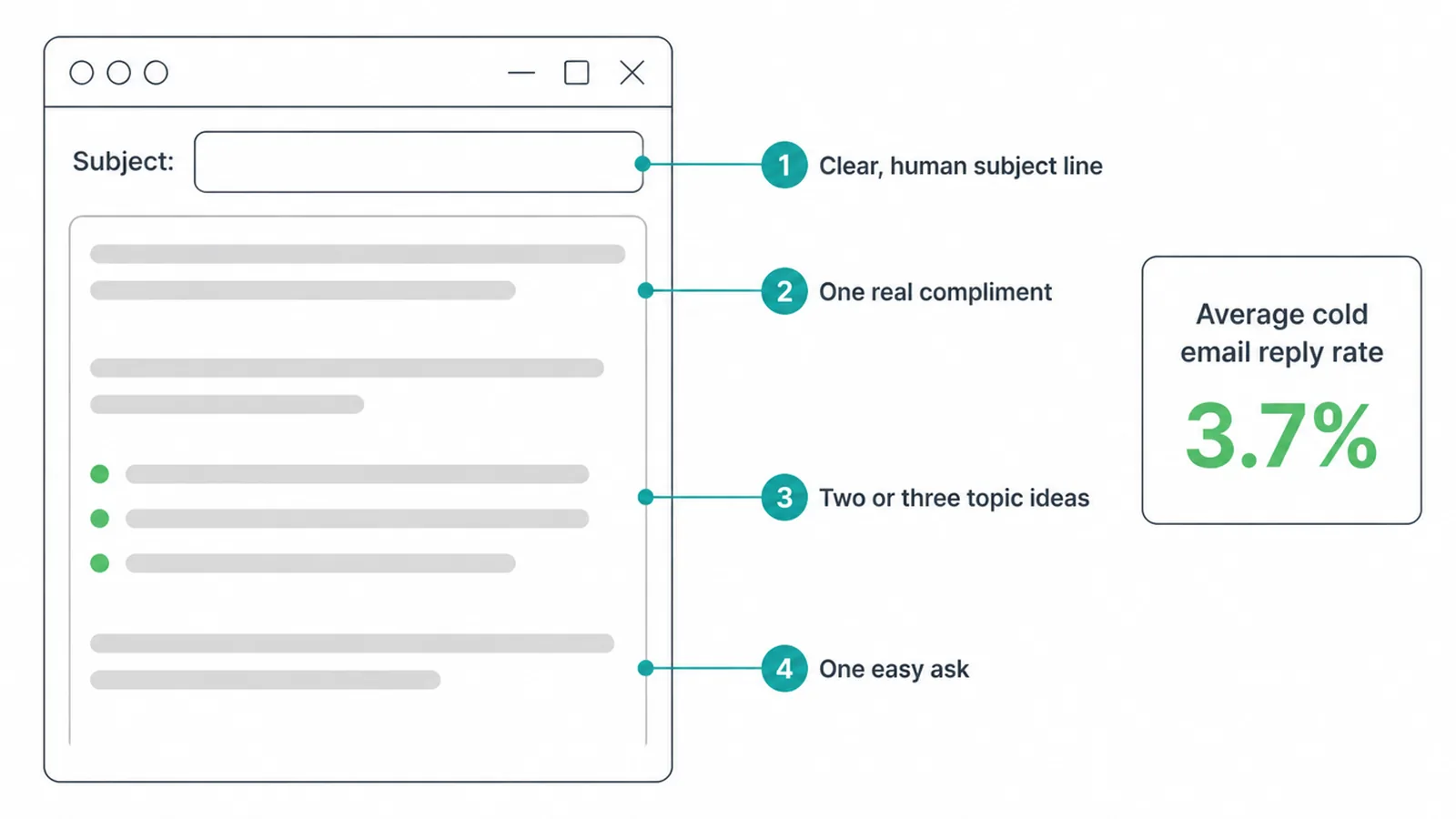
A pitch that works usually has four parts:
- A clear, human subject line. Not "Guest post opportunity." Something that names their site or topic.
- One real compliment. Mention a specific article of theirs you actually read.
- Two or three topic ideas. Each one shaped for THEIR audience, not yours.
- One easy ask. "Would any of these be a fit?" Keep it simple to say yes to.
Send a small batch of these, not a mass blast to fifty addresses. A spray-and-pray template reads like spam and lands like one. Five personal pitches to the right sites will beat fifty copies of the same email.
6. Writing a guest post that earns its place
Once a site says yes, the guest post itself has to be genuinely useful, or the whole effort is wasted. Write it yourself, or work closely with a writer who knows your business.
Make it original. Cover the topic better than what is already out there. Treat their readers like your own, because some of them will become exactly that.
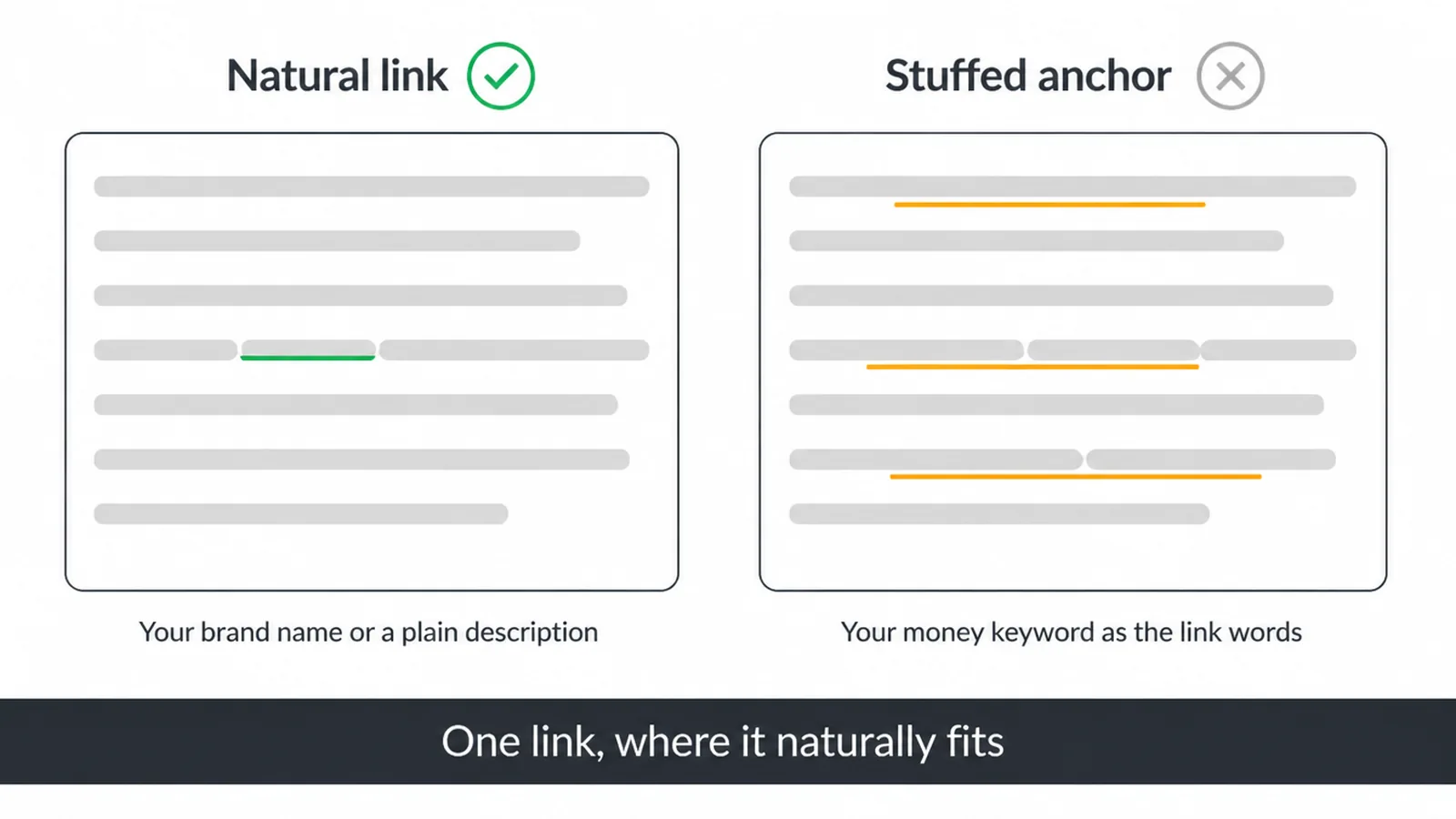
On the link, keep it light. One link, placed where it naturally fits the sentence, pointing to a page that actually helps the reader. Use your brand name or a plain description as the link words.
Do not drop in your main keyword as the anchor text. That is the optimised-anchor pattern Google flags, and it is the fastest way to make a good post look spammy.
7. What to avoid with guest posting
Most guest posting trouble comes from a few habits, and avoiding them keeps you safe. The big ones map straight back to Google's spam policy. If you only remember one rule, remember that anything done "primarily for the purpose of manipulating search rankings" is the thing to skip.
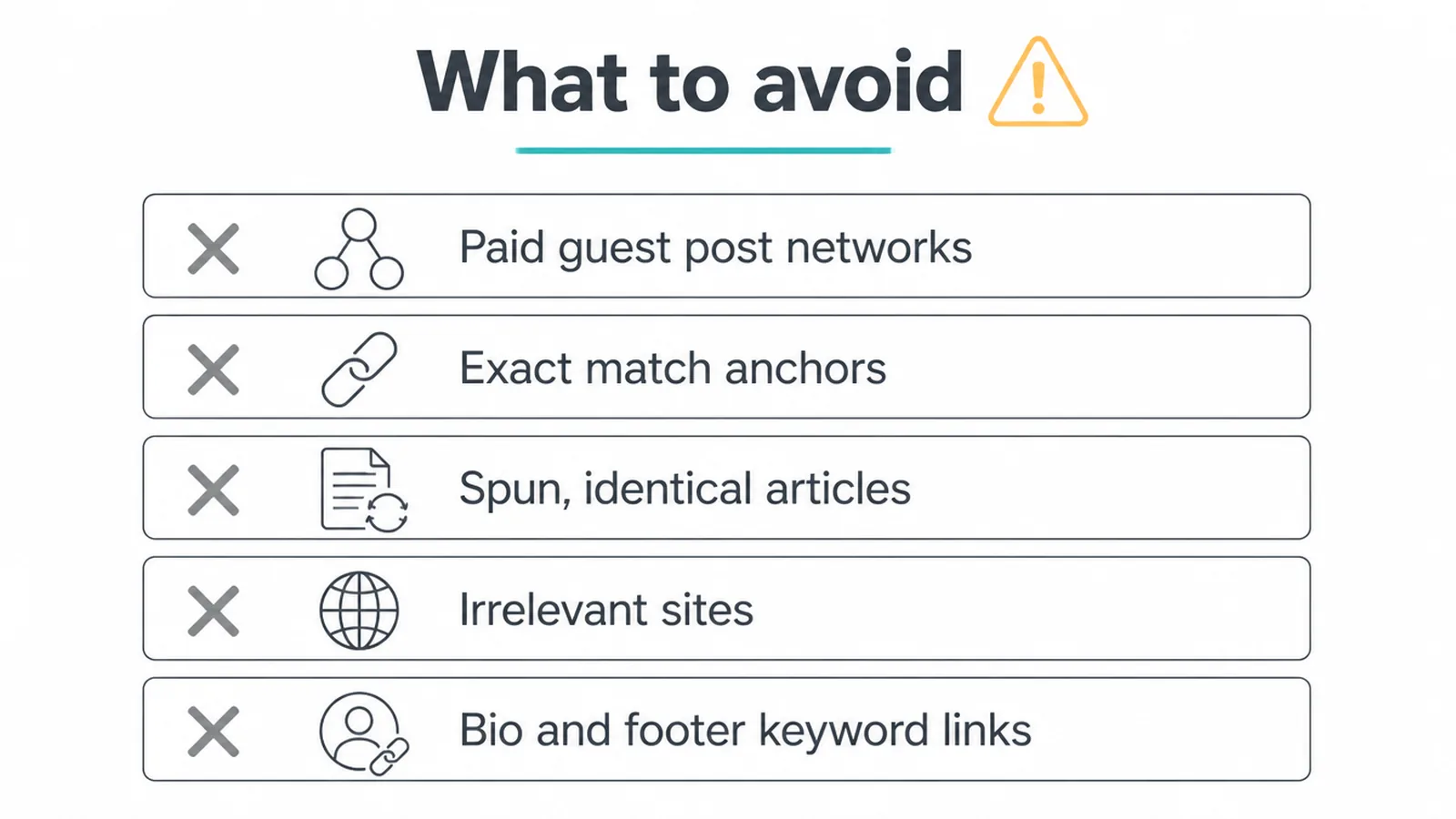
- Paid guest-post networks. Services that place posts and links for a fee are the textbook link-spam pattern.
- Exact-match anchors. Your money keyword as the link text inside the article.
- Spun, identical articles. The same post lightly reworded and spread across sites.
- Irrelevant sites. A link from a site with nothing to do with your field looks bought and adds no real readers.
- Bio and footer keyword links. Stuffing keyword links into author bios or footers across many sites.
Some of these patterns can do more than waste your time. If bad links pile up against your site, you may need to clean them up. We cover how to spot and deal with them in our guide to finding and removing toxic backlinks.
8. Guest posting do's and don'ts at a glance
Here is the short version you can keep on hand. When you are about to pitch or publish, run down this list first.
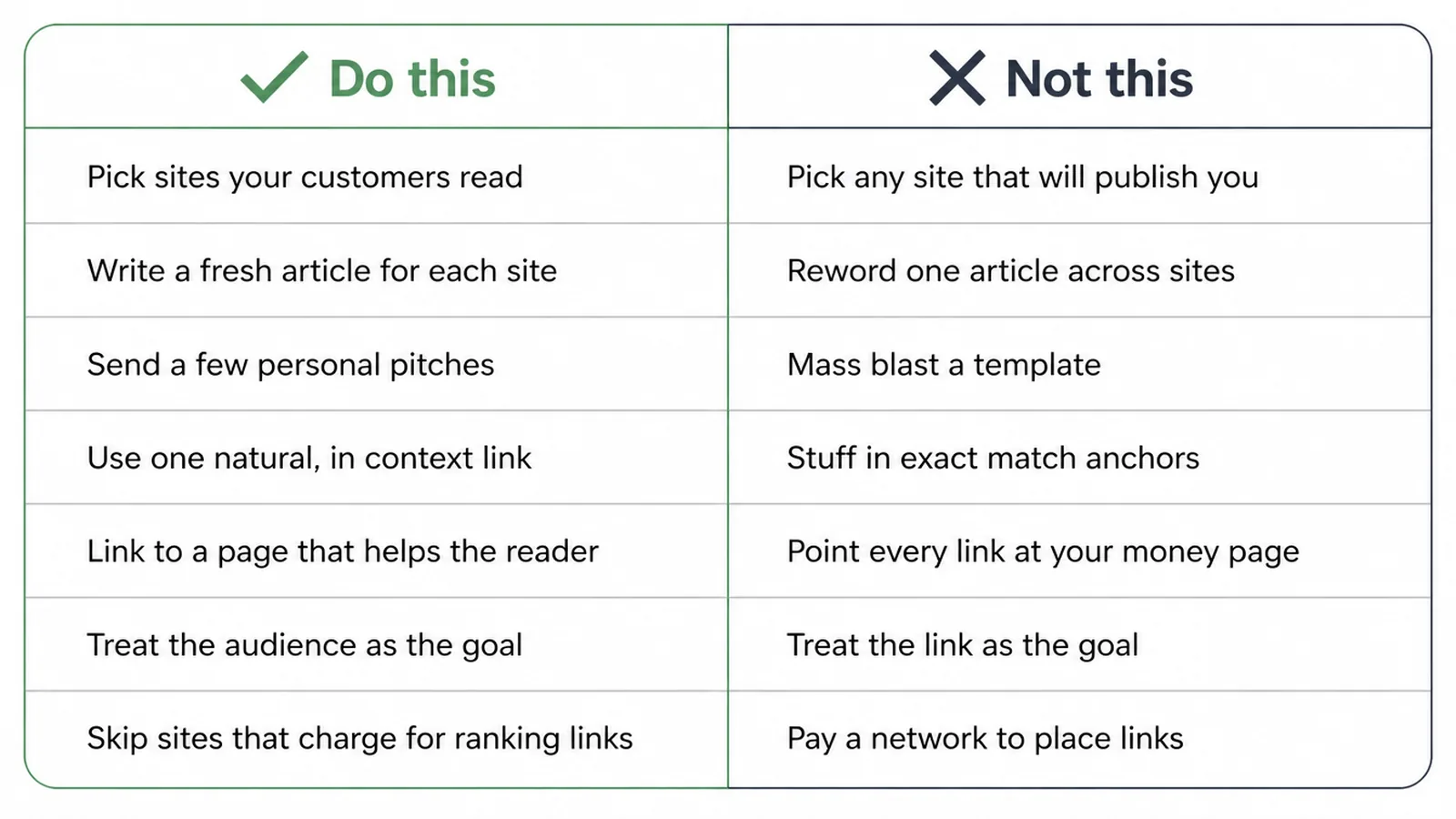
| Do this | Not this |
|---|---|
| Pick sites your customers actually read | Pick any site that will publish you |
| Write a fresh, original article for each site | Reword one article across many sites |
| Send a few personal, specific pitches | Mass-blast a template to a big list |
| Use one natural, in-context link | Stuff in exact-match keyword anchors |
| Point the link at a page that helps the reader | Point every link at your money page |
| Treat the audience as the goal | Treat the link as the goal |
| Skip sites that charge for ranking links | Pay a network to place links for you |
Guest posting is one tactic in a bigger plan. If you want a hand building the whole picture, our SEO services cover content, links, and the technical side together, so the effort actually compounds.
Frequently asked questions
1. What is guest posting?
Guest posting is when you write an article for someone else's website in your field. The site gets free, useful content. You get to reach their readers, show your expertise, and usually include one link back to your own site. The link is a bonus, not the whole point. The point is the audience and the trust you build with them.
2. Is guest posting still good for SEO?
Yes, when you do it for real readers on sites that matter in your field. Google still finds and trusts pages through links from other pages. A good guest post on a relevant site sends you a real link and real visitors. The thing that stopped working is bulk placements made only to grab links. Those barely help and can get you in trouble.
3. Is guest posting against Google's rules?
Writing a genuine article for another site is fine. What breaks the rules is paying for links that pass ranking credit, stuffing keyword-rich anchor text into the article, or blasting the same post across many sites just for links. Google calls that link spam. So the act of guest posting is fine. Doing it to manipulate rankings at scale is the problem.
4. Will Google penalise guest posts?
Google does not penalise a real, helpful guest article. It targets the spammy pattern: paid ranking links, optimised anchors, and the same content spread everywhere. Most of the time Google simply ignores the value of links it sees as spam, so they do nothing for you. If the pattern is bad enough, it can hurt your site. Write for readers and you stay on the safe side.
5. How do I find sites to guest post on?
Start with relevance. List the blogs your own customers actually read. Search for things like your topic plus write for us, or look at where people you respect in your field have written. Skip any site that publishes anything from anyone for a fee. If the site has real readers and covers your topic well, it is worth a pitch.
6. How do I write a guest post pitch?
Keep it short and personal. Use a clear subject line, name one real thing you liked about their site, and offer two or three specific topic ideas that fit their readers. Make the ask easy. Do not mass-blast a template to fifty sites. Most cold emails get ignored, so a small batch of personal, well-aimed pitches beats a big spray every time.
7. Should I pay for guest posts?
Paying a network to place posts and links for ranking credit is exactly the pattern Google calls link spam. Skip it. It is fine to pay a real writer to help you create a genuine article, and some sites charge an editorial fee. But buying links that are meant to move rankings is risky and usually a waste of money.
8. What anchor text should I use in a guest post?
Use natural, in-context words, often your brand name or a plain description of the page. Avoid exact-match keyword anchors stuffed into the article, like your main money keyword repeated as the link text. Google flags optimised anchor text in guest posts as a spam signal. One natural link that fits the sentence is all you need.