How to Use AI to Make Money in 2026: Practical Business Ideas

AI can support revenue or reduce time spent on repeated jobs such as quoting, follow-up, content drafts and customer replies, with a person checking the output. Business.com reports that a small business worker saves an average of 5.6 hours a week using AI. Seed Light sets up the first job worth automating.
Key takeaways
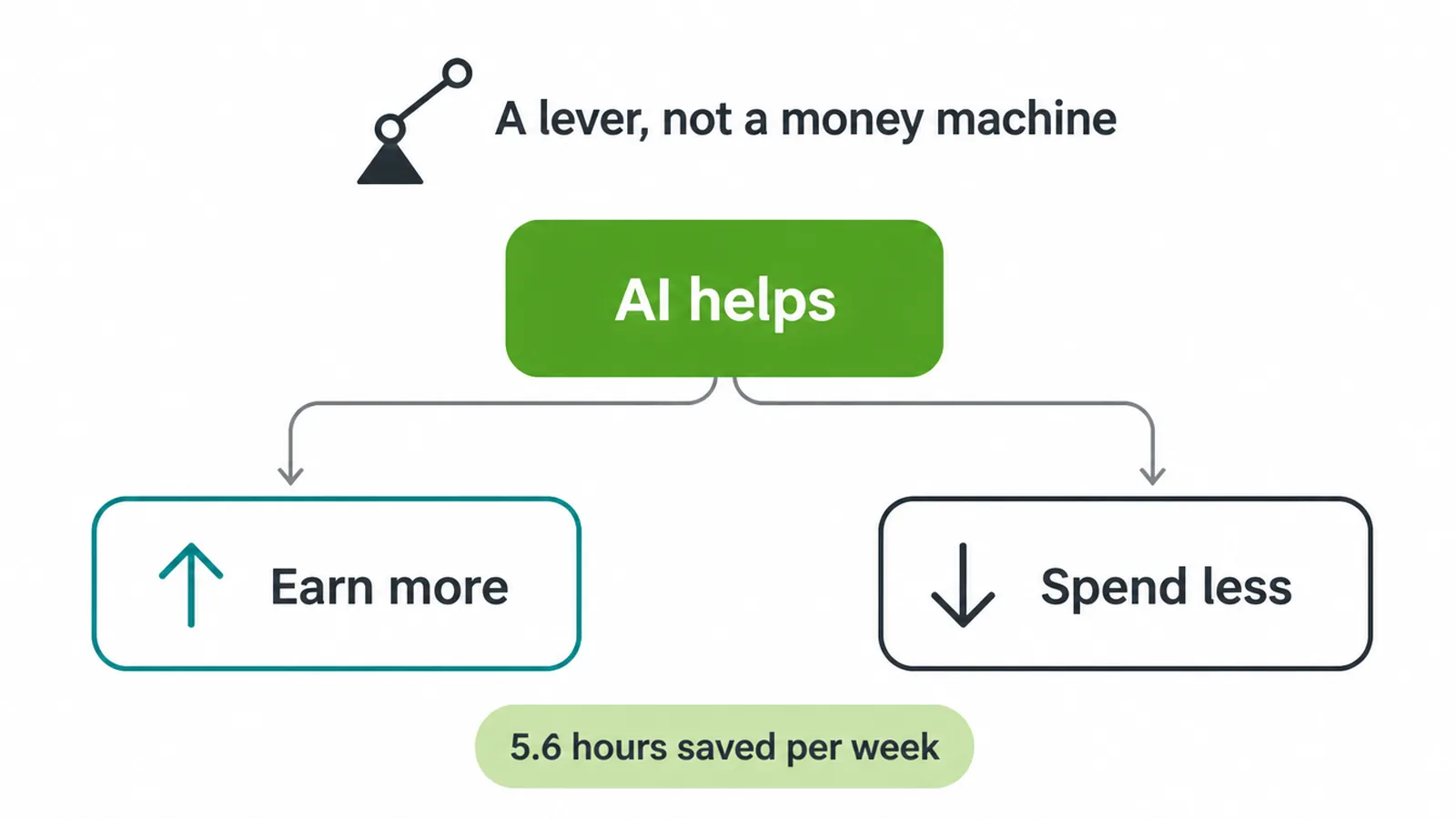
- AI is a lever, not a money machine. It helps an existing business earn more or spend less. It does not create demand on its own.
- Most small businesses already use it. 58% of small businesses now use generative AI, up from 40% in 2024 (U.S. Chamber of Commerce, 2025).
- The real win is time. The average small business worker saves 5.6 hours per week using AI (Business.com, 2026). That time is what you reinvest into selling and serving.
- Watch for scams. The tools are real. The "guaranteed AI income" promises are usually not.
- Start with one task. Pick the job that eats your week, try AI on just that, and measure the hours saved.
1. The honest framing: AI is a lever, not a money machine
If you want to use AI to make money, start here. Money comes from a customer paying you for a result they want. AI does not change that.
What it changes is how fast and how cheaply you can deliver that result. So the two real paths are simple. Earn more, or spend less. AI helps with both, but only if you point it at the right task.
This matters because the internet is full of get-rich listicles that skip the boring part. The boring part is the business. You still need a thing people want, a way to reach them, and the skill to deliver. AI is the helper that sits on top of all that.
Used well, it is a strong helper. The average small business worker saves 5.6 hours every week with AI (Business.com, 2026). Five hours back is real. What you do with those hours is what makes the money.
If you are new to all this, two posts pair well with this one. Read what AI automation actually is for the basics, and AI for small business for the wider picture. This post stays in one lane: the money and revenue angle.
2. 5 real ways to use AI to make money
These are the honest ways AI helps you make money. None of them are magic. Each one either earns you more or saves you cost, and you still do the real work. Pick one to start.
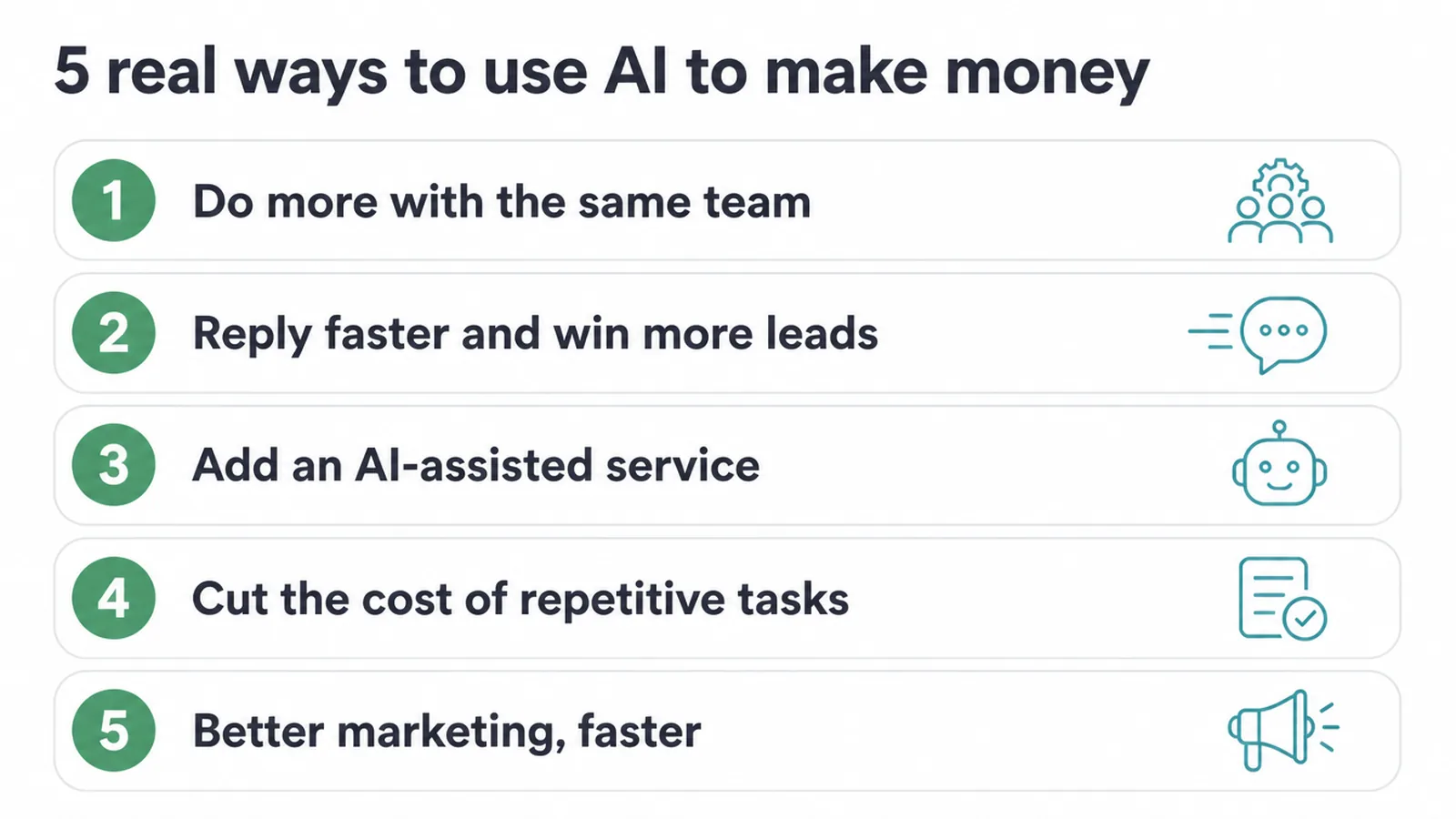
1. Do more with the same team
This is the biggest one. AI takes the slow, repeat parts off your plate so the same people get more done. That means more jobs delivered, more customers served, and more revenue without hiring. There is evidence behind this. 82% of small businesses using AI increased their workforce over the past year (U.S.
Chamber of Commerce, 2025). So for most, AI is helping them grow, not shrink. A good place to feel this is content, which is the work our content marketing service takes off your plate. See using AI for content creation to make posts and pages faster while keeping your own voice.
2. Reply faster and win more leads
Most businesses lose customers in the gap between a question and a reply. People message three places and go with whoever answers first. AI helps you close that gap.
It can draft fast replies, sort new leads, and answer common questions any time of day. Faster replies mean fewer customers slip away, and that is money you were already losing. For how this works in practice, read AI lead generation.
3. Add an AI-assisted service
If you already sell a service, AI can help you add a new one or do an existing one faster. A designer can offer quicker drafts. A marketer can offer more content. A coach can offer more support between sessions.
The key word is assisted. You still plan it, you still check it, and you still put your name on it. The AI speeds up the grunt work so you can take on more clients at a fair quality. The judgement stays yours.
4. Cut the cost of repetitive tasks
Every business has tasks that repeat. Quotes, invoices, follow-up emails, data entry, simple reports. AI handles a lot of this with you checking the output. Less time on repeat jobs means lower cost per job, which is the same as making money.
Managers feel this most. They save more than twice as much time as front-line staff, 7.2 hours a week versus 3.4 (Business.com, 2026). If you want help setting this up properly, that is what our AI and automation service does.
5. Better marketing, faster
AI is a strong helper for marketing. It can draft posts, outline emails, and give you ten ideas when you are stuck on one. The catch is that AI on its own sounds generic.
Your job is to keep your voice and add what only you know about your customers. Done right, you publish more often without burning out, and steady digital marketing is what brings in steady leads. Use AI as a starting draft, never the final word.
3. Where AI adds value, and where it doesn't
Here is a plain look at common jobs. AI helps with the doing. You still own the deciding. Read the right column carefully, because that is where money is actually made or lost.
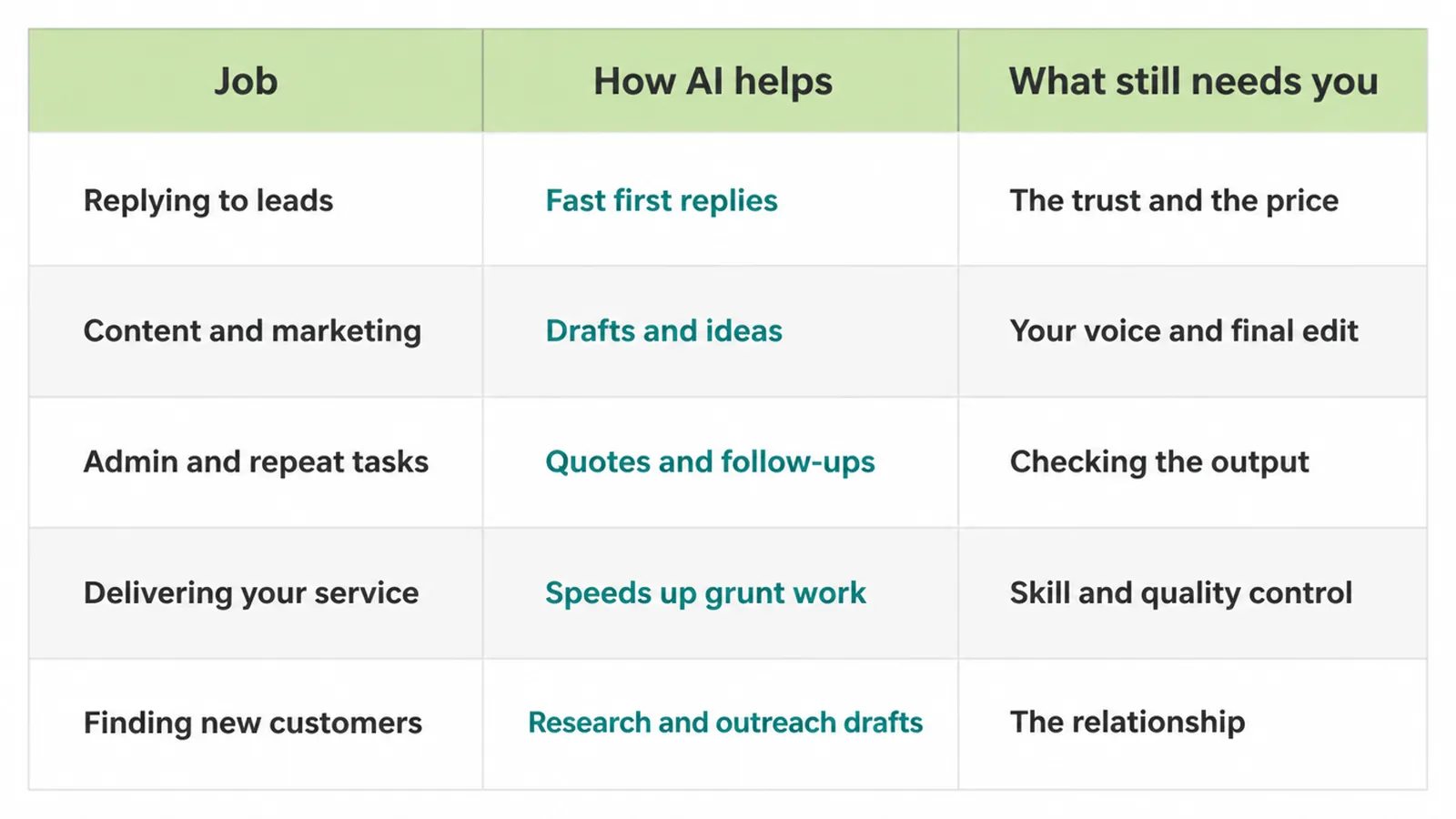
| Job | How AI helps you earn or save | What still needs you |
|---|---|---|
| Replying to leads | Fast first replies, sorting, common answers any time | The real conversation, the price, the trust |
| Content and marketing | Drafts, ideas, outlines in minutes | Your voice, your offer, the final edit |
| Admin and repeat tasks | Quotes, follow-ups, reports done faster | Checking the output before it goes out |
| Delivering your service | Speeds up the grunt work so you take on more | The skill, the quality control, your name on it |
| Finding new customers | Research and first-draft outreach | The relationship, the offer they actually want |
4. The honest limits, and a scam warning
Time to answer the question on a lot of minds. Is making money with AI a scam? The tools are not. AI is real and genuinely useful, which is why 57% of US small businesses are investing in it, up from 36% in 2023 (Business.com, 2026).
But the promises around it often are a scam. There is a whole world of posts and paid courses selling a dream, and you should treat them with care.
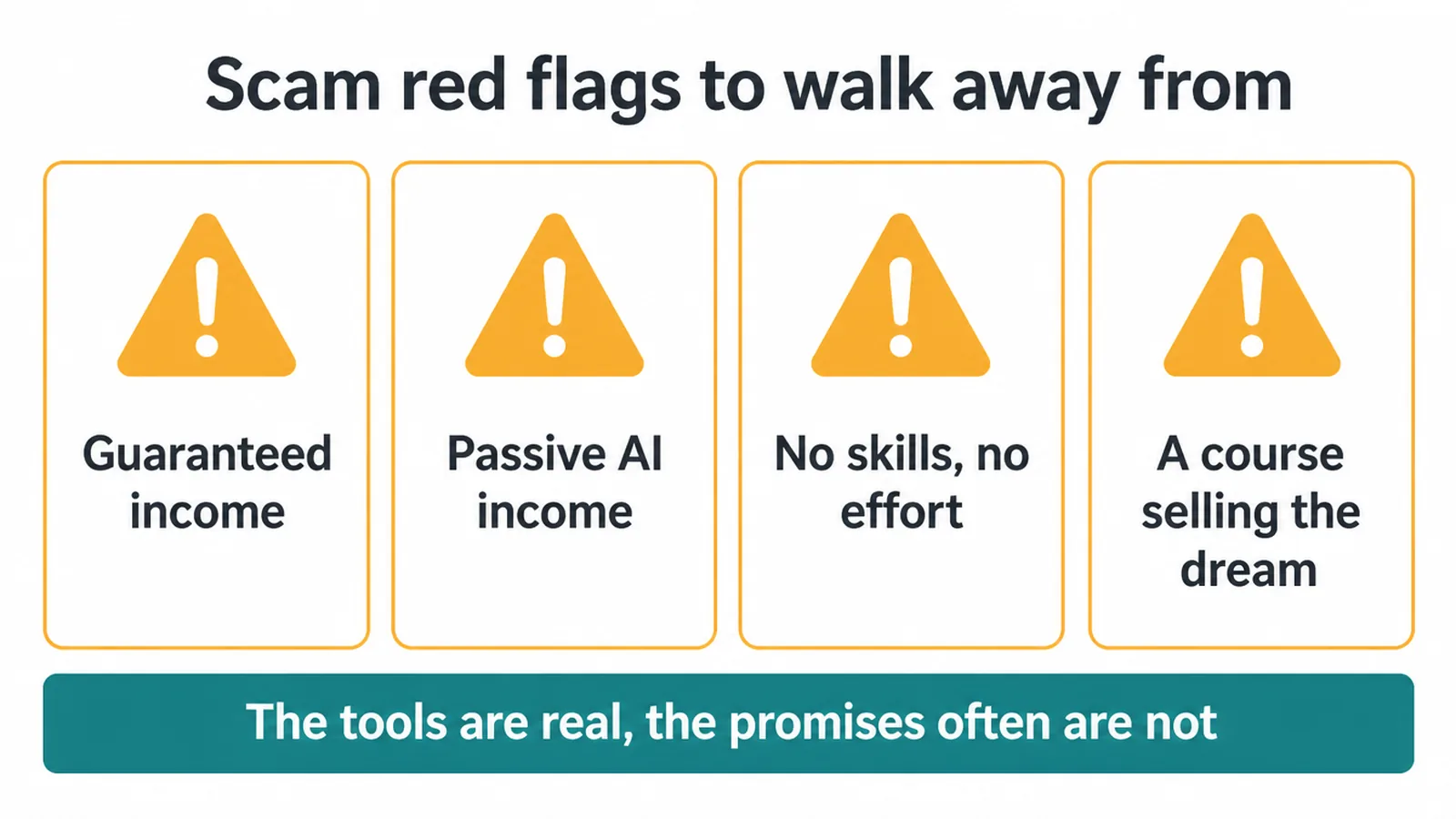
Here are the red flags. Walk away when you see any of these:
- Guaranteed income. Nobody can promise what your business will earn. Anyone who does is guessing or lying.
- "Passive AI income." The idea that AI quietly makes money while you do nothing. Real businesses take real work.
- A set payout with no skills and no effort. If it needed no skill, everyone would already do it.
- A course selling the dream. Often the only person making money is the one selling the course.
And here is the honest limit. AI cannot create demand you do not have. It cannot fake expertise you have not earned. It cannot build trust on your behalf. It speeds up work that already makes sense. It does not invent a business out of nothing.
Worried it will take your job or your team? For most small businesses that fear is overblown. Only 12% of small and medium businesses say they are very likely to reduce staff because of AI in the next year (Business.com, 2026). You still do the work, and you still check it.
5. A four step plan to start this week
Do not try to use AI to make money everywhere at once. That is how people burn a weekend and quit. Start small and prove it. Here is a simple plan:
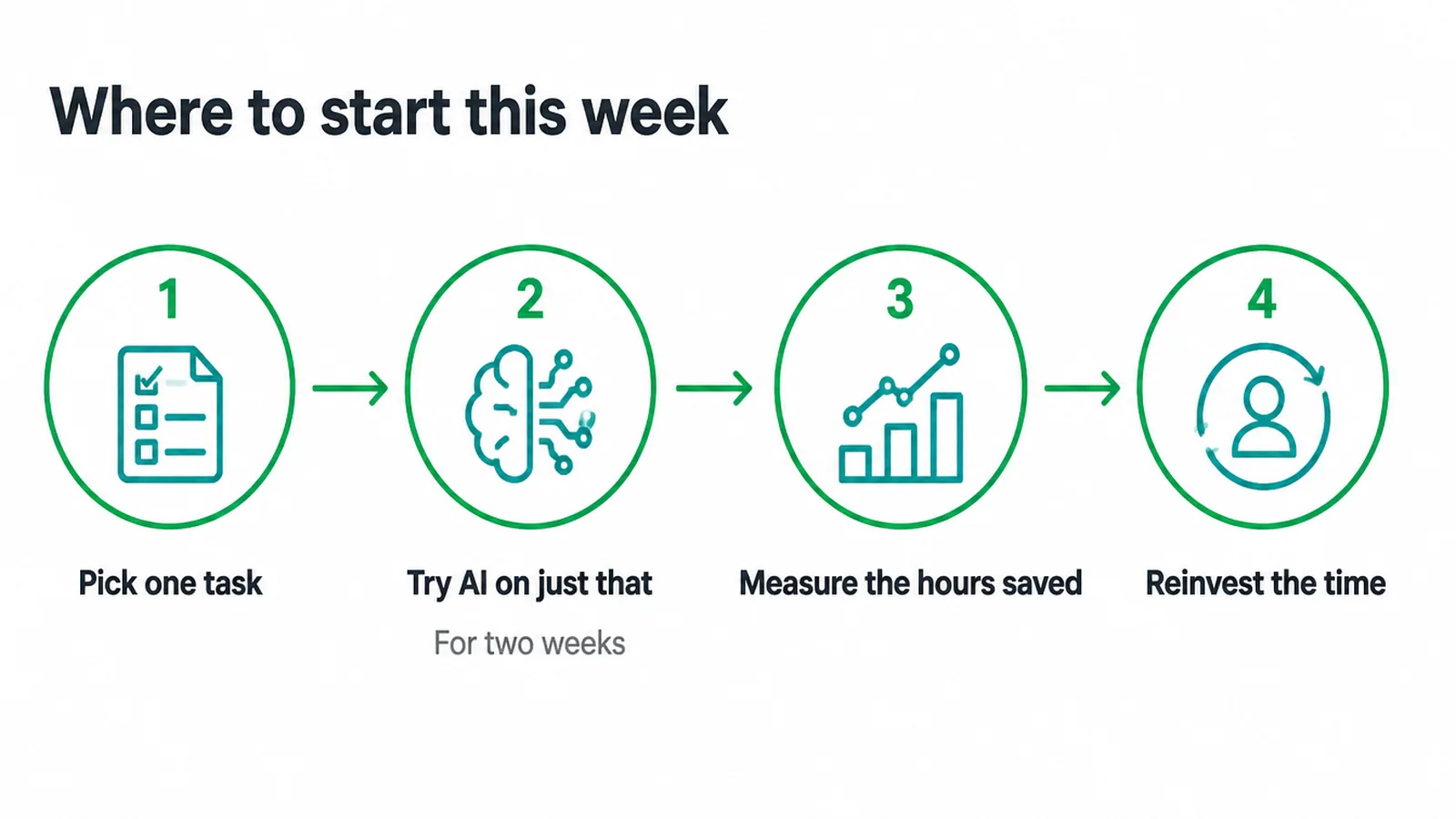
- Pick one task. The single thing that eats the most of your week. Often it is replies, admin, or content.
- Try AI on just that. For two weeks. One task, one tool, nothing else.
- Measure the hours saved. Write down roughly how long the task used to take and how long it takes now.
- Reinvest the time. Put those hours into selling and serving more customers. That is where the money shows up.
One clear win beats ten half-used tools. Resist the urge to buy a stack of subscriptions on day one. Get one thing working, feel the time come back, then add the next.
If you would rather have someone set this up so it actually sticks, that is our day job. Get in touch with Seed Light and we will help you find the one task worth automating first. You can also see how we approach this on our AI and automation page.
Frequently asked questions
1. How can AI actually make me money?
AI does not make money by itself. It helps a business you already run earn more or spend less. It saves you time on slow tasks, helps you reply to customers faster, and lets a small team serve more people. The money still comes from customers paying you for a result. AI just makes you quicker and cheaper at producing it.
2. Can a small business use AI to earn more?
Yes, and lots already do. More than half of small businesses now use generative AI. Most use it to do more with the same people, reply to leads faster, and cut time on repeat jobs. That freed-up time goes back into selling and serving more customers, which is where the extra money comes from.
3. What are realistic ways to use AI for revenue?
Do more with the same team, reply to new leads faster so fewer slip away, add an AI-assisted service you still check by hand, cut the cost of repetitive tasks, and produce marketing faster while keeping your own voice. None of these are magic. They are small wins that add up when you stay consistent.
4. Is making money with AI a scam?
The tools are real and useful. The promises are often the scam. Anyone guaranteeing income, passive AI cash, or a big payout with no skills and no work is selling a dream, usually a course. AI cannot create demand, expertise, or trust that you do not have. Treat any guaranteed-money claim as a red flag.
5. Do I need to be technical to use AI?
No. Most useful AI tools work like a chat box or a normal app. You type plain English and read what comes back. The skill is knowing your own business well enough to ask good questions and check the answers. You can start without writing a single line of code.
6. Will AI replace my job or my team?
For most small businesses, no. Only a small share say they are very likely to cut staff because of AI in the next year. Many businesses using AI actually grew their team. AI tends to remove the boring parts of a job, not the whole person. You still need people to decide, build trust, and check the work.
7. How much money can I make with AI?
There is no honest number anyone can give you. It depends on your business, your customers, and the work you put in. Be very careful with any post or course that promises a set amount. A safer way to think about it is hours saved and customers served, not a dollar figure pulled from thin air.
8. What is the first thing I should try?
Pick the one task that eats the most of your week. Try AI on just that for two weeks. Measure the hours it saves. Then reinvest that time into selling or serving more customers. Do not buy ten tools on day one. Get one clear win first, then build from there.