Topical Authority: Build Depth That Strengthens SEO

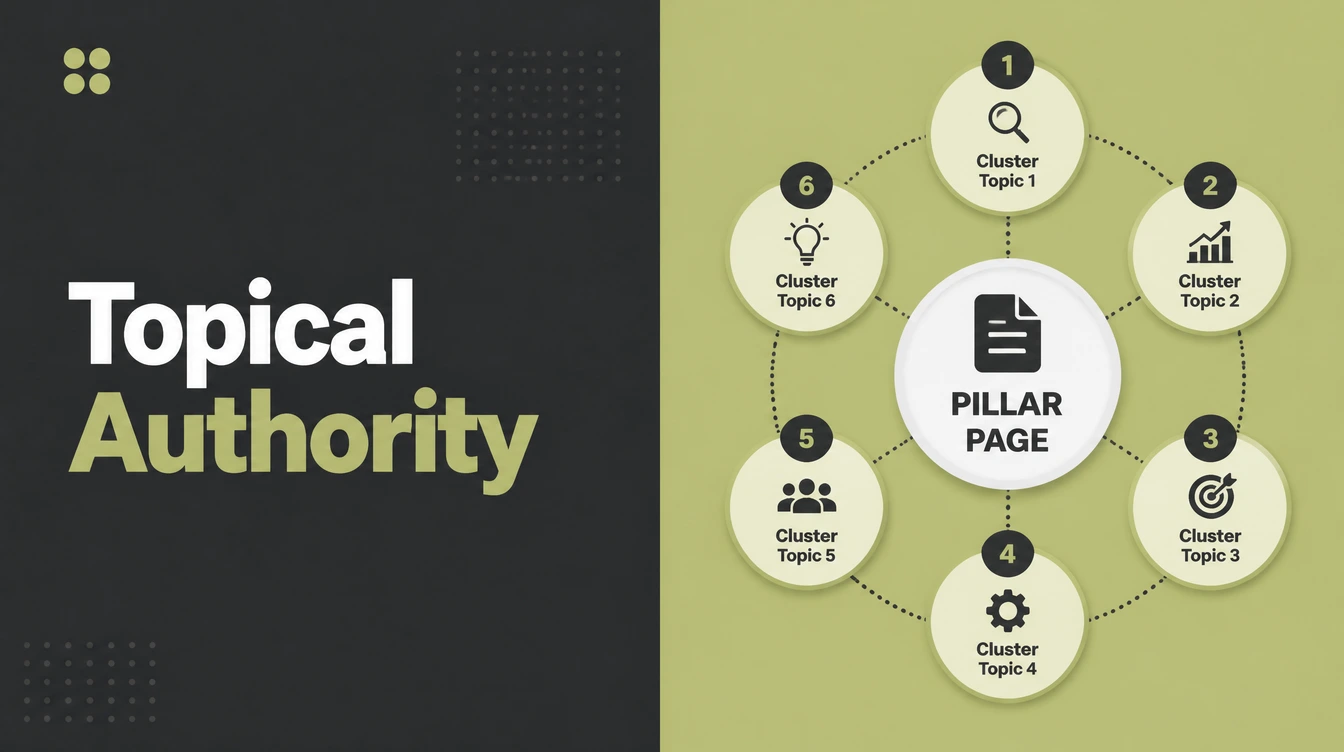
Topical authority is when search engines treat your site as the go-to source on a subject because you cover it completely. You build it with clusters: one broad pillar page plus focused spokes, all linked together. It takes months of steady publishing. Seed Light picks one narrow topic a small site can genuinely own.
Key takeaways
- Internal linking pays off. HubSpot found that the more internal links they added between related pages, the higher those pages climbed in search and the more impressions they earned. Linking your cluster together is not optional.
- Topical authority is subject-specific. A small site that covers one topic deeply can out-rank a much bigger site in that niche.
- Build clusters, not one-off posts. One pillar page plus focused spokes, all linked together, beats scattered articles.
- Trust is the goal. Google says trust is the most important part of E-E-A-T. Deep, honest coverage builds it.
- This takes months, not weeks. Steady publishing over time is what builds it.
1. What is topical authority?
Topical authority is when search engines see your site as the trusted go-to source on a subject because you have covered it deeply and consistently. It is not a badge you apply for.
You earn it by answering the full set of questions people ask about a topic, including the hard ones. Cover the whole subject well, and Google starts to treat you as the obvious place to send searchers.
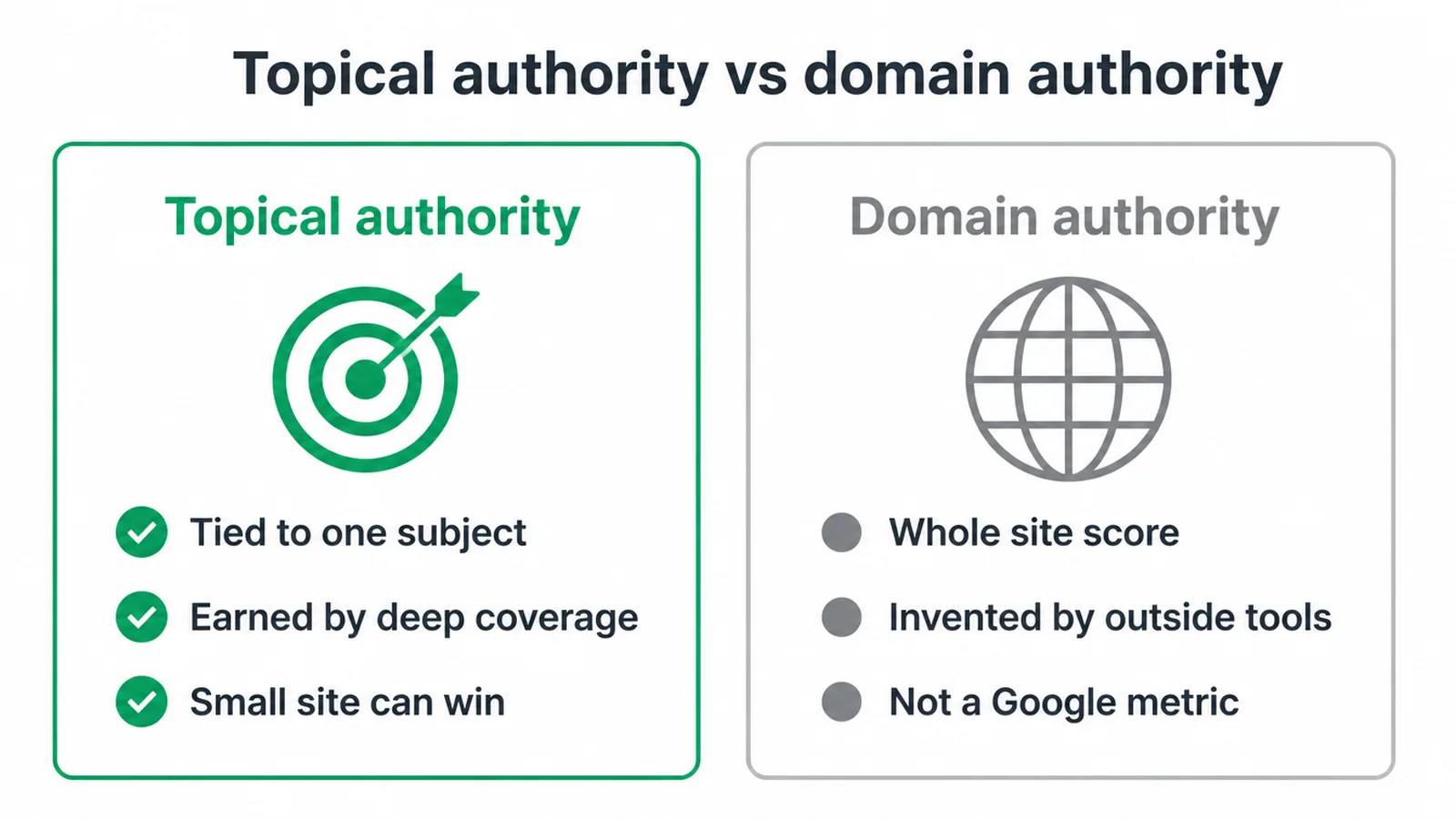
It helps to know how this differs from domain authority. Domain authority is a rough, whole-site popularity score that outside tools made up. It is not a Google metric. Topical authority is different because it is tied to a subject.
You can be a tiny site with massive authority on one narrow topic, and that is enough to out-rank a huge brand inside your niche. That is good news if you are small. You do not have to beat everyone at everything. You have to beat them at one thing.
This is the core idea behind good search engine optimisation: pick a lane and own it. Depth wins. A site that says everything about one topic will beat a site that says a little about a hundred topics.
2. Why topical authority matters now
Topical authority matters more than ever because Google increasingly judges whole sites rather than single pages. It looks at the pattern of what you publish. When that pattern shows deep, consistent coverage of one subject, every page in your cluster benefits, even the new ones.
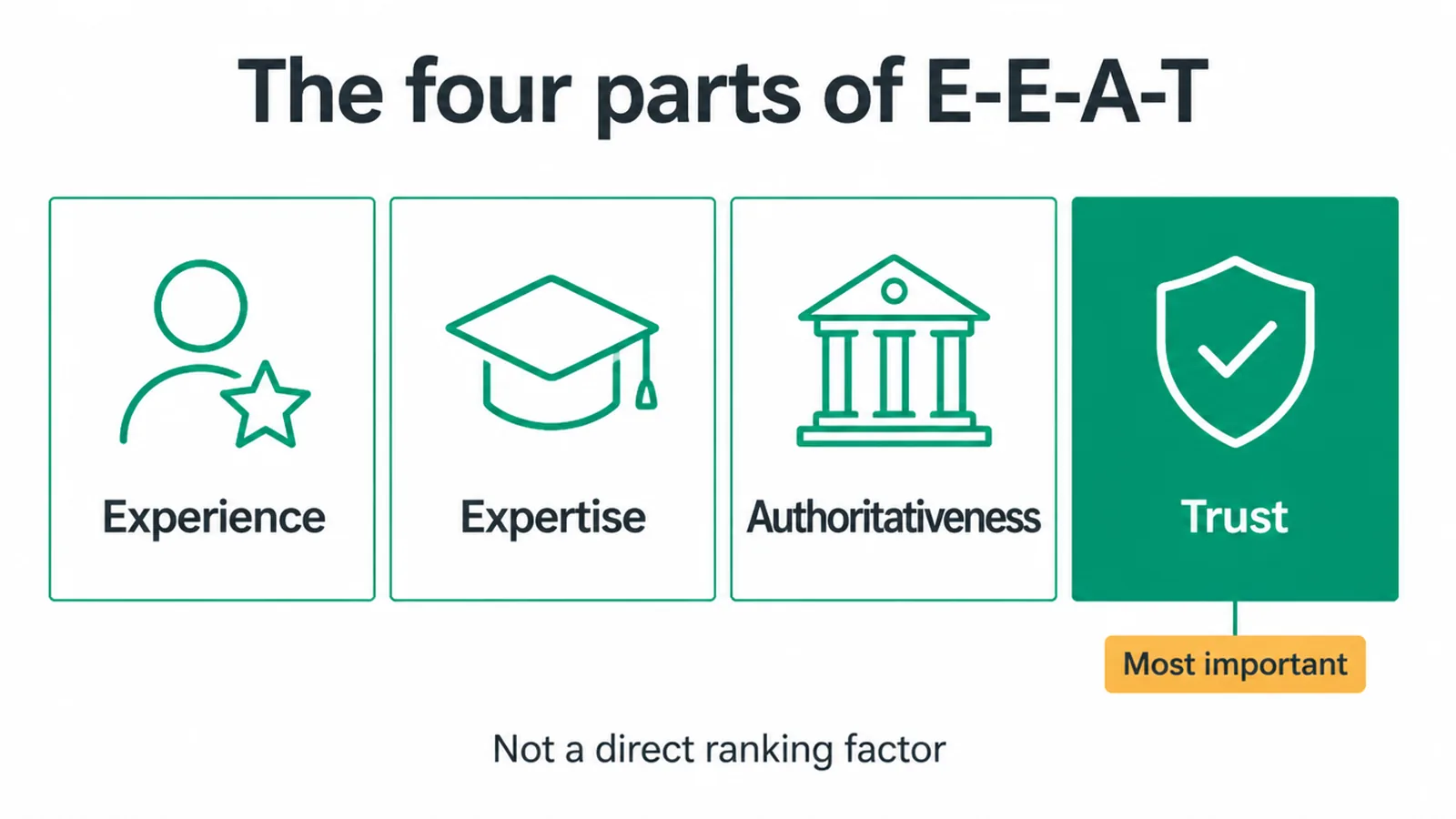
A big part of this is E-E-A-T, which stands for experience, expertise, authoritativeness, and trust. Google added the extra "Experience" to its rater guidelines in December 2022. Of these, Google is clear that trust is the most important.
Now, E-E-A-T is not a direct ranking factor. As Google puts it, "using a mix of factors that can identify content with good E-E-A-T is useful". So you cannot game one dial. You build the signals that add up to trust.
The other half is helpful, people-first content. Google describes this as "content that's created primarily for people, and not to manipulate search engine rankings". It even asks, "Does your content clearly demonstrate first-hand expertise and a depth of knowledge"?
Cover a topic deeply, from real experience, and you tick those boxes naturally. The payoff is real: once you build authority on a topic, you start ranking for terms you never even targeted. Want the bigger picture? See our guide on how to rank higher on Google.
3. Topic clusters: pillars and spokes
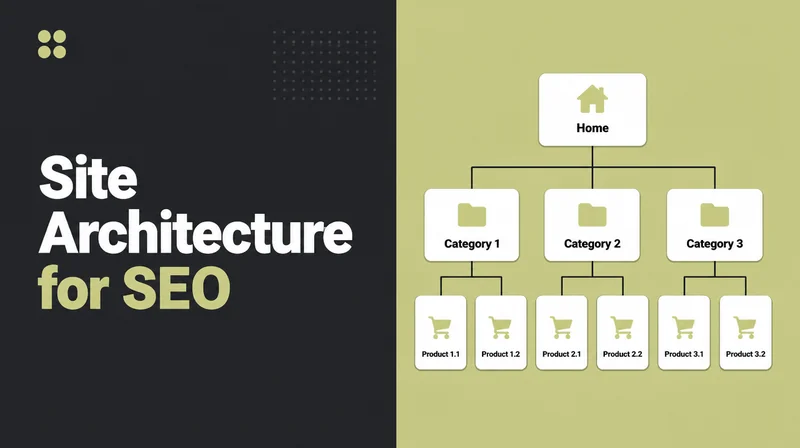
You build topical authority with topic clusters. A cluster is one pillar page plus several spokes. The pillar is a broad overview of the whole topic. Each spoke is a focused page that answers one narrow question in depth.
The pillar links down to every spoke. Every spoke links back up to the pillar and across to its siblings. Together they read as one connected body of work, which is exactly what tells Google you have covered the subject.
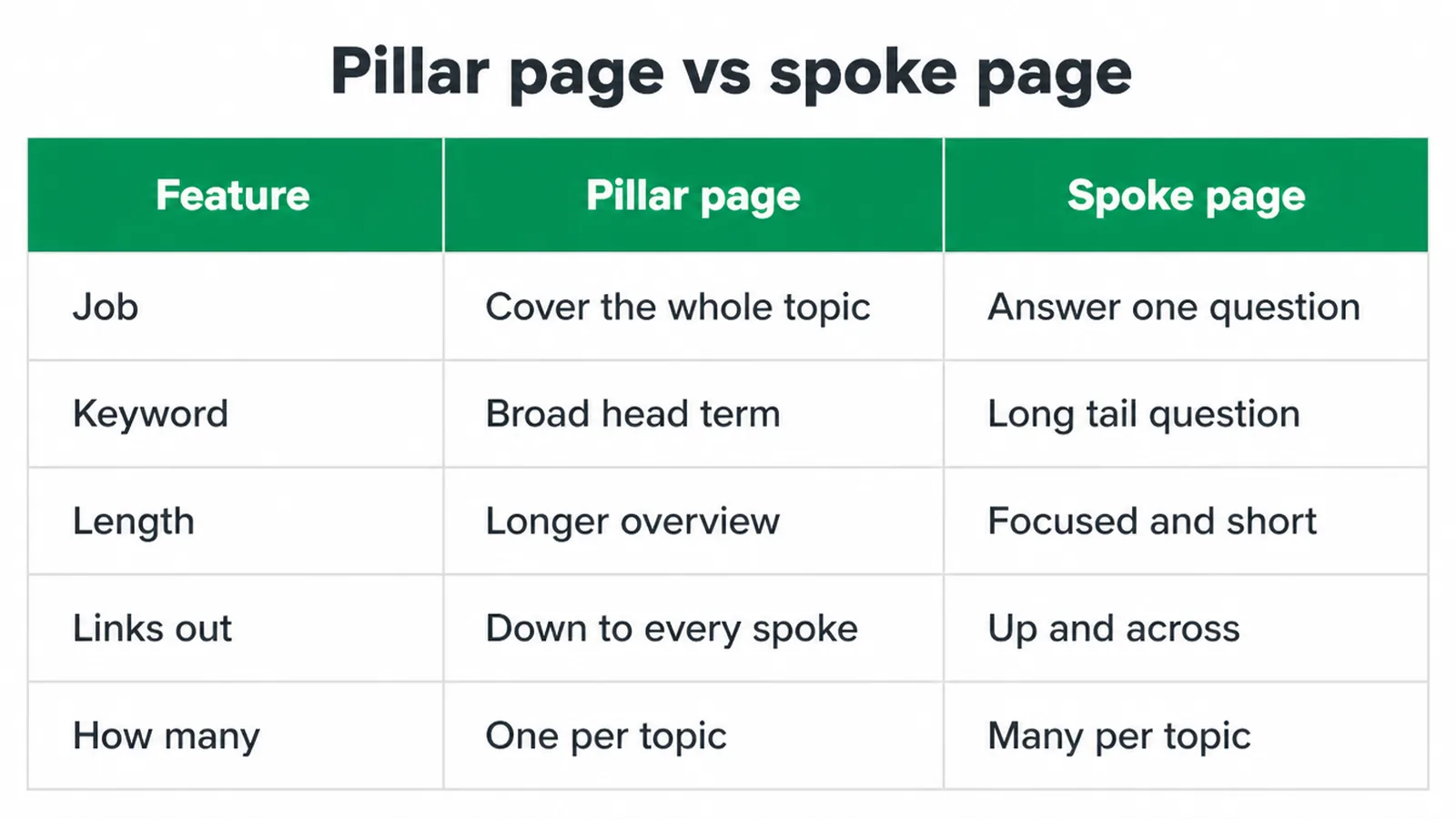
Here is the simplest way to see the difference between the two page types.
| Feature | Pillar page | Cluster (spoke) page |
|---|---|---|
| Job | Cover the whole topic broadly | Answer one narrow question deeply |
| Target keyword | Broad, head term | Specific, long-tail question |
| Length | Longer, overview style | Focused, to the point |
| Links out | Down to every spoke | Up to the pillar, across to siblings |
| How many | One per topic | Many per topic |
Getting the structure right is its own skill. The mechanics, how you name URLs and wire the internal links, sit in our on-page SEO checklist. To find the questions each spoke should answer, start with keyword research. That is where your cluster map comes from.
4. How to build topical authority step by step
To build topical authority, pick one winnable topic, map a full cluster of questions around it, write a strong pillar plus deep spokes, link them all together, and keep publishing on a steady schedule. That is the whole plan. Here is each step.
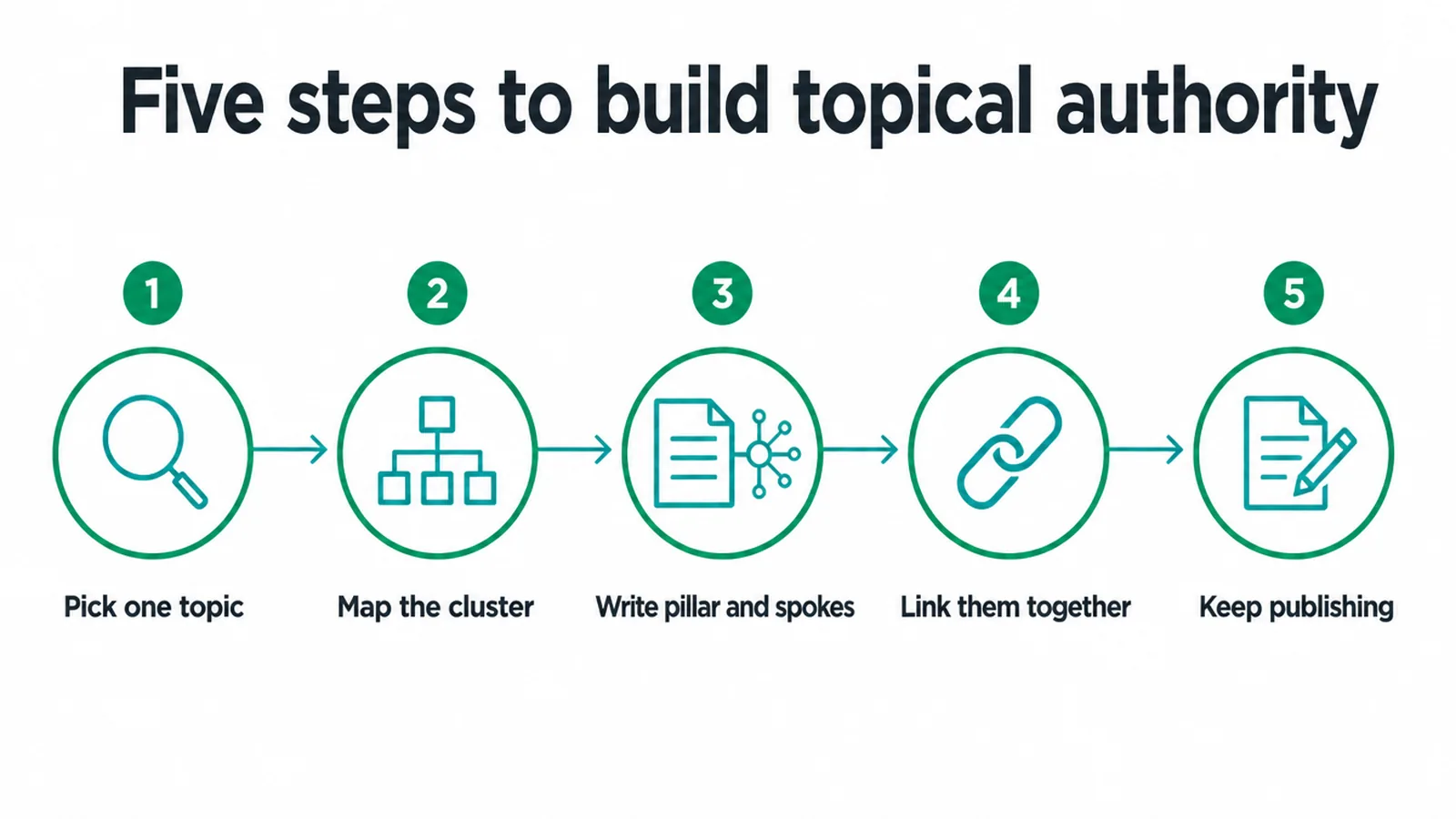
1. Pick one topic you can actually own. Do not try to cover everything. Choose a subject that fits your business and is narrow enough that you can genuinely go deeper than your rivals. A small, focused topic beats a broad, crowded one.
2. Map the cluster. List every question a person might ask about that topic. Use keyword research to find the real searches, then group them. The broad term becomes your pillar. Each specific question becomes a spoke.
3. Write the pillar and the spokes. Make each piece genuinely useful and grounded in first-hand expertise, exactly what Google asks for. Plain words, clear structure, real answers. Our guide on SEO content writing shows how to write pages that rank without stuffing in keywords.
4. Link them all together. This is the step most people skip, and it matters. Remember the HubSpot finding: more internal links between related pages meant higher rankings and more impressions.
Wire the pillar to the spokes and the spokes to each other. The internal links step in the on-page SEO checklist covers how to do this cleanly.
5. Keep going, consistently. Topical authority is built over months, not weeks. A steady drip of strong pages beats one big burst followed by silence. A simple content calendar keeps you publishing without burning out.
5. A worked cluster example you can copy
Let us make this concrete. Say your topic is "email marketing for small businesses". Your pillar page is a broad overview of that whole subject. Around it, you build spokes, each one answering a single question in depth. Steal this shape and swap in your own topic.
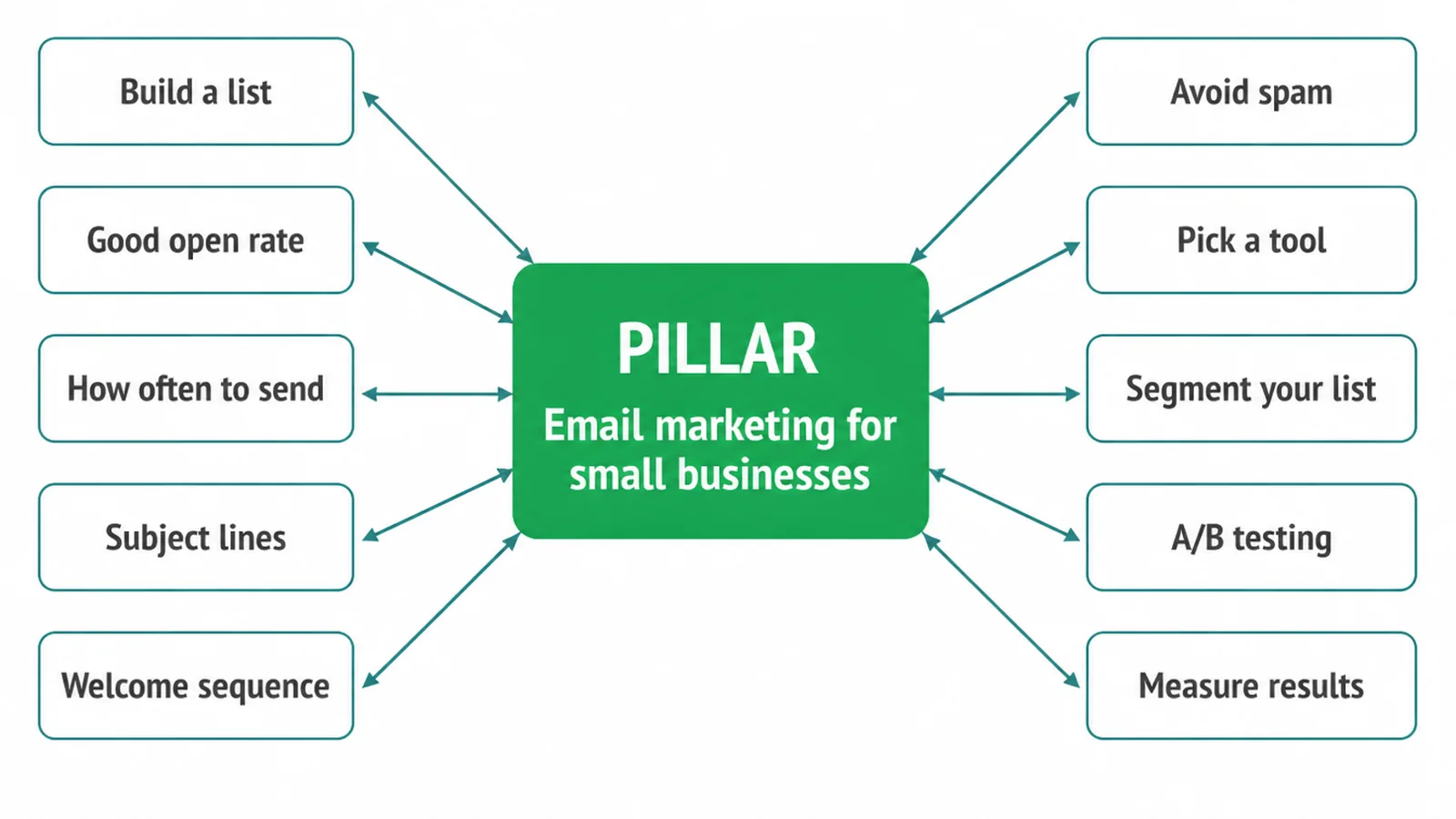
Pillar: Email Marketing for Small Businesses (the complete overview)
Spokes, one question each:
- How do I build an email list from scratch?
- What is a good email open rate?
- How often should I send marketing emails?
- How do I write a subject line people open?
- What is an email welcome sequence?
- How do I stop emails landing in spam?
- Which email marketing tool should I pick?
- How do I segment my email list?
- What is A/B testing in email?
- How do I measure email marketing results?
Notice the pattern. The pillar owns the broad term. Each spoke owns a long-tail question that the pillar only touches on. The pillar links down to all ten.
Each spoke links back to the pillar and to the two or three siblings it naturally relates to. Cover those ten questions well, and you have answered most of what anyone asks about email marketing. That completeness is what topical authority is made of.
6. How to measure topical authority
There is no single number for topical authority, so you measure it with a handful of signals that move together. No one metric tells the whole story. Watch the trend across all of them over time, not week to week.
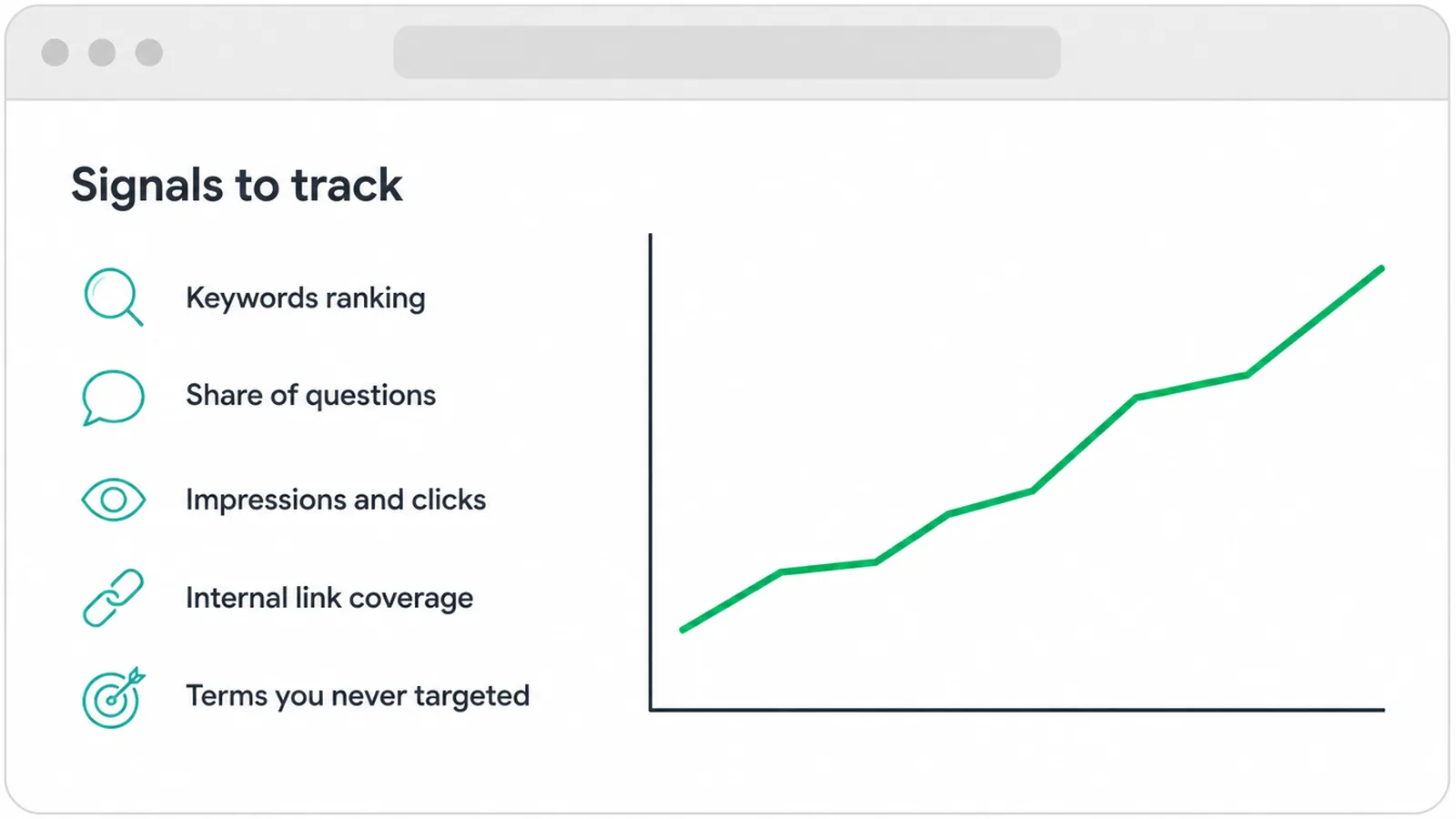
- Keywords ranking in your topic. Count how many terms within your subject you rank for. As your cluster grows, this should climb.
- Share of questions you rank for. Of all the questions people ask in your topic, how many do you show up for? Aim to own more of them.
- Impressions and clicks. Use Search Console to track how often you appear and how often people click. Our walk-through on ranking higher on Google points you to the reports that matter.
- Internal-link coverage. Check that every spoke links to the pillar and to its siblings. Gaps here leak the authority you built.
- Rankings for terms you never targeted. This is the real tell. When you start ranking for related terms you never wrote a page for, Google trusts your coverage of the whole topic.
7. Why most topical authority efforts stall
Most topical-authority efforts stall for the same few reasons. Avoid these and you are ahead of nearly everyone.
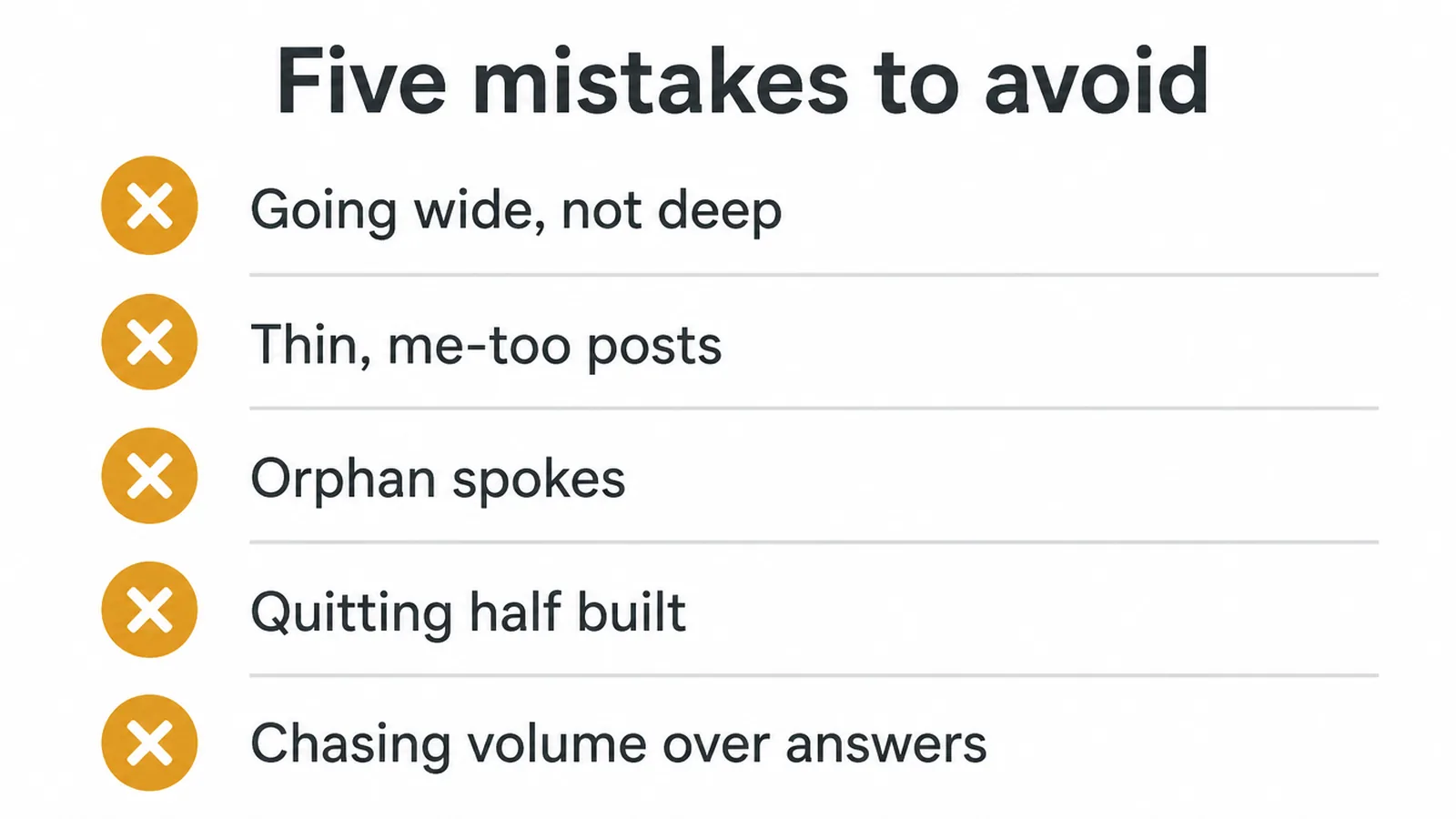
- Going wide, not deep. Touching twenty topics lightly builds authority on none. Pick one and go deep.
- Thin, me-too posts. Pages that just repeat what everyone else said add nothing. Each spoke needs a real, first-hand answer.
- Orphan spokes. A great page with no internal links pointing to it is wasted. Wire every spoke into the cluster.
- Quitting half-built. A cluster that is two-thirds done does not read as complete coverage. Finish the set.
- Chasing volume over answers. Publishing more for the sake of more does not help. Answering the question fully does.
Frequently asked questions
1. What is topical authority?
Topical authority is when search engines treat your site as a trusted go-to source on a subject. You earn it by covering that subject deeply and consistently, answering the full set of questions people ask, instead of writing one shallow post and moving on.
2. What is a topic cluster?
A topic cluster is one broad pillar page plus several focused supporting pages, called spokes. The pillar gives the overview. Each spoke answers one narrow question in depth. They all link to each other, so the topic reads as one connected body of work.
3. What is the difference between topical authority and domain authority?
Domain authority is a rough, whole-site popularity score that third-party tools invent. Topical authority is subject-specific. It reflects how completely you cover one topic. A small site with deep coverage can out-rank a much larger site in its niche.
4. How long does it take to build topical authority?
Think in months, not weeks. You are building a connected library of content and earning trust over time. The pace depends on how often you publish, how good each piece is, and how competitive your topic is. Consistency matters more than speed.
5. Is topical authority a ranking factor?
There is no single dial called topical authority inside Google. It is the result of many signals working together, like helpful people-first content, clear expertise, and trust. Cover a topic well and those signals tend to line up in your favour.
6. How many articles do I need to build topical authority?
There is no magic number. What matters is covering the real questions your audience asks, not hitting a count. A focused cluster that answers a topic completely beats a large pile of thin, me-too posts that all say the same thing.
7. Can a small website build topical authority?
Yes. Topical authority is subject-specific, so you do not need to out-muscle a giant brand across everything. Pick one narrow topic you can genuinely own, cover it better than anyone, and a small site can win in that niche.
8. How do I measure topical authority?
No single metric captures it. Track how many keywords in your topic you rank for, your share of the questions people ask, impressions and clicks in Search Console, your internal-link coverage, and whether you start ranking for terms you never directly targeted.