About Us Page Examples: 5 Patterns Worth Adapting

A good about us page shows the real business behind the website. Lead with who you help, show real faces, add one honest proof point and finish with a next step. Clear writing and real proof help people understand the business quickly. Seed Light writes about pages this way for clients.
Key takeaways
- Your about page is a trust page, not a diary. Its job is to prove a real, reliable business is behind the screen.
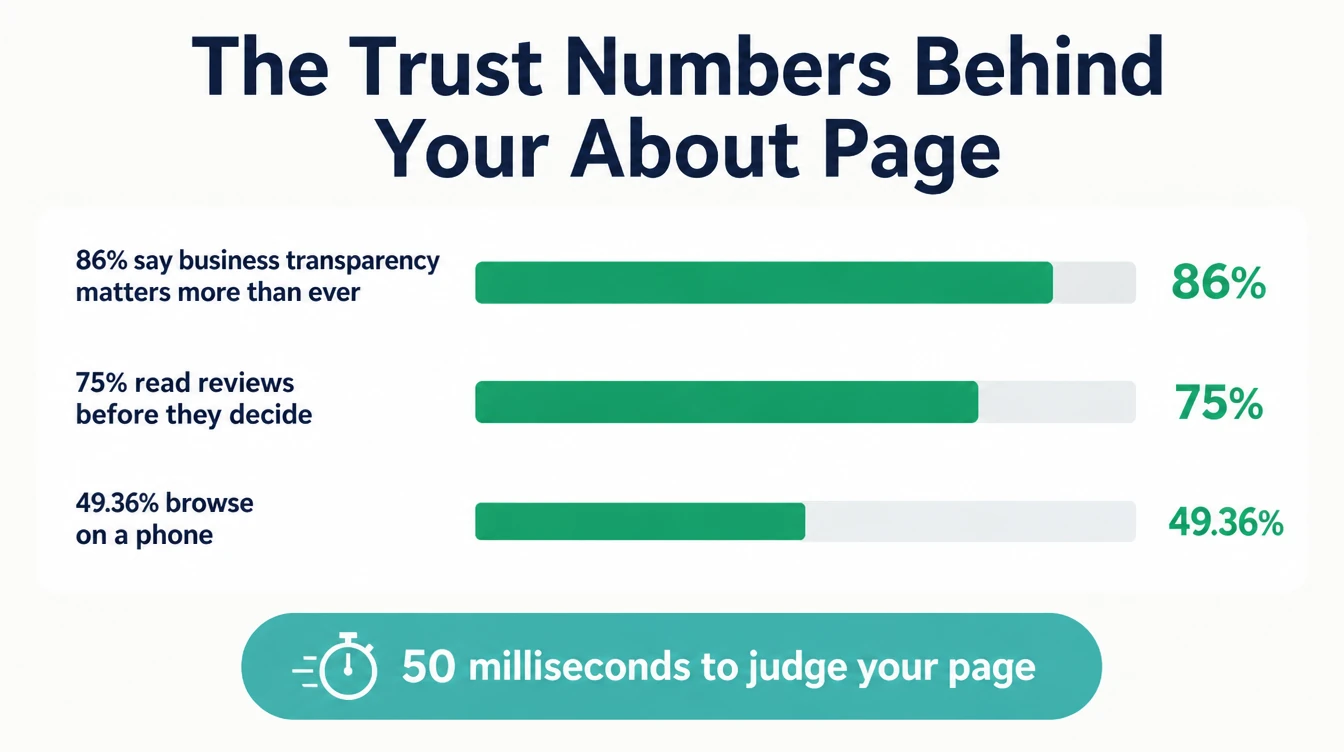
- Trust is the whole game. A survey found 86% of consumers say transparency from businesses is more important than ever (Sprout Social, 2018).
- Real faces win. Stanford research, built on work with 4,500+ people over 3 years, says showing real people behind your site boosts credibility (Stanford, 2002).
- Use one of five patterns. Founder story, mission-first, team faces, timeline, or proof-led. Pick the one that fits your business.
- About half of web traffic is mobile. Mobile was 49.36% of worldwide web traffic (StatCounter, August 2026), so write short and check the page on a small screen.
1. What makes a great about us page?
A great about us page proves there is a real, reliable business behind your website and answers one quiet question your visitor is already asking: can I trust these people? The best about us page examples do this fast.
They lead with who you help, show real faces, drop one honest proof point, and point you to a next step. They do not ramble about your founding date in paragraph one.
In a 2006 study, Lindgaard and colleagues found that people rated a page's visual appeal after 50 milliseconds of viewing.
By the time a visitor reads a word, they already have a gut feeling about you. Your about page either confirms that feeling or fixes it.
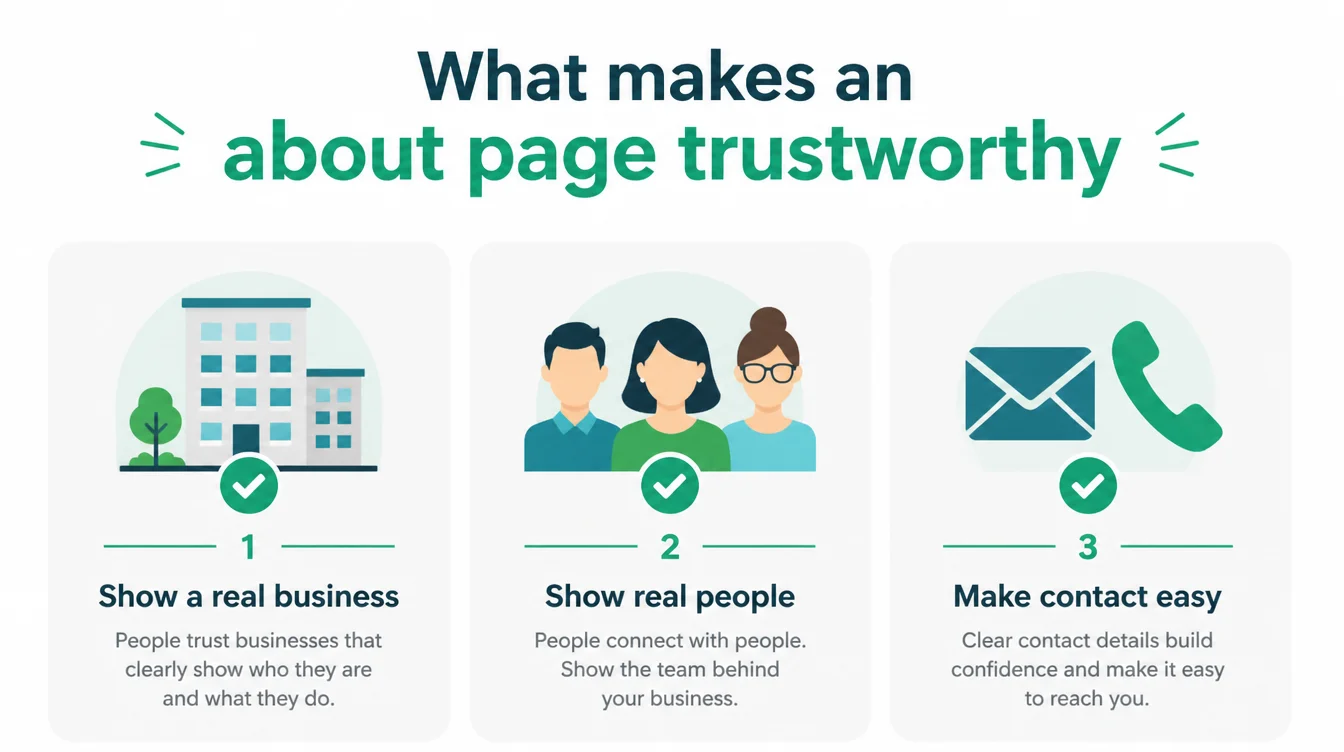
The Stanford Web Credibility Project, based on research with 4,500+ people over 3 years, gives three guidelines that read like an about-page checklist: show that there is a real organisation behind your site, show that honest, trustworthy people stand behind it, and make it easy to contact you.
Hit those three and you are most of the way there. If you are still planning your whole site, our guide to a small business website shows where the about page fits.
2. What should you include?
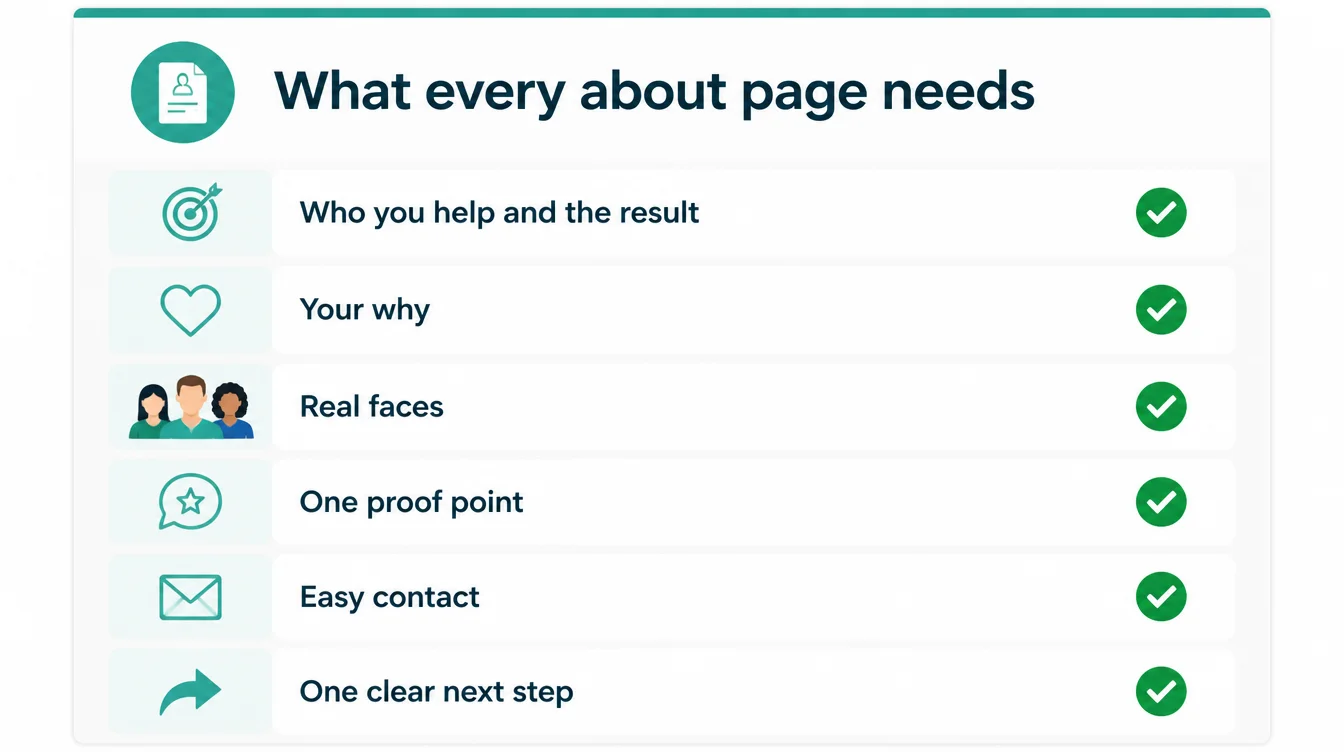
Keep it simple. A small business about page needs six things, and not much else.
- Who you help and the result. One line. "We help busy cafe owners get more regulars." A visitor should know in five seconds if they are in the right place.
- Your why. A short reason you started. Real and human beats polished and fake.
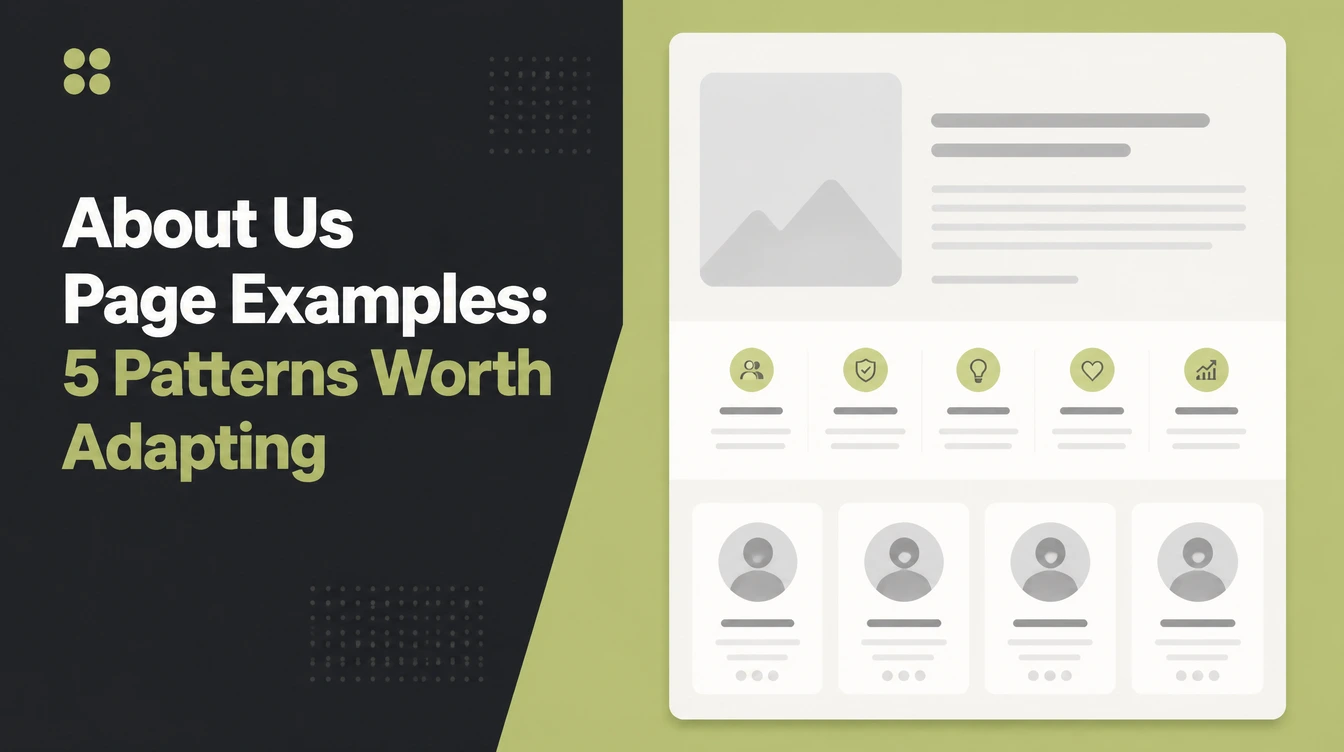
- Real faces. A photo of you or your team. This is the single biggest trust lever you have.
- One proof point. A review, a number of years, a count of happy customers. Pick one honest thing.
- Easy contact. A phone number, an email, a button. Do not make people hunt.
- One clear next step. Book a call, see your work, get a quote. One, not five.
The proof point matters more than most owners think. 75% of consumers always or regularly read online reviews (BrightLocal, 2024). People look for signs that others have trusted you and lived to tell the tale. A short quote from a real customer on your about page does that quietly.
The biggest trap is making the whole page about you. It feels natural, but your reader does not care about your journey until they know what is in it for them. Lead with their problem. If your visual identity is shaky, our branding work can give the page a face worth trusting.
3. 5 about us page patterns that work
You do not need to invent a style. Strong about us page examples almost always follow one of five patterns. Pick the one that matches your business and your comfort level, then fill it with your own words.

1. Founder story
You tell a short, honest story of why you started. Great for solo owners and trades where the person is the product. Watch out for making it too long or too much about you.
2. Mission-first
You lead with the change you want to make. Good for cause-driven brands and newer businesses with a clear purpose. The risk is sounding vague, so back the mission with one concrete proof.
3. Team with real faces
You show a grid of real people with short, warm bios. Perfect for service firms where clients want to know who they will deal with. Skip the stiff corporate headshots.
4. Timeline
You walk through a few key moments. Useful for businesses with a few years behind them and a real story of growth. Keep it to three or four beats so it stays scannable.
5. Proof-led
You lead with numbers, reviews, and logos. Strong when you have results to show. The danger is feeling cold, so add one human line to warm it up.
| Pattern | Best for | Standout move | Watch out for |
|---|---|---|---|
| Founder story | Solo owners, trades | One honest reason you started | Too long, too me-focused |
| Mission-first | Cause-driven brands | A clear change you make | Sounding vague |
| Team faces | Service firms | Real photos, warm bios | Stiff corporate headshots |
| Timeline | Established businesses | Three or four key moments | Listing every year |
| Proof-led | Results-heavy businesses | Reviews and numbers up front | Feeling cold and faceless |
Not sure which fits? If you are also shopping for help building the page, our guide on how to choose a web design company will save you from the wrong partner.

4. A fill-in-the-blank about us page template
Here is a skeleton you can copy and finish in ten minutes. Keep each line short. Swap the brackets for your own words.

- Hook: "We help [who you help] [get what result] without [the pain they fear]."
- Why: "We started [your business] because [the honest reason]."
- What we do: "Today we [main thing you do] for [type of customer]."
- Proof: "Over [time or number], we have [one real, honest result]." Or paste a short customer quote.
- Faces: Add a real photo of you or the team, with first names.
- Next step: One button. "Get a quote", "See our work", or "Book a call".
That is the whole thing. Read it out loud when you are done. If it sounds like a person talking to a customer, you nailed it. If it sounds like a press release, cut the big words and try again.
When you are ready to build the page properly, our web design service turns this skeleton into a page that loads fast and reads well on any screen.
5. Mistakes small businesses make
Most weak about pages fail in the same five ways. Avoid these and you are ahead of most rivals.
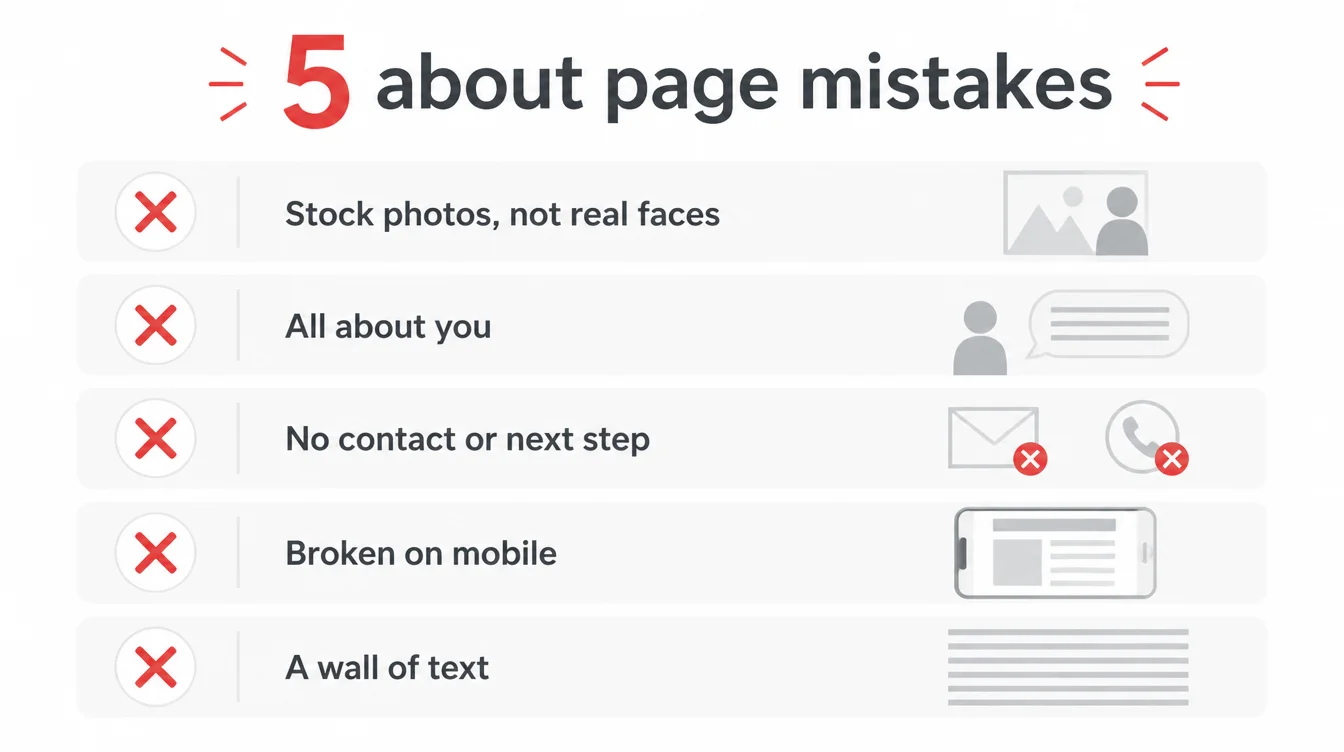
- Stock photos instead of real faces. A smiling model in a headset fools nobody. Use a real photo, even an imperfect one.
- All about you, none about them. Your visitor wants to know what is in it for them. Lead with their problem.
- No contact and no next step. A page that ends in a dead end wastes the trust you just built. Always give one clear action.
- Broken on mobile. Mobile was 49.36% of worldwide web traffic (StatCounter, August 2026), so a page that only looks right on a laptop fails about half of web traffic.
- A wall of text. Big blocks scare people off. Break copy into short lines, headings, and bullets.
The mobile one trips up more owners than any other. If your page squeezes text or hides your photo on a phone, fix that first. Our guide on making a website mobile friendly walks you through it.
For the wider list of traps, see common small business website mistakes. And a page everyone can read, including people using screen readers, builds trust too, which is why website accessibility belongs on your checklist.

6. Make it load fast and rank
A beautiful about page that loads slowly still loses. Heavy photos can delay the words and proof people came to see. Speed is part of trust.

Two simple habits help. First, keep your images sized for the web so the page loads quickly. Our guide to Core Web Vitals explains the speed signals that matter. Second, build the page on a solid foundation so it stays fast as you add content.
That is where good web design and development earns its keep. A clear, helpful about page also gives search engines real context about who you are, which supports your wider visibility over time.
Your about page is one of the few pages on your site where a stranger decides whether to trust you. Treat it like the trust page it is.
Show real faces, prove you are real, make contact easy, and give one clear next step. If you want a hand turning your story into a page that actually wins leads, get in touch with us and we will help you build it.
7. How Better B2C explains its service first
Here is the same order in our own work. Better B2C is a registered non-profit that runs a free online business directory.
On its site, the service is explained in one short passage before any credentials or history, and the proof sits next to the claims it supports. That is what an about page needs to do as well.
Frequently asked questions
1. What is an about us page?
An about us page is the page on your website that tells visitors who you are, who you help, and why you can be trusted. It is a trust page, not a diary. The best ones answer one quiet question your visitor is already asking: can I rely on these people to do what they say?
2. What should an about us page include?
A strong about us page includes who you help and the result you deliver, a short story of why you started, real faces of the people behind the work, a piece of proof such as a review or number, an easy way to make contact, and one clear next step. Keep it about the customer.
3. How do I write an about us page for a small business?
Start with one line that says who you help and what result they get. Add a short reason you started. Show a real photo of yourself or your team. Add one honest proof point and one clear next step. Read it out loud. If it sounds like a person talking to a customer, you are close.
4. How long should an about us page be?
Long enough to build trust and short enough to read in under a minute. For most small businesses that is a few short paragraphs plus a photo and a button. If your story is rich, break it into scannable chunks with headings so a busy reader can skim and still get the point.
5. Should an about us page use we or they?
Use first person. Write we for a team or I for a solo owner. First person feels like a real person talking to you and reads warmer than stiff third person. Save they and the brand name for press bios. On your own about page, talk to the visitor directly.
6. Do I need team photos on my about us page?
Real photos help a lot. Stanford research found that showing the honest, trustworthy people behind a site is one of the strongest ways to boost credibility. A genuine snapshot of you or your team beats a generic stock photo every time. If you work solo, one clear photo of you is plenty.
7. What are common about us page mistakes?
The big ones are using stock photos instead of real faces, making the whole page about you instead of the customer, hiding your contact details, writing a wall of text, and forgetting that about half of web traffic is mobile. Fix those five to make the page clearer and easier to use.
8. Can an about us page help SEO?
Yes, in two ways. A clear, helpful about page gives search engines real context about who you are and what you do. And because it builds trust and loads fast, it helps visitors stay and take action, which is the kind of behaviour search engines reward over time.